
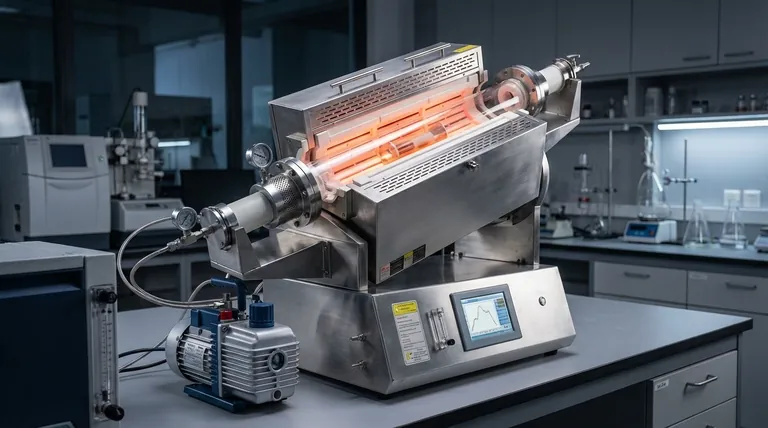
The integration of an axial rotation mechanism fundamentally transforms a tube furnace from a static heating device into a dynamic experimental platform. By allowing the furnace to be positioned at precise angles—including vertically upward, vertically downward, horizontal, or specific inclinations—this mechanism gives researchers direct control over how gravity and physical orientation influence the thermal process.
The core value of an axial rotation mechanism lies in its ability to simulate diverse environmental conditions; it enables the study of gravity-driven processes and enhances gas-solid mixing kinetics in ways that fixed-geometry furnaces cannot.
Expanding the Scope of Research
Breaking Free from Static Limitations
Standard tube furnaces typically lock researchers into a single, horizontal orientation.
An axial rotation mechanism removes this constraint. It provides the mechanical flexibility to align the heating zone with the specific physical requirements of the experiment.
Complete Angular Freedom
The mechanism allows for a full range of positioning.
You can configure the furnace for vertical upward or downward alignment for specific flow studies. Alternatively, you can set precise tilt angles to induce movement within the sample tube.
Optimizing Physical Interactions
Facilitating Gravity-Driven Processes
Many thermal processes are heavily influenced by gravity.
By positioning the furnace vertically, researchers can study phenomena where gravity acts as a primary driver, such as specific sedimentation or vertical flow experiments. This allows for the isolation of gravity as a variable in the thermal analysis.
Enhancing Reaction Kinetics
For experiments involving gas-solid interactions, static positioning often leads to poor contact between reactants.
Using a specific inclination or tilt angle promotes better gas-solid mixing. This movement ensures that reactive gases (controlled by devices like rotameters) interact more uniformly with the solid sample, leading to more reliable kinetics data.
Operational Considerations
Understanding Mechanical Stability
While versatile, rotating a furnace changes the mechanical stresses on the system.
Users must ensure that the mounting and locking mechanisms are robust enough to hold the furnace steady at extreme angles, particularly vertical ones.
Sample Containment Challenges
Changing the angle of the furnace inherently changes the behavior of the sample.
When moving from horizontal to vertical or tilted positions, standard crucibles or boats may slip. Specialized sample holders or packed bed configurations are often required to prevent sample displacement during the experiment.
Making the Right Choice for Your Goal
To maximize the utility of an axial rotation mechanism, align the furnace orientation with your specific research objective:
- If your primary focus is gravity-driven phenomena: distinct vertical positioning (upward or downward) is essential to isolate gravitational effects on the process.
- If your primary focus is reaction kinetics: Use specific tilt angles to induce movement and maximize gas-solid mixing for uniform reaction rates.
- If your primary focus is standard annealing: A horizontal position remains the baseline standard for static heat treatment.
Ultimately, the axial rotation mechanism shifts the focus from simple heating to controlling the complete physical environment of your reaction.
Summary Table:
| Feature | Advantage | Research Impact |
|---|---|---|
| Variable Orientation | Horizontal, Vertical, or Tilted angles | Simulation of diverse environmental conditions |
| Gravity Control | Vertical alignment (Up/Down) | Isolation of gravity-driven phenomena and sedimentation |
| Enhanced Kinetics | Specific inclination angles | Improved gas-solid mixing for uniform reaction rates |
| Dynamic Positioning | Mechanical flexibility | Precise control over physical sample movement |
Unlock Dynamic Thermal Analysis with KINTEK
Take your thermal research beyond static limitations. KINTEK’s advanced furnace solutions—backed by expert R&D and precision manufacturing—offer high-performance Tube, Muffle, Rotary, Vacuum, and CVD systems designed for your most demanding applications. Whether you require standard configurations or customizable systems with integrated axial rotation to optimize reaction kinetics and gravity-driven studies, our team provides the technical expertise to tailor the perfect solution for your lab.
Ready to elevate your material processing? Contact KINTEK today to discuss your unique needs!
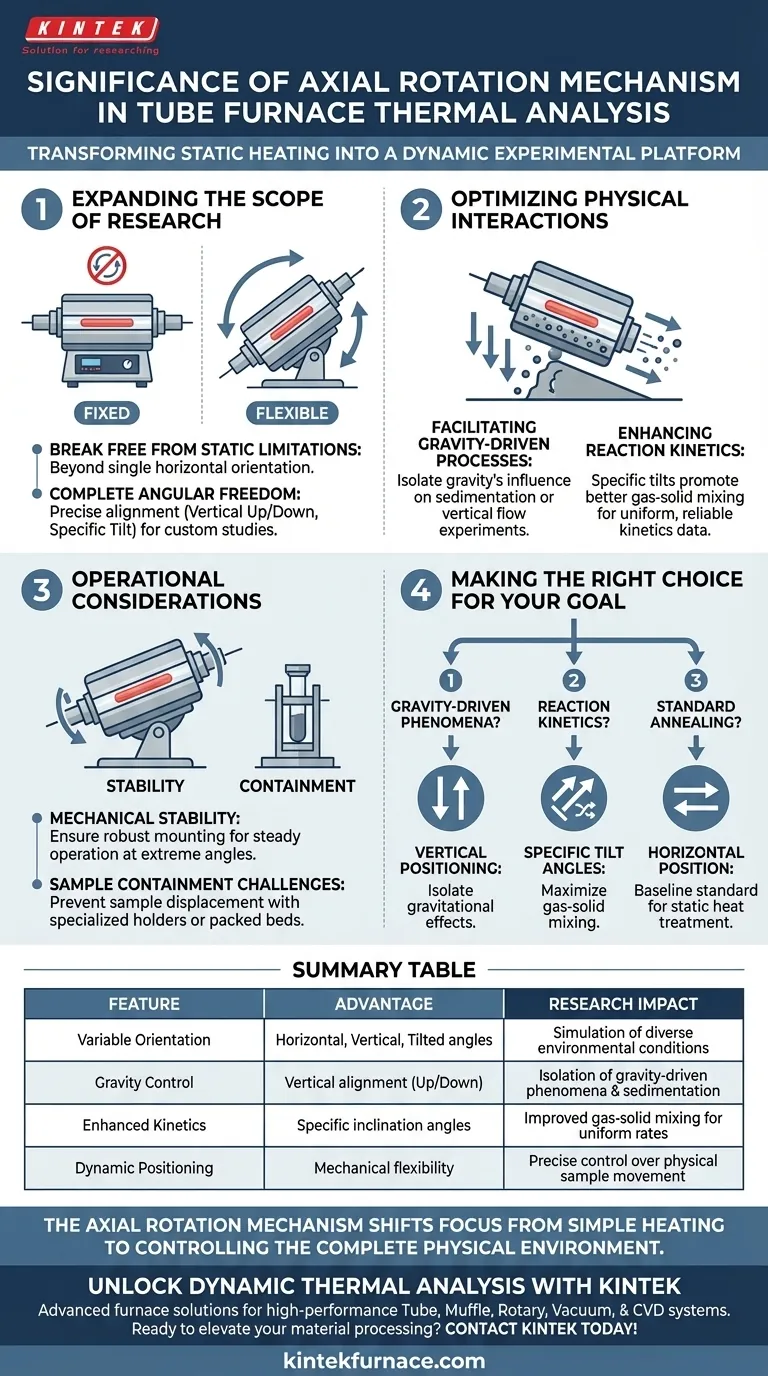
Visual Guide
References
- Beata Brzychczyk, L. J. Sikora. Modernization of a Tube Furnace as Part of Zero-Waste Practice. DOI: 10.3390/su17198940
This article is also based on technical information from Kintek Furnace Knowledge Base .
Related Products
- Vacuum Sealed Continuous Working Rotary Tube Furnace Rotating Tube Furnace
- Split Multi Heating Zone Rotary Tube Furnace Rotating Tube Furnace
- Laboratory Vacuum Tilt Rotary Tube Furnace Rotating Tube Furnace
- Vertical Laboratory Quartz Tube Furnace Tubular Furnace
- Slide PECVD Tube Furnace with Liquid Gasifier PECVD Machine
People Also Ask
- What is the purpose of rotary tube furnaces? Achieve Uniform Heat Treatment for Powders and Granules
- What are the key advantages of using a rotary tube furnace? Achieve Dynamic, Uniform Heating for Powders
- How does the amount of material processed vary between batch and continuous rotary tube furnaces? Scale Your Production Efficiently
- What are the advantages of rotary tube furnaces in fuel compatibility? Boost Efficiency and Cut Costs
- What is the temperature range of some rotary tube furnaces? Achieve Uniform Heating Up to 1200°C



















