
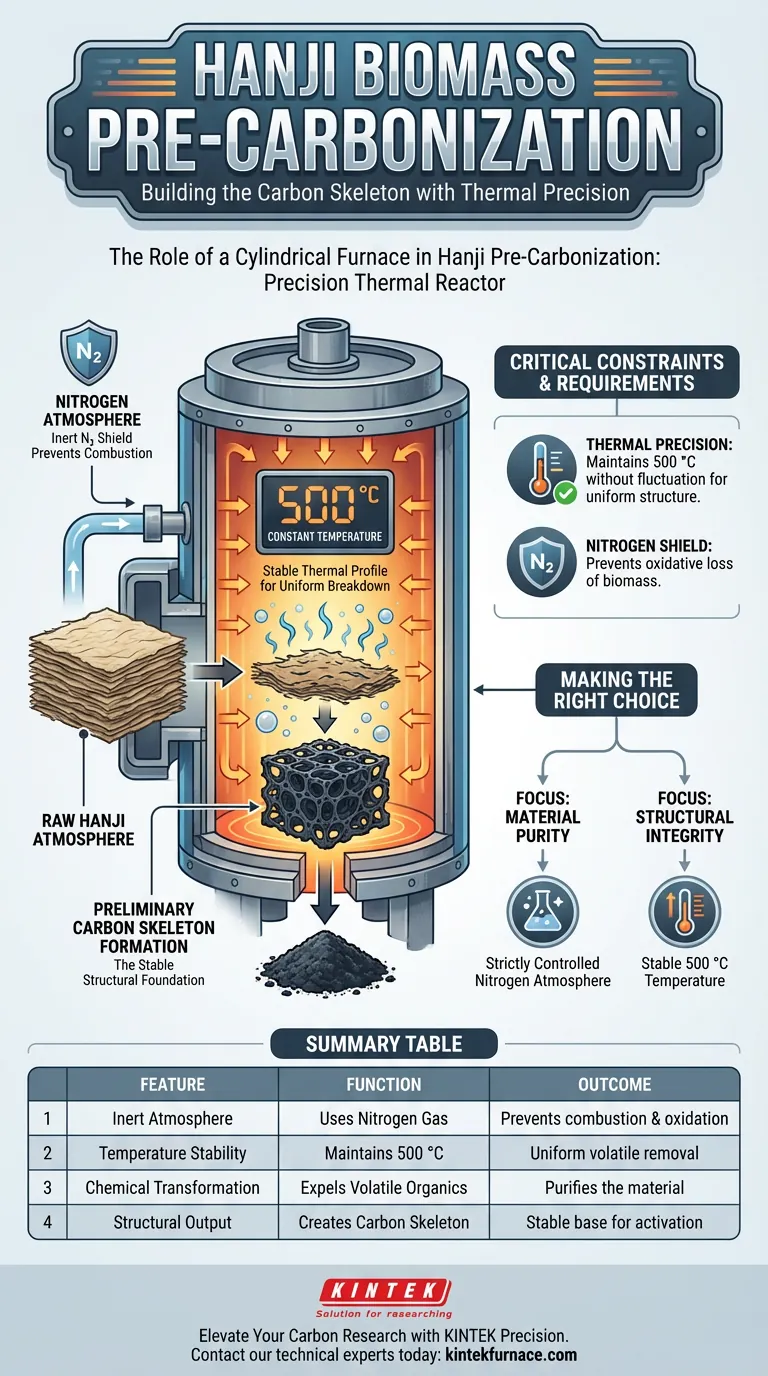
The cylindrical furnace serves as a precision-controlled thermal reactor. It facilitates the pre-carbonization of Hanji by maintaining a specific nitrogen atmosphere and a constant temperature of 500 °C. This environment allows the biomass to undergo essential chemical changes without combusting.
The furnace’s primary role is to convert raw Hanji into a stable preliminary carbon skeleton. By removing volatile components in a controlled 500 °C nitrogen environment, it establishes the necessary structural foundation for subsequent activation stages.
The Mechanics of Pre-Carbonization
Establishing a Controlled Atmosphere
The furnace creates a specialized environment by introducing nitrogen gas. This ensures the Hanji is treated in an inert atmosphere rather than normal air.
This control is critical because it prevents the biomass from burning up, which would occur if oxygen were present at high temperatures.
Thermal Stabilization
The equipment is designed to hold a stable constant temperature of 500 °C.
Maintaining this specific temperature profile is required to initiate the breakdown of the biomass material uniformly.
Material Transformation
Removal of Volatile Components
As the Hanji sits within the furnace at 500 °C, the heat drives off volatile organic compounds.
These non-carbon elements are expelled from the material, effectively purifying the structure.
Formation of the Carbon Skeleton
Once the volatiles are removed, the remaining material forms a preliminary carbon skeleton.
This skeleton retains the physical shape needed for future processing. It serves as the robust baseline required before the material can undergo activation.
Critical Constraints and Requirements
Reliance on Thermal Precision
The success of this process hinges on the furnace's ability to maintain 500 °C without fluctuation.
If the temperature varies significantly, the carbon skeleton may form unevenly, compromising the material's structural integrity.
Necessity of the Nitrogen Shield
The process is entirely dependent on the integrity of the nitrogen atmosphere.
A failure to maintain this inert environment would result in the loss of the biomass through oxidation, rendering the pre-carbonization phase a failure.
Making the Right Choice for Your Goal
To ensure the successful conversion of Hanji into a carbon precursor, consider these operational priorities:
- If your primary focus is Material Purity: Ensure the furnace maintains a strictly controlled nitrogen atmosphere to prevent any oxidative degradation of the biomass.
- If your primary focus is Structural Integrity: Verify the furnace can hold a stable 500 °C temperature to facilitate uniform removal of volatiles and consistent skeleton formation.
The cylindrical furnace is the essential tool that bridges the gap between raw natural biomass and high-performance carbon material.
Summary Table:
| Feature | Function in Hanji Pre-Carbonization |
|---|---|
| Inert Atmosphere | Uses nitrogen gas to prevent biomass combustion and oxidation. |
| Temperature Stability | Maintains a constant 500 °C for uniform volatile removal. |
| Chemical Transformation | Expels volatile organic compounds to purify the material. |
| Structural Output | Creates a stable preliminary carbon skeleton for future activation. |
Elevate Your Carbon Research with KINTEK Precision
Achieving the perfect carbon skeleton requires absolute thermal stability and atmospheric integrity. Backed by expert R&D and manufacturing, KINTEK offers a comprehensive range of Muffle, Tube, Rotary, Vacuum, and CVD systems, all customizable to meet your unique high-temperature processing needs. Whether you are perfecting Hanji pre-carbonization or developing advanced carbon materials, our lab furnaces deliver the uniform heating and inert control you demand.
Ready to optimize your thermal processes? Contact our technical experts today to find the ideal furnace solution for your laboratory.
Visual Guide
References
- Yunju Choi, Heon‐Cheol Shin. Enhancing Li-S Battery Performance with Porous Carbon from Hanji. DOI: 10.3390/batteries11010004
This article is also based on technical information from Kintek Furnace Knowledge Base .
Related Products
- High Temperature Muffle Oven Furnace for Laboratory Debinding and Pre Sintering
- Electric Rotary Kiln Small Rotary Furnace for Activated Carbon Regeneration
- Vacuum Heat Treat Sintering Furnace with Pressure for Vacuum Sintering
- Custom Made Versatile CVD Tube Furnace Chemical Vapor Deposition CVD Equipment Machine
- Multi Heating Zones CVD Tube Furnace Machine for Chemical Vapor Deposition Equipment
People Also Ask
- What thermal phenomena occur during polymer binder burnout in ceramic green bodies? Lab Furnace Guide
- Why is controlled heat treatment in a muffle furnace necessary for calcined clay? Achieve Optimal Pozzolanic Activity
- What role does a high-temperature muffle furnace play in STFO synthesis? Achieve Pure Perovskite Results
- How does a high-temperature muffle furnace facilitate the formation of LaNbxAl1−xO3+δ perovskite structures? Key Roles
- What role does a high-temperature muffle furnace play in the multi-stage synthesis of Li0.5MnFe1.5O4? Key to Pure Spinel














