
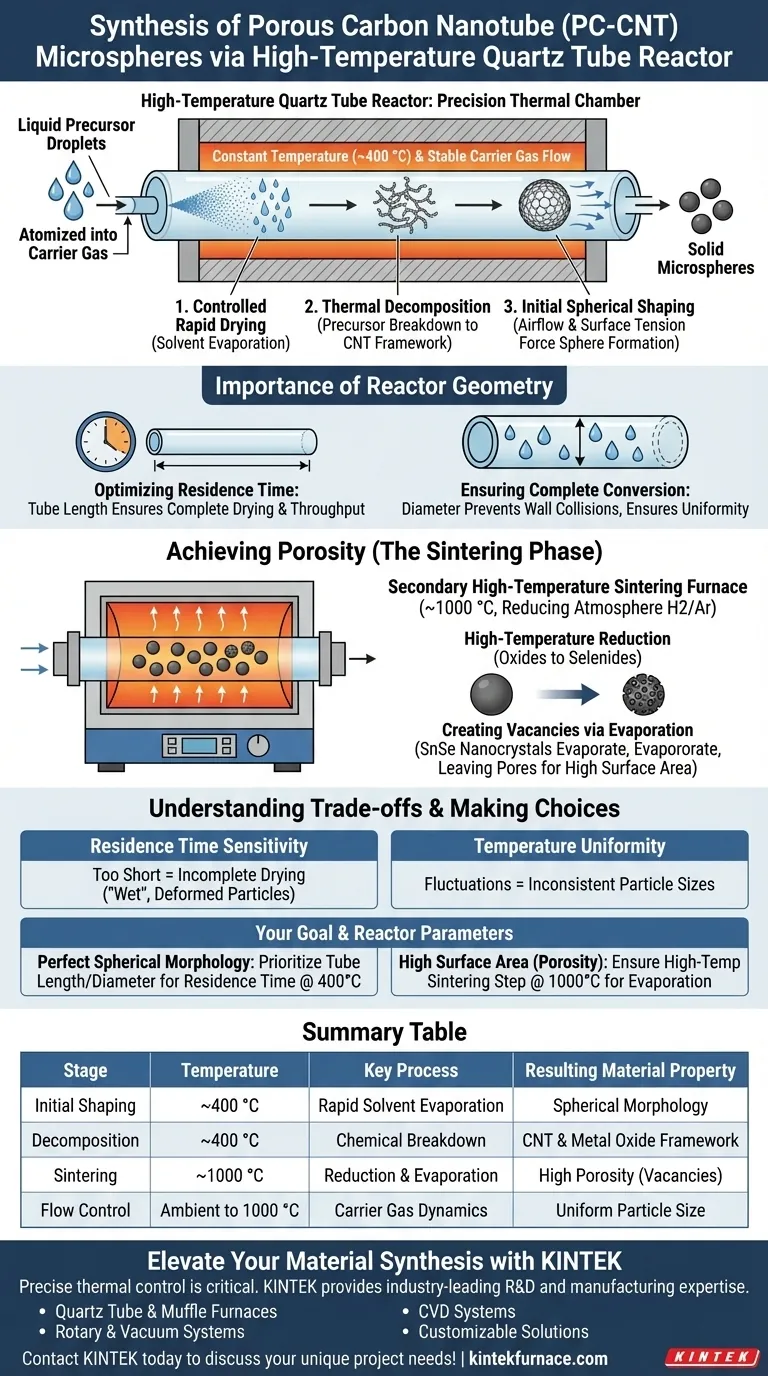
A high-temperature quartz tube reactor acts as a precision thermal chamber to transform liquid precursor droplets into solid, structured microspheres. By maintaining a constant temperature (typically around 400 °C) and a stable carrier gas flow, the reactor drives rapid drying, thermal decomposition, and the initial spherical shaping of the material.
The reactor’s optimized geometry ensures precursor droplets maintain sufficient residence time within the heating zone to fully dry and convert into spheres, setting the foundation for the subsequent creation of a high-surface-area porous structure.
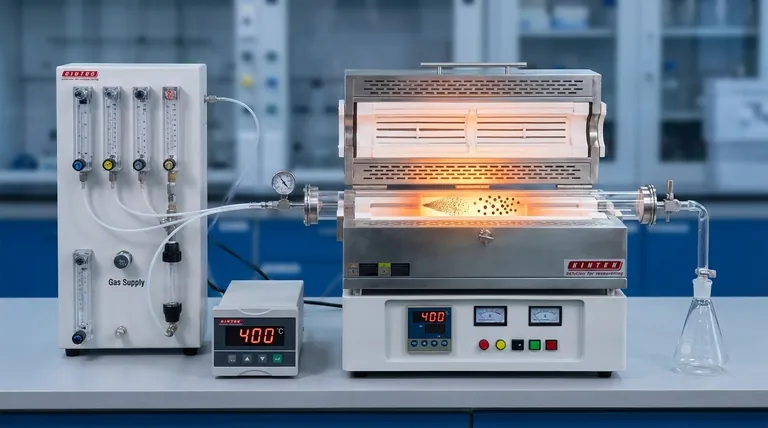
The Role of Thermal Environment and Flow
The fundamental function of the quartz tube reactor is to provide a stable environment where physical and chemical transformations occur simultaneously.
Controlled Rapid Drying
The reactor maintains a constant temperature, such as 400 °C. This heat forces the solvent within the atomized spray droplets to evaporate rapidly.
Thermal Decomposition
As the solvent evaporates, the precursor materials undergo thermal decomposition. This breaks down the initial chemical compounds to leave behind the carbon nanotube framework and metal oxide precursors.
Initial Spherical Shaping
The combination of airflow and surface tension during the drying phase forces the droplets to contract. This facilitates the formation of a distinct spherical morphology, which is essential for the material's final application.
Importance of Reactor Geometry
The physical dimensions of the quartz tube are not arbitrary; they are critical engineering variables that dictate the quality of the synthesis.
Optimizing Residence Time
The length of the quartz tube determines how long the droplets remain in the heating zone. An optimized length ensures the "residence time" is long enough for complete drying but short enough to maintain throughput.
Ensuring Complete Conversion
The reactor's diameter influences the flow dynamics of the carrier gas. Correct sizing prevents wall collisions and ensures that every droplet undergoes complete component conversion before exiting the reactor.
Achieving Porosity (The Sintering Phase)
While the initial reactor stage forms the spheres, the "porous" characteristic of PC-CNT microspheres often requires a secondary high-temperature phase, typically performed in a tube sintering furnace.
High-Temperature Reduction
This stage operates at significantly higher temperatures (approx. 1000 °C) under a reducing atmosphere (e.g., H2/Ar). This environment converts oxides within the precursors into selenides.
Creating Vacancies via Evaporation
High heat triggers the complete evaporation of specific nanocrystals, such as SnSe. When these crystals evaporate, they leave behind significant vacancies, effectively creating the pores that define the high specific surface area of the final product.
Understanding the Trade-offs
Achieving uniform microspheres requires balancing several competing factors within the reactor.
Residence Time Sensitivity
If the reactor tube is too short or the gas flow too fast, the residence time decreases. This leads to incomplete drying and "wet" particles that deform rather than remaining spherical.
Temperature Uniformity
Fluctuations in the heating zone can lead to inconsistent particle sizes. Precise thermal control is required to ensure that decomposition happens uniformly across the entire batch of droplets.
Making the Right Choice for Your Goal
To maximize the efficiency of your PC-CNT synthesis, align your reactor parameters with your specific structural requirements.
- If your primary focus is Perfect Spherical Morphology: Prioritize the optimization of the tube length and diameter to ensure adequate residence time at 400 °C for shaping.
- If your primary focus is High Surface Area (Porosity): Ensure your process includes a high-temperature sintering step (1000 °C) capable of fully evaporating sacrificial nanocrystals.
The quartz tube reactor is not just a heating vessel; it is a shaping tool that uses time and temperature to sculpt liquid droplets into functional microspheres.
Summary Table:
| Stage | Temperature | Key Process | Resulting Material Property |
|---|---|---|---|
| Initial Shaping | ~400 °C | Rapid Solvent Evaporation | Spherical Morphology |
| Decomposition | ~400 °C | Chemical Breakdown | CNT & Metal Oxide Framework |
| Sintering | ~1000 °C | Reduction & Evaporation | High Porosity (Vacancies) |
| Flow Control | Ambient to 1000 °C | Carrier Gas Dynamics | Uniform Particle Size |
Elevate Your Material Synthesis with KINTEK
Precise control over thermal environments and residence time is critical for producing high-quality PC-CNT microspheres. KINTEK provides industry-leading R&D and manufacturing expertise to deliver the exact heating solutions your lab requires.
Our extensive range of high-performance lab equipment includes:
- Quartz Tube & Muffle Furnaces for precise thermal decomposition.
- Rotary & Vacuum Systems to ensure uniform heat distribution.
- CVD Systems for advanced carbon nanotube growth.
- Customizable Solutions tailored to your specific temperature and atmosphere requirements.
Whether you are focusing on spherical morphology or maximizing surface area, our expert-engineered systems provide the stability and precision you need. Contact KINTEK today to discuss your unique project needs!
Visual Guide
References
- Hyo Yeong Seo, Gi Dae Park. Engineering Porous Carbon Nanotube Microspheres with Nickel Sulfoselenide Nanocrystals for High‐Performance Potassium‐Ion Batteries: Electrochemical Mechanisms and Cycling Stability. DOI: 10.1002/sstr.202500222
This article is also based on technical information from Kintek Furnace Knowledge Base .
Related Products
- 1200℃ Split Tube Furnace Laboratory Quartz Tube Furnace with Quartz Tube
- Vertical Laboratory Quartz Tube Furnace Tubular Furnace
- 1700℃ High Temperature Laboratory Tube Furnace with Alumina Tube
- Laboratory Quartz Tube Furnace RTP Heating Tubular Furnace
- 1400℃ High Temperature Laboratory Tube Furnace with Alumina Tube
People Also Ask
- What is a split tube furnace? Unlock Easy Access for Complex Lab Experiments
- What are the components of a basic tube furnace design capable of withstanding 1200°C? Essential Parts for High-Temp Labs
- What are the primary benefits of using a split tube furnace? Enhance Lab Efficiency with Unmatched Flexibility
- How does gas flow impact the performance of a split tube furnace? Optimize Your Process with Precision Control
- Why is a split tube furnace utilized as the core reaction equipment in coal chemical looping? Simulate Thermal Shock



















