
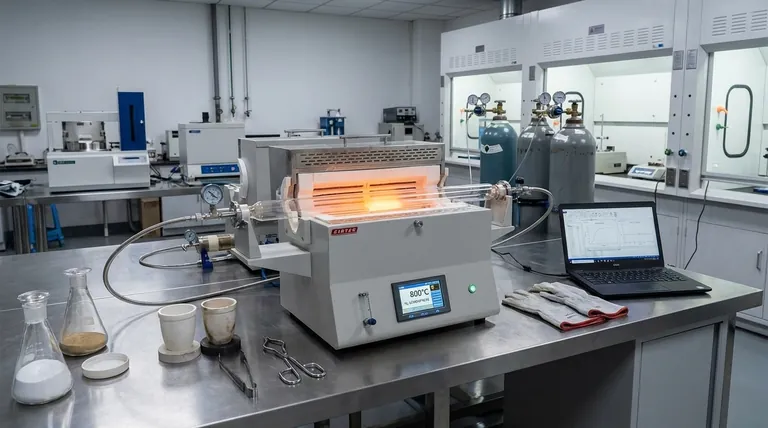
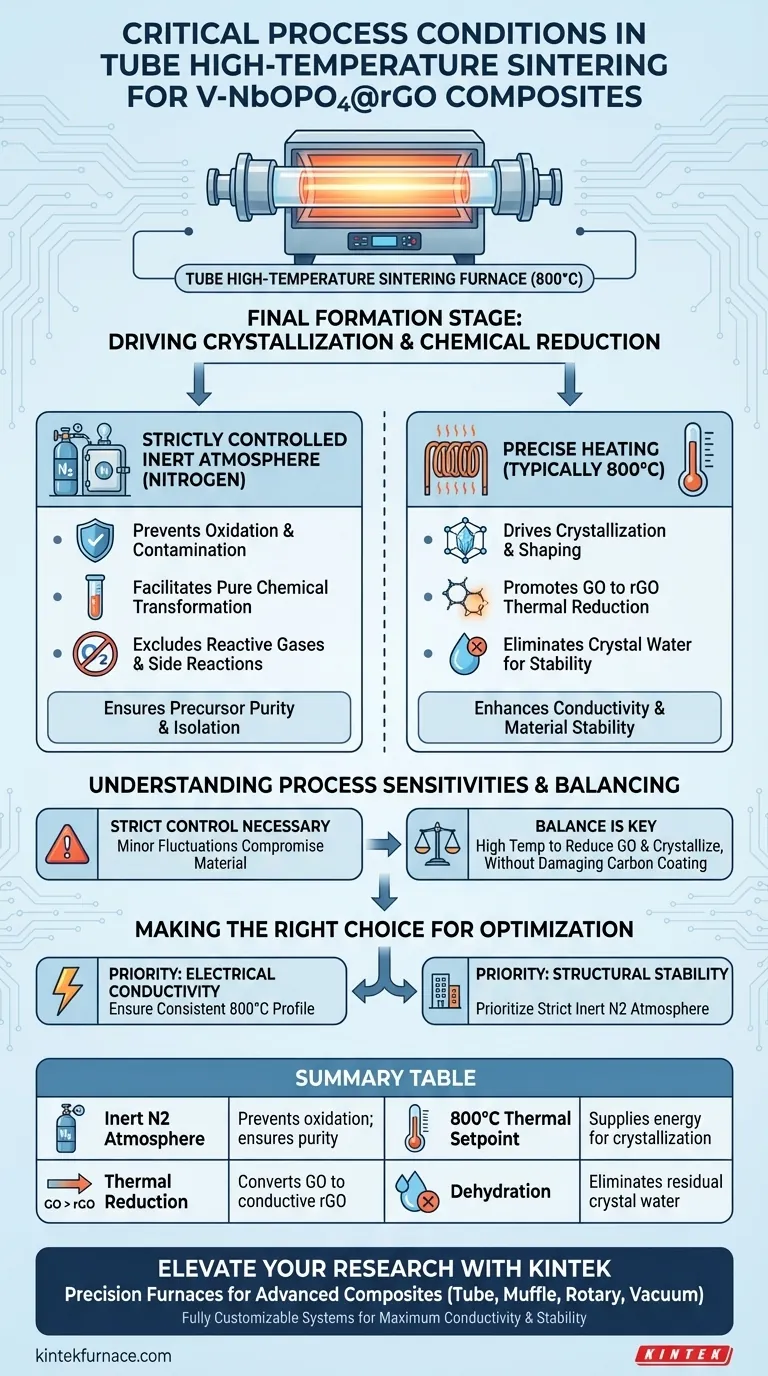
The tube high-temperature sintering furnace creates a critical processing environment defined by a strictly controlled inert nitrogen atmosphere and precise heating, typically at 800°C. These conditions are necessary to crystallize the precursor, thermally reduce graphene oxide (GO) into conductive reduced graphene oxide (rGO), and eliminate crystal water from the V-NbOPO4@rGO structure.
By maintaining a precise inert environment at high heat, the furnace simultaneously drives structural crystallization and chemical reduction. This dual action transforms raw precursors into a highly conductive, stable composite free of moisture, essential for advanced material performance.
The Role of the Inert Atmosphere
Strictly Controlled Nitrogen Environment
The furnace utilizes a nitrogen atmosphere to create an inert environment during the sintering process. This prevents external contaminants or oxygen from interfering with the chemical formation of the composite.
Facilitating Chemical Transformation
By excluding reactive gases, the nitrogen atmosphere allows the internal chemical changes to proceed without side reactions. This isolation is vital for the purity of the final V-NbOPO4@rGO composite.
Thermal Mechanisms at 800°C
Driving Crystallization and Shaping
At temperatures such as 800°C, the furnace supplies the energy required to organize the atomic structure of the precursor. This heat treatment enables the material to crystallize properly and take on its final, defined shape.
Enhancing Electrical Conductivity
The high-temperature environment promotes the thermal reduction of graphene oxide (GO). As the GO converts into reduced graphene oxide (rGO), the material's electrical conductivity increases significantly.
Stabilizing the Compound
The sintering process ensures the complete elimination of crystal water from the structure. Removing this moisture is essential for creating a stable, vanadium-doped niobium phosphate carbon-coated composite that will not degrade over time.
Understanding Process Sensitivities
The Necessity of Strict Control
The term "strictly controlled" indicates that deviations in the atmosphere or temperature profile can compromise the material. Even minor fluctuations can prevent the complete reduction of GO or leave residual moisture in the lattice.
Balancing Reduction and Structure
The process relies on achieving a balance where the temperature is high enough to reduce GO and crystallize the phosphate without damaging the carbon coating. The 800°C setpoint is a specific parameter selected to optimize this trade-off.
Making the Right Choice for Your Goal
To optimize the synthesis of V-NbOPO4@rGO composites, consider your specific performance requirements:
- If your primary focus is electrical conductivity: Ensure the furnace maintains a consistent 800°C temperature profile to maximize the thermal reduction of GO into rGO.
- If your primary focus is structural stability: Prioritize the strict control of the inert nitrogen atmosphere to facilitate pure crystallization and the complete removal of crystal water.
Precise control over both atmosphere and temperature is the only way to ensure a stable, conductive, and high-performance final composite.
Summary Table:
| Process Parameter | Role in V-NbOPO4@rGO Formation |
|---|---|
| Inert Nitrogen Atmosphere | Prevents oxidation; ensures precursor purity and chemical isolation |
| 800°C Thermal Setpoint | Supplies energy for crystallization and atomic structural organization |
| Thermal Reduction | Converts Graphene Oxide (GO) to conductive rGO for better electrical performance |
| Dehydration | Eliminates residual crystal water to ensure long-term compound stability |
Elevate Your Material Research with KINTEK
Precision is non-negotiable when synthesizing advanced composites like V-NbOPO4@rGO. Backed by expert R&D and world-class manufacturing, KINTEK provides high-performance Tube, Muffle, Rotary, and Vacuum furnaces designed to meet the strictest process sensitivities.
Whether you require precise 800°C thermal profiles or strictly controlled inert environments, our systems are fully customizable to your unique lab requirements. Achieve maximum conductivity and structural stability in your materials today.
Contact KINTEK for a Custom Solution
Visual Guide
References
- Zhongteng Chen, Zhipeng Sun. Tuning the Electronic Structure of Niobium Oxyphosphate/Reduced Graphene Oxide Composites by Vanadium‐Doping for High‐Performance Na<sup>+</sup> Storage Application. DOI: 10.1002/cnl2.70010
This article is also based on technical information from Kintek Furnace Knowledge Base .
Related Products
- 1400℃ High Temperature Laboratory Tube Furnace with Alumina Tube
- 1700℃ High Temperature Laboratory Tube Furnace with Alumina Tube
- 1200℃ Split Tube Furnace Laboratory Quartz Tube Furnace with Quartz Tube
- 2200 ℃ Tungsten Vacuum Heat Treat and Sintering Furnace
- Vertical Laboratory Quartz Tube Furnace Tubular Furnace
People Also Ask
- How does zone-melting in tube furnaces synthesize bismuth micro-wires? Master Single-Crystal Thermoelectric Growth
- How are high-temperature laboratory tube furnaces applied in long-term vacuum homogenization heat treatments for intermetallic samples?
- How do high-temperature laboratory tube furnaces ensure environmental stability? Precision Thermal Reduction Tips
- How are high-temp tube furnaces used to measure diffusion coefficients per Fick's law? Master Precision Annealing
- How are high-temperature tube furnaces applied in testing ceramic-supported alloy membranes? Insights



















