
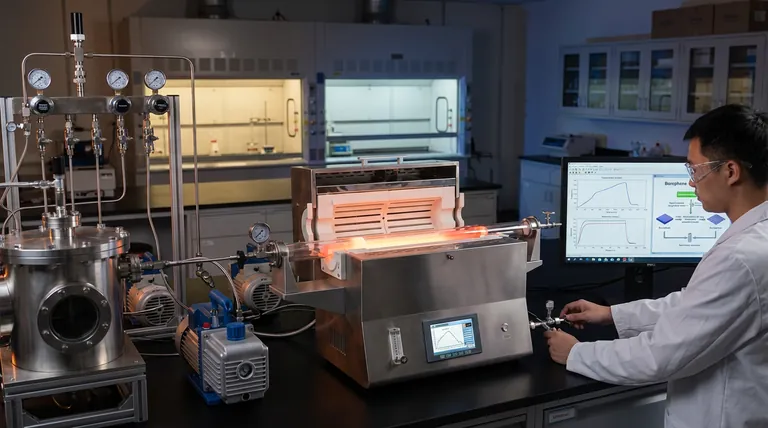
Strict pressure control is the governing factor for structural integrity in Borophene synthesis. In a vacuum tube furnace, the pressure system regulates the concentration of the reaction atmosphere and the rate at which precursors decompose. This precise balance is required to ensure boron atoms deposit in an ordered, single-phase structure rather than forming disordered grains.
The synthesis of single-phase Borophene relies on a delicate equilibrium between precursor decomposition and atomic diffusion. Pressure control acts as the throttle for this process, preventing excessive atomic concentrations that lead to chaotic growth patterns and ensuring large-area, single-crystal film formation.
Regulating the Reaction Atmosphere
Setting the Precursor Concentration
The pressure within the furnace, typically maintained between $10^{-3}$ Pa and 50 Pa, directly dictates the density of the gas environment. This control allows you to fine-tune exactly how much precursor material—such as boranes or borohydrides—is available for reaction at any given moment. Without this regulation, the chemical environment becomes unpredictable.
Stabilizing Decomposition Rates
Thermal decomposition is driven by both temperature and pressure. By maintaining a specific vacuum level, you stabilize the rate at which precursors break down. This ensures a steady, manageable supply of boron atoms are released, rather than an uncontrollable flood that the substrate cannot accommodate.
Managing Atomic Behavior on the Substrate
Guiding Diffusion Paths
Once boron atoms land on the substrate, they must migrate to specific lattice sites to form a crystal. The pressure environment critically influences the diffusion paths of these atoms. Proper pressure conditions ensure atoms have the necessary mobility to find their correct position in the Borophene lattice.
Preventing Disordered Growth
The primary enemy of single-phase Borophene is excessive atomic concentration. If the pressure allows the concentration of boron atoms to spike, they accumulate faster than they can arrange themselves. This leads to disordered grain growth. Strict regulation keeps concentrations low enough to foster orderly, single-crystal phase formation.
The Risks of Improper Pressure Regulation
The Impact of High Pressure
If the pressure exceeds the optimal range (approaching or exceeding 50 Pa), the reaction atmosphere becomes too dense. This causes a supersaturation of boron atoms on the surface. The result is rapid, chaotic nucleation that destroys the desired single-crystal phase.
The Impact of Insufficient Vacuum
Conversely, failing to maintain the required lower limit (around $10^{-3}$ Pa) can starve the reaction. While this avoids disordered growth, it often results in insufficient film coverage or growth rates that are too slow to be practical for creating large-area thin films.
Optimizing Your Synthesis Strategy
To achieve high-quality Borophene, you must treat pressure as a dynamic variable that shapes the material's quality.
- If your primary focus is High Crystallinity: Target the lower end of the pressure range to reduce the decomposition rate, giving atoms maximum time to diffuse into ordered lattice sites.
- If your primary focus is Large-Area Coverage: Maintain a stable pressure in the mid-to-high allowable range to ensure a consistent supply of precursors across the entire substrate surface without causing supersaturation.
Ultimately, the pressure controller is not just a gauge; it is the primary tool for sculpting the atomic architecture of high-quality Borophene.
Summary Table:
| Control Parameter | Optimal Range / Condition | Impact on Borophene Synthesis |
|---|---|---|
| Vacuum Pressure | $10^{-3}$ Pa to 50 Pa | Regulates precursor density and decomposition rate. |
| Atomic Concentration | Low & Controlled | Prevents disordered grain growth; fosters single-crystal phase. |
| Diffusion Mobility | High (Low Pressure) | Allows atoms to migrate to correct lattice sites. |
| High Pressure Risk | > 50 Pa | Leads to supersaturation and chaotic nucleation. |
| Low Pressure Risk | < $10^{-3}$ Pa | Results in insufficient film coverage or slow growth. |
Elevate Your Material Synthesis with KINTEK Precision
Achieving the delicate balance required for single-phase Borophene demands equipment with uncompromising accuracy. Backed by expert R&D and world-class manufacturing, KINTEK provides high-performance Vacuum, Tube, CVD, and Muffle furnace systems specifically designed for advanced thermal decomposition and thin-film growth.
Our systems offer the industry-leading pressure stability and thermal uniformity needed to prevent disordered growth and ensure large-area, single-crystal formation. Whether you need a standard setup or a custom-engineered solution for your unique research goals, KINTEK is your partner in laboratory excellence.
Ready to optimize your synthesis results? Contact our technical experts today to find the perfect furnace for your lab!
References
- Gourang Hari Gupta, Suveen Kumar. Borophene nanomaterials: synthesis and applications in biosensors. DOI: 10.1039/d3ma00829k
This article is also based on technical information from Kintek Furnace Knowledge Base .
Related Products
- High Pressure Laboratory Vacuum Tube Furnace
- Vacuum Hot Press Furnace Machine Heated Vacuum Press Tube Furnace
- Laboratory Vacuum Tilt Rotary Tube Furnace Rotating Tube Furnace
- Vacuum Sealed Continuous Working Rotary Tube Furnace Rotating Tube Furnace
- Vacuum Heat Treat Sintering Furnace with Pressure for Vacuum Sintering
People Also Ask
- What role does a high vacuum tube furnace play in Co-Al sintering? Master High-Purity Porous Material Synthesis
- What are the different types of tube furnaces available? Find the Perfect Fit for Your Lab's Needs
- What is the role of a vacuum tube furnace during the final thermal treatment stage of Fe3O4@CSAC catalysts?
- What are the main advantages of vacuum tube furnaces in the market? Achieve Purity and Precision in Material Processing
- What conditions does a tube furnace provide for post-ion-implantation? Achieve Precise Microstructural Repair



















