
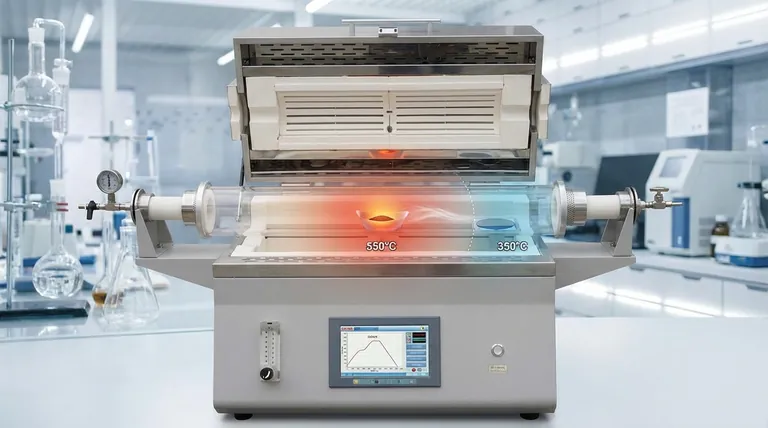
The temperature zone layout dictates the synthesis quality of Bi2Se3 nanofilms by establishing a precise thermal gradient essential for crystal growth. Specifically, placing the evaporation source in a central constant temperature zone at 550 °C and the substrate in a downstream edge area at 350 °C creates the necessary conditions for ordered deposition, directly controlling the uniformity and thickness of the final film.
The strategic spatial separation of temperature zones utilizes the thermal difference along the airflow direction to drive the phase change from vapor to solid. This gradient is the primary lever for ensuring precursors deposit in an ordered structure rather than randomly condensing.
The Mechanics of the Thermal Gradient
Establishing the Source Zone
For Bi2Se3 synthesis, the central zone of the furnace acts as the engine for volatilization.
By maintaining this area at a constant 550 °C, you ensure the evaporation source generates a steady stream of precursor vapor.
Stability in this zone is critical; fluctuations here will result in an inconsistent supply of material to the substrate.
Defining the Deposition Zone
The downstream edge area functions as the collection point.
This zone is maintained at a significantly lower temperature of 350 °C.
This temperature drop is not accidental; it provides the specific thermodynamic environment required for the vaporized Bi2Se3 to condense onto the substrate.
The Role of Airflow Direction
The layout relies on the physical movement of the carrier gas from the hot center to the cooler edge.
The airflow transports the volatilized precursors from the high-energy generation zone to the lower-energy deposition zone.
This directional flow ensures that the material reaches the substrate only when it is thermally ready to settle.
How Layout Influences Film Properties
Achieving Ordered Deposition
The synthesis quality hinges on "ordered deposition," which is a direct result of the temperature difference between the two zones.
If the temperature gap is too small or the transition too gradual, the deposition becomes chaotic.
The specific 550 °C to 350 °C gradient forces the atoms to arrange themselves systematically, leading to high-quality crystal structures.
Controlling Uniformity and Thickness
The layout determines the rate at which material accumulates on the substrate.
By fixing the substrate at the 350 °C isotherm, you lock in a specific deposition rate.
This precise regulation allows you to dictate the final thickness of the nanofilm and ensures the surface remains uniform across the substrate.
Understanding the Trade-offs
Sensitivity to Positioning
The greatest risk in this layout is the physical placement of the substrate.
Because the substrate relies on the "downstream edge" temperature profile, even a variation of a few centimeters can drastically alter the local temperature.
If the substrate is placed too close to the center, the temperature may exceed 350 °C, preventing deposition; too far, and the precursors may precipitate prematurely.
Balancing the Gradient
A steeper temperature gradient can lead to sharper deposition but may induce thermal stress.
Conversely, a shallow gradient might allow for gentler cooling but risks poor transport efficiency of the precursors.
You must accept that the "sweet spot" for Bi2Se3 (the 200 °C difference) is specific and allows little margin for error in zone configuration.
Optimizing Your Furnace Configuration
To ensure reproducible high-quality Bi2Se3 films, you must treat position as a variable as critical as temperature itself.
- If your primary focus is Film Uniformity: Ensure your substrate is positioned exactly where the temperature stabilizes at 350 °C, avoiding areas with turbulent airflow or fluctuating thermal gradients.
- If your primary focus is Thickness Control: Strictly regulate the duration the source remains at 550 °C, as the constant temperature zone drives the volume of material available for deposition.
Mastering the spatial relationship between your heat source and your substrate is the key to transitioning from random deposition to engineered nanofilm growth.
Summary Table:
| Zone Type | Function | Temperature Target | Impact on Quality |
|---|---|---|---|
| Central Zone | Source Volatilization | 550 °C | Ensures steady precursor vapor supply |
| Downstream Edge | Substrate Deposition | 350 °C | Facilitates ordered crystal growth |
| Thermal Gradient | Material Transport | 200 °C ΔT | Controls film uniformity and thickness |
Elevate Your Nanofilm Research with KINTEK
Precision in temperature gradients is the difference between random deposition and high-quality crystal growth. KINTEK provides industry-leading Tube, Muffle, Vacuum, and CVD systems engineered specifically for the rigorous demands of advanced material synthesis.
Backed by expert R&D and manufacturing, our high-temperature furnaces are fully customizable to meet your unique thermal zone requirements for Bi2Se3 and other thin-film applications.
Ready to master your thermal profile? Contact KINTEK experts today to find your perfect custom furnace solution.
Visual Guide

References
- Yang Gao, Fei Chen. Study on Saturable Absorption Characteristics of Bi2Se3 Topological Insulators with Film Thickness Dependence and Its Laser Application. DOI: 10.3390/coatings14060679
This article is also based on technical information from Kintek Furnace Knowledge Base .
Related Products
- Vertical Laboratory Quartz Tube Furnace Tubular Furnace
- 1700℃ High Temperature Laboratory Tube Furnace with Alumina Tube
- Vacuum Sealed Continuous Working Rotary Tube Furnace Rotating Tube Furnace
- Split Multi Heating Zone Rotary Tube Furnace Rotating Tube Furnace
- Laboratory Vacuum Tilt Rotary Tube Furnace Rotating Tube Furnace
People Also Ask
- What are the key differences between single-zone and multi-zone vertical tube furnaces? Choose the Right Furnace for Your Lab
- How are wafers loaded and unloaded in a vertical tube furnace? Achieve Precision and Purity in Wafer Processing
- How are metal support wires selected for sample suspension? Expert Guide to High-Temp Furnace Materials
- Why is a vertical tube furnace preferred for quenching tests? Achieve Rapid, Repeatable Cooling for Accurate Results
- What makes a vertical tube furnace easy to operate? Discover Intuitive Automation for Precision Heating



















