
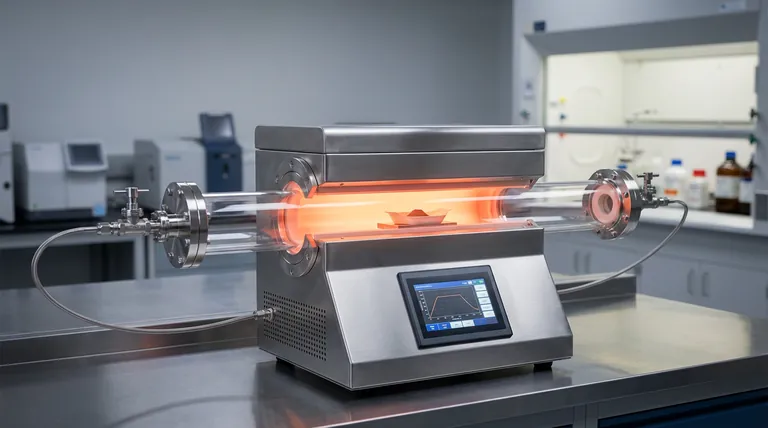
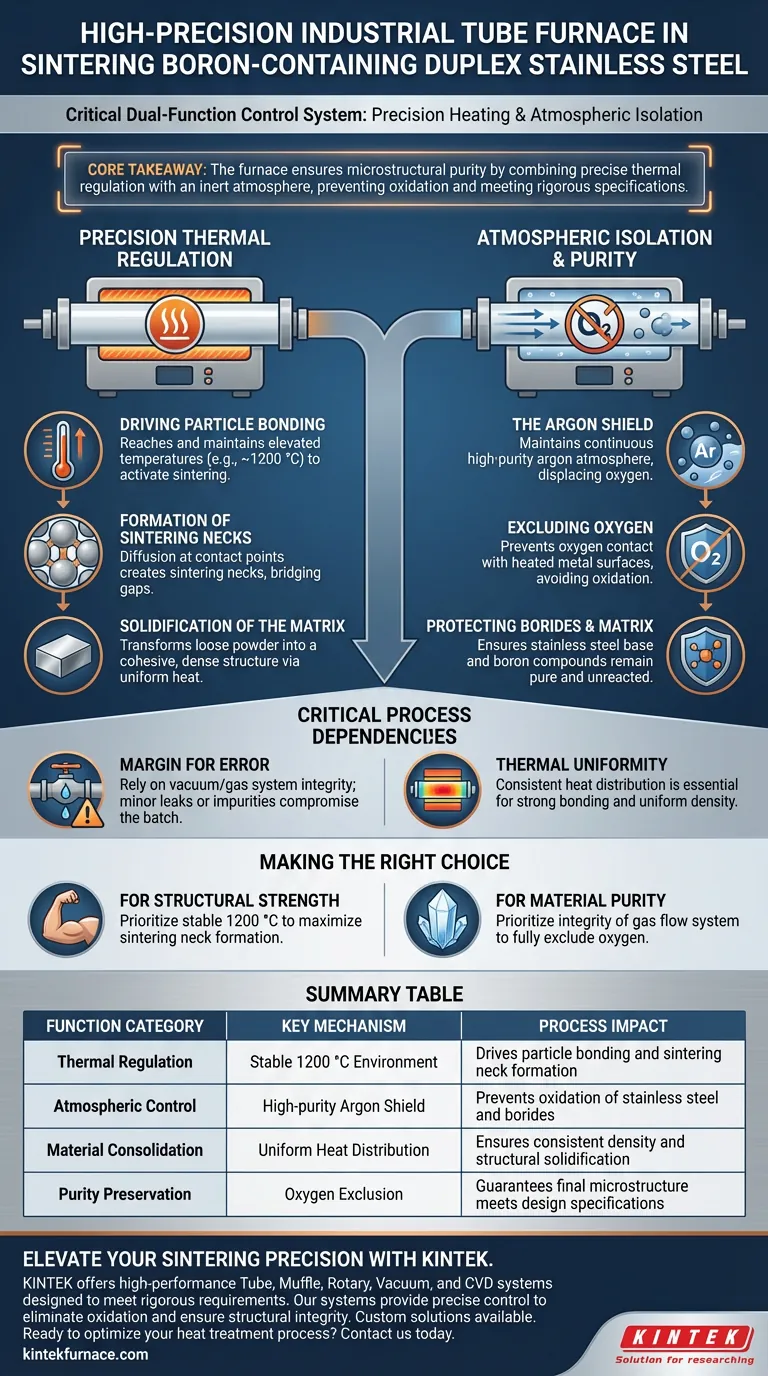
A high-precision industrial tube furnace acts as a critical dual-function control system during the sintering of boron-containing duplex stainless steel. Its primary mechanical function is to generate a stable high-temperature environment (typically around 1200 °C) that forces metal particles to bond by forming "sintering necks." Simultaneously, it serves as an isolation chamber, utilizing high-purity argon to strictly exclude oxygen and prevent chemical degradation.
Core Takeaway The furnace is not merely a heating device, but a tool for ensuring microstructural purity. By combining precise thermal regulation with an inert atmosphere, it prevents the oxidation of both the stainless steel matrix and borides, ensuring the material meets rigorous design specifications.
Precision Thermal Regulation
Driving Particle Bonding
The fundamental role of the furnace is to reach and maintain elevated temperatures, such as 1200 °C. This specific thermal energy is required to activate the sintering process.
Formation of Sintering Necks
At these temperatures, diffusion occurs at the contact points between individual powder particles. This results in the growth of sintering necks, which bridge the gaps between particles.
Solidification of the Matrix
The growth of these necks transforms the loose powder compact into a solid, cohesive structure. The precision of the furnace ensures this densification happens uniformly across the material.
Atmospheric Isolation and Purity
The Argon Shield
To protect the material, the furnace maintains a continuous atmosphere of high-purity argon. This inert gas fills the tube, effectively displacing standard atmospheric air.
Excluding Oxygen
The presence of oxygen at sintering temperatures would be catastrophic for stainless steel. The argon environment acts as a barrier, preventing oxygen from contacting the heated metal surfaces.
Protecting Borides and the Matrix
Both the stainless steel base and the boron compounds (borides) are highly susceptible to oxidation. The furnace’s atmospheric control ensures these elements remain pure and unreacted.
Ensuring Design Compliance
By preventing oxidation, the furnace guarantees that the final sintered microstructure is free of oxides. This purity is essential for the material to meet specific mechanical and design requirements.
Critical Process Dependencies
The Margin for Error
While high-precision furnaces offer control, they rely heavily on the integrity of the vacuum or gas system. Even a minor leak or impurity in the argon supply can compromise the entire batch.
Thermal Uniformity
The formation of sintering necks depends on consistent heat distribution. Any cold spots in the furnace tube will result in weak bonding and inconsistent material density.
Making the Right Choice for Your Goal
To ensure the successful sintering of boron-containing duplex stainless steel, prioritize the following operational parameters:
- If your primary focus is Structural Strength: Verify that the furnace can maintain a stable 1200 °C without fluctuation to maximize the formation of strong sintering necks.
- If your primary focus is Material Purity: Prioritize the integrity of the gas flow system to ensure the high-purity argon atmosphere completely excludes oxygen throughout the cycle.
The success of your sintering process depends on the furnace's ability to balance extreme heat with absolute atmospheric isolation.
Summary Table:
| Function Category | Key Mechanism | Process Impact |
|---|---|---|
| Thermal Regulation | Stable 1200 °C Environment | Drives particle bonding and sintering neck formation |
| Atmospheric Control | High-purity Argon Shield | Prevents oxidation of stainless steel and borides |
| Material Consolidation | Uniform Heat Distribution | Ensures consistent density and structural solidification |
| Purity Preservation | Oxygen Exclusion | Guarantees final microstructure meets design specifications |
Elevate Your Sintering Precision with KINTEK
Achieving the perfect balance of thermal uniformity and atmospheric purity is critical for advanced materials like boron-containing duplex stainless steel. Backed by expert R&D and manufacturing, KINTEK offers high-performance Tube, Muffle, Rotary, Vacuum, and CVD systems designed to meet your most rigorous lab and industrial requirements.
Our systems provide the precise control needed to eliminate oxidation and ensure structural integrity. Whether you need a standard model or a fully customizable solution for unique high-temp applications, KINTEK delivers the reliability your research deserves.
Ready to optimize your heat treatment process? Contact us today to find your custom furnace solution.
Visual Guide
References
- Microstructural Evolution of a Pre-Alloyed Duplex Stainless Steel 2205 with Boron Addition Prepared by Powder Metallurgy. DOI: 10.3390/powders4030024
This article is also based on technical information from Kintek Furnace Knowledge Base .
Related Products
- High Pressure Laboratory Vacuum Tube Furnace
- 1700℃ High Temperature Laboratory Tube Furnace with Alumina Tube
- 1400℃ High Temperature Laboratory Tube Furnace with Alumina Tube
- Vertical Laboratory Quartz Tube Furnace Tubular Furnace
- Magnesium Extraction and Purification Condensing Tube Furnace
People Also Ask
- What role does a high vacuum tube furnace play in Co-Al sintering? Master High-Purity Porous Material Synthesis
- What are the different types of tube furnaces available? Find the Perfect Fit for Your Lab's Needs
- What are the main advantages of vacuum tube furnaces in the market? Achieve Purity and Precision in Material Processing
- What is the role of a vacuum tube furnace during the final thermal treatment stage of Fe3O4@CSAC catalysts?
- What conditions does a tube furnace provide for post-ion-implantation? Achieve Precise Microstructural Repair



















