
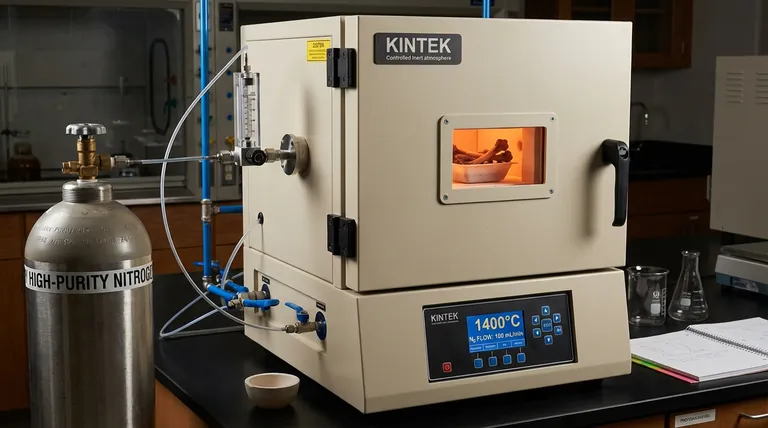
The primary purpose of introducing high-purity nitrogen is to displace oxygen within the tube furnace, creating a strictly inert atmosphere. This prevents the chicken bones from combusting (burning) at high temperatures, forcing the material to undergo thermal decomposition—pyrolysis—rather than oxidation.
By excluding oxygen, nitrogen acts as a protective shield that preserves carbon structures and essential minerals. It ensures the conversion of bone mass into high-quality biochar and bio-oil, rather than reducing it to mere ash.
Creating the Conditions for Pyrolysis
The Distinction Between Burning and Decomposing
Combustion requires three elements: fuel, heat, and oxygen.
If you heat chicken bones in normal air, the presence of oxygen causes the organic material to burn, leaving behind ash with little chemical value.
Displacing the Oxygen
High-purity nitrogen acts as a displacement agent.
By filling the chamber with this inert gas, you starve the reaction of oxygen. This forces the organic macromolecules in the bone to break down solely due to thermal stress, a process known as true thermal decomposition.
Preserving Material Quality
Protecting the Carbon Matrix
The goal of pyrolysis is often to produce biochar, a stable carbon-rich residue.
In an oxidative environment, carbon reacts with oxygen to form CO2 and dissipates. Nitrogen protects the carbon matrix, ensuring a higher yield of solid biochar.
Retaining Key Minerals
Chicken bones are a valuable source of minerals, specifically phosphorus and calcium.
A nitrogen atmosphere facilitates the precise production of biochar that retains these minerals. This results in a final product that is nutrient-rich and structurally useful for agricultural or material science applications.
The Role of a "Sweeping" Gas
Removing Volatile Byproducts
Nitrogen does not just sit static in the furnace; it is usually maintained as a constant flow (e.g., 100 mL min⁻¹).
This flow acts as a "sweeping gas." As the bones heat up, they release volatile gases and moisture. The flowing nitrogen efficiently carries these volatiles away from the solid material.
Preventing Secondary Reactions
If volatile gases remain in the hot zone, they can re-deposit on the biochar or undergo unwanted secondary reactions.
By continuously flushing the chamber, nitrogen ensures the reaction environment remains stable and consistent. It also transports these gases to downstream systems for cooling, collection, or analysis.
Understanding the Trade-offs
The Necessity of High Purity
Standard industrial nitrogen may contain trace amounts of oxygen.
Even small amounts of oxygen can compromise the pyrolysis process, leading to partial surface oxidation. For research-grade biochar or precise chemical analysis, high-purity nitrogen is non-negotiable to ensure a truly anaerobic environment.
Managing Flow Rates
While flow is essential for sweeping volatiles, it must be carefully calibrated.
An excessive flow rate might cool the sample surface or disturb the thermal equilibrium. Conversely, a flow that is too weak may fail to evacuate volatile gases efficiently, altering the pore structure of the resulting biochar.
Making the Right Choice for Your Goal
To maximize the effectiveness of your pyrolysis experiment, consider your specific end goals:
- If your primary focus is Biochar Yield: Ensure the nitrogen flow is sufficient to prevent oxidation of the carbon, maximizing the solid residue left behind.
- If your primary focus is Nutrient Recovery (P & Ca): Maintain a strictly inert atmosphere to prevent mineral loss through volatilization or ash formation.
- If your primary focus is Bio-oil Analysis: Calibrate the nitrogen flow to efficiently sweep volatiles into the condensation system without diluting them excessively.
Control your atmosphere, and you control the chemistry of your final product.
Summary Table:
| Feature | Role of Nitrogen in Pyrolysis | Benefit to Process |
|---|---|---|
| Atmosphere Control | Displaces Oxygen (Anaerobic) | Prevents combustion and ash formation |
| Gas Dynamics | Sweeping Gas Flow | Removes volatiles and prevents secondary reactions |
| Material Integrity | Protects Carbon Matrix | Increases solid biochar yield and quality |
| Nutrient Retention | Preserves P and Ca | Ensures mineral-rich final products |
| Purity Level | High-Purity Gas | Prevents partial surface oxidation during heating |
Maximize Your Material Research with KINTEK Precision
Achieving the perfect biochar or mineral extract requires absolute control over your thermal environment. At KINTEK, we specialize in providing the high-performance equipment necessary for sophisticated pyrolysis applications.
Backed by expert R&D and manufacturing, KINTEK offers a comprehensive range of Muffle, Tube, Rotary, Vacuum, and CVD systems, all of which are fully customizable to meet your unique temperature and atmospheric requirements. Whether you are processing biomass or advanced ceramics, our furnaces ensure the stable, inert conditions your research demands.
Ready to elevate your lab's capabilities? Contact us today to discuss your specific needs with our technical team and discover the KINTEK advantage.
References
- Mircea Gabriel Macavei, Aneta Magdziarz. Thermochemical Conversion of Animal-Derived Waste: A Mini-Review with a Focus on Chicken Bone Waste. DOI: 10.3390/pr12020358
This article is also based on technical information from Kintek Furnace Knowledge Base .
Related Products
- Vacuum Sealed Continuous Working Rotary Tube Furnace Rotating Tube Furnace
- 1400℃ High Temperature Laboratory Tube Furnace with Alumina Tube
- 1700℃ High Temperature Laboratory Tube Furnace with Alumina Tube
- 1200℃ Split Tube Furnace Laboratory Quartz Tube Furnace with Quartz Tube
- Vertical Laboratory Quartz Tube Furnace Tubular Furnace
People Also Ask
- What is the purpose of rotary tube furnaces? Achieve Uniform Heat Treatment for Powders and Granules
- What are the key advantages of using a rotary tube furnace? Achieve Dynamic, Uniform Heating for Powders
- What are the advantages of rotary tube furnaces in fuel compatibility? Boost Efficiency and Cut Costs
- How does the amount of material processed vary between batch and continuous rotary tube furnaces? Scale Your Production Efficiently
- What is the temperature range of some rotary tube furnaces? Achieve Uniform Heating Up to 1200°C



















