Knowledge How does the positioning of the substrate within a tube furnace affect the in-situ growth of SnSe2 and SnSe?
Author avatar

Tech Team · Kintek Furnace

Updated 1 day ago

How does the positioning of the substrate within a tube furnace affect the in-situ growth of SnSe2 and SnSe?


The positioning of the substrate is the decisive factor in controlling the phase composition of Tin Selenide during in-situ growth. By placing the substrate at specific distances from the heating center, you expose it to a unique temperature field and local precursor concentration. This precise placement allows you to selectively grow either Selenium-rich (SnSe2) or Selenium-poor (SnSe) phases within the same experimental setup.

Core Takeaway The substrate’s physical location acts as a thermodynamic selector switch. By utilizing the furnace's natural temperature gradient, shifting the substrate allows you to toggle between growing SnSe2 and SnSe by altering the local thermal energy and vapor ratio without changing the external source settings.
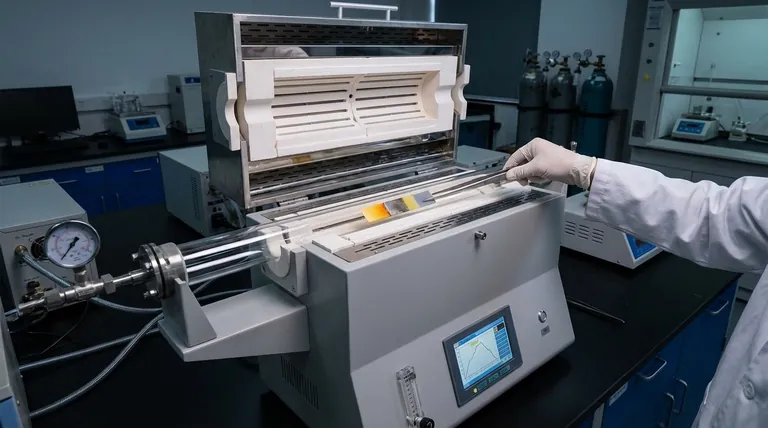
How does the positioning of the substrate within a tube furnace affect the in-situ growth of SnSe2 and SnSe?

The Mechanism of Phase Selection

Harnessing the Temperature Gradient

A tube furnace does not maintain a uniform temperature throughout its entire length.

There is a natural temperature gradient, typically ranging from 360 to 405 degrees Celsius in this context.

The specific position of the substrate determines the exact temperature it experiences within this range.

Controlling Local Vapor Concentration

Positioning dictates more than just surface temperature.

The location affects the local concentration ratio of the precursor vapors reaching the substrate surface.

As vapors travel away from the source, their density and mixing ratios evolve, creating distinct chemical environments at different distances.

Thermodynamic Stability and Phase Formation

The combination of local temperature and vapor concentration creates specific thermodynamic conditions.

These conditions dictate which crystalline phase is energetically favorable to form at that exact spot.

One position provides the stability required for the Selenium-rich phase (SnSe2), while a different position favors the Selenium-poor phase (SnSe).

Understanding the Trade-offs

High Sensitivity to Placement

The reliance on a spatial gradient means the process is extremely sensitive to physical positioning.

A deviation of just a few centimeters can drastically alter the temperature field the substrate experiences.

This can lead to unintentional mixed-phase growth if the substrate spans a transition zone between the two thermodynamic stability regions.

Calibration Complexity

Relying on the natural gradient requires precise mapping of your specific furnace.

The 360 to 405 degrees Celsius range is a general operating window, but the exact profile can vary between equipment.

You must empirically determine the exact "sweet spot" distances for pure phase growth in your specific hardware.

Making the Right Choice for Your Goal

To effectively utilize position-controlled growth, you must treat the furnace tube as a coordinate system where distance equals chemical composition.

  • If your primary focus is the Selenium-rich phase (SnSe2): Calibrate your substrate placement to find the specific zone in the gradient where thermodynamic stability supports high selenium incorporation.
  • If your primary focus is the Selenium-poor phase (SnSe): Shift the substrate to the distance where the temperature and concentration ratio suppress excess selenium, stabilizing the mono-selenide structure.

Mastering the spatial profile of your furnace allows you to dictate material properties simply by moving your sample.

Summary Table:

Factor Effect on Growth Phase Outcome
Temperature Zone Dictates thermal energy for reaction 360-405°C Gradient
Precursor Concentration Controls local vapor density/mixing ratio Se-rich vs. Se-poor
Spatial Positioning Acts as a thermodynamic selector switch Phase Stability Control
Distance from Source Influences chemical environment evolution Selective SnSe2 or SnSe

Elevate Your Material Synthesis with KINTEK

Precise phase control in SnSe2 and SnSe growth requires equipment with superior thermal stability and customizable zones. At KINTEK, we specialize in high-performance Tube, Muffle, Vacuum, and CVD systems designed to give you total control over your experimental gradients.

Whether you need a standard setup or a custom-engineered solution for your unique R&D needs, our expert manufacturing team is ready to support your breakthrough.

Ready to master your temperature profiles? Contact our specialists today to find the perfect furnace for your lab.

Visual Guide
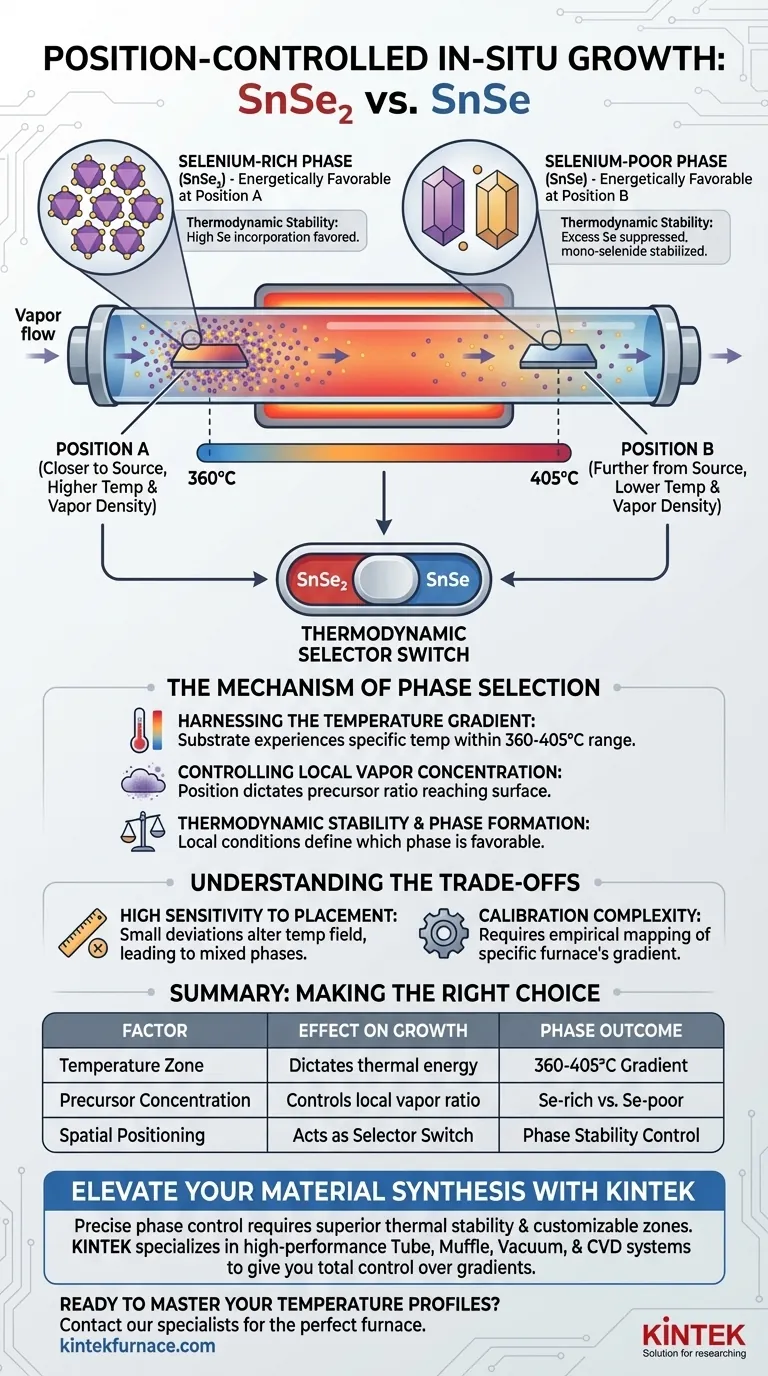
How does the positioning of the substrate within a tube furnace affect the in-situ growth of SnSe2 and SnSe? Visual Guide

References

  1. Manab Mandal, K. Sethupathi. In Situ Simultaneous Growth of Layered SnSe<sub>2</sub> and SnSe: a Linear Precursor Approach. DOI: 10.1002/admi.202500239

This article is also based on technical information from Kintek Furnace Knowledge Base .

Related Products

People Also Ask

Related Products

1700℃ High Temperature Laboratory Tube Furnace with Quartz or Alumina Tube

1700℃ High Temperature Laboratory Tube Furnace with Quartz or Alumina Tube

KINTEK's Tube Furnace with Alumina Tube: Precision heating up to 1700°C for material synthesis, CVD, and sintering. Compact, customizable, and vacuum-ready. Explore now!

1400℃ High Temperature Laboratory Tube Furnace with Quartz and Alumina Tube

1400℃ High Temperature Laboratory Tube Furnace with Quartz and Alumina Tube

KINTEK's Tube Furnace with Alumina Tube: Precision high-temperature processing up to 2000°C for labs. Ideal for material synthesis, CVD, and sintering. Customizable options available.

2200 ℃ Tungsten Vacuum Heat Treat and Sintering Furnace

2200 ℃ Tungsten Vacuum Heat Treat and Sintering Furnace

2200°C Tungsten Vacuum Furnace for high-temperature materials processing. Precise control, superior vacuum, customizable solutions. Ideal for research & industrial applications.

Vacuum Heat Treat Furnace with Ceramic Fiber Liner

Vacuum Heat Treat Furnace with Ceramic Fiber Liner

KINTEK's Vacuum Furnace with Ceramic Fiber Lining offers precise high-temperature processing up to 1700°C, ensuring uniform heat distribution and energy efficiency. Ideal for labs and production.

1200℃ Split Tube Furnace Laboratory Quartz Tube Furnace with Quartz Tube

1200℃ Split Tube Furnace Laboratory Quartz Tube Furnace with Quartz Tube

Discover KINTEK's 1200℃ Split Tube Furnace with quartz tube for precise high-temperature lab applications. Customizable, durable, and efficient. Get yours now!

1200℃ Controlled Inert Nitrogen Atmosphere Furnace

1200℃ Controlled Inert Nitrogen Atmosphere Furnace

KINTEK 1200℃ Controlled Atmosphere Furnace: Precision heating with gas control for labs. Ideal for sintering, annealing, and material research. Customizable sizes available.

Multi Heating Zones CVD Tube Furnace Machine for Chemical Vapor Deposition Equipment

Multi Heating Zones CVD Tube Furnace Machine for Chemical Vapor Deposition Equipment

KINTEK's Multi-Zone CVD Tube Furnaces offer precision temperature control for advanced thin film deposition. Ideal for research and production, customizable for your lab needs.

High Pressure Laboratory Vacuum Tube Furnace Quartz Tubular Furnace

High Pressure Laboratory Vacuum Tube Furnace Quartz Tubular Furnace

KINTEK High Pressure Tube Furnace: Precision heating up to 1100°C with 15Mpa pressure control. Ideal for sintering, crystal growth, and lab research. Customizable solutions available.

1400℃ Controlled Inert Nitrogen Atmosphere Furnace

1400℃ Controlled Inert Nitrogen Atmosphere Furnace

KT-14A Controlled Atmosphere Furnace for labs & industry. 1400°C max temp, vacuum sealing, inert gas control. Customizable solutions available.

Vacuum Heat Treat Sintering Furnace Molybdenum Wire Vacuum Sintering Furnace

Vacuum Heat Treat Sintering Furnace Molybdenum Wire Vacuum Sintering Furnace

KINTEK's Vacuum Molybdenum Wire Sintering Furnace excels in high-temperature, high-vacuum processes for sintering, annealing, and material research. Achieve precise 1700°C heating with uniform results. Custom solutions available.

2200 ℃ Graphite Vacuum Heat Treat Furnace

2200 ℃ Graphite Vacuum Heat Treat Furnace

2200℃ Graphite Vacuum Furnace for high-temperature sintering. Precise PID control, 6*10⁻³Pa vacuum, durable graphite heating. Ideal for research & production.

1700℃ Controlled Inert Nitrogen Atmosphere Furnace

1700℃ Controlled Inert Nitrogen Atmosphere Furnace

KT-17A Controlled Atmosphere Furnace: Precise 1700°C heating with vacuum & gas control. Ideal for sintering, research & material processing. Explore now!

Custom Made Versatile CVD Tube Furnace Chemical Vapor Deposition CVD Equipment Machine

Custom Made Versatile CVD Tube Furnace Chemical Vapor Deposition CVD Equipment Machine

KINTEK's CVD Tube Furnace offers precision temperature control up to 1600°C, ideal for thin film deposition. Customizable for research and industrial needs.

9MPa Air Pressure Vacuum Heat Treat and Sintering Furnace

9MPa Air Pressure Vacuum Heat Treat and Sintering Furnace

Achieve superior ceramic densification with KINTEK's advanced air pressure sintering furnace. High-pressure up to 9MPa, precise 2200℃ control.

Vertical Laboratory Quartz Tube Furnace Tubular Furnace

Vertical Laboratory Quartz Tube Furnace Tubular Furnace

Precision KINTEK Vertical Tube Furnace: 1800℃ heating, PID control, customizable for labs. Ideal for CVD, crystal growth & materials testing.

Magnesium Extraction and Purification Condensing Tube Furnace

Magnesium Extraction and Purification Condensing Tube Furnace

Magnesium purification tube furnace for high-purity metal production. Achieve ≤10Pa vacuum, dual-zone heating. Ideal for aerospace, electronics, and lab research.

Vacuum Heat Treat Sintering Furnace with Pressure for Vacuum Sintering

Vacuum Heat Treat Sintering Furnace with Pressure for Vacuum Sintering

KINTEK's Vacuum Pressure Sintering Furnace offers 2100℃ precision for ceramics, metals, and composites. Customizable, high-performance, and contamination-free. Get a quote now!

Vacuum Heat Treat Sintering and Brazing Furnace

Vacuum Heat Treat Sintering and Brazing Furnace

KINTEK Vacuum Brazing Furnaces deliver precision, clean joints with superior temperature control. Customizable for diverse metals, ideal for aerospace, medical, and thermal applications. Get a quote!

1400℃ Muffle Oven Furnace for Laboratory

1400℃ Muffle Oven Furnace for Laboratory

KT-14M Muffle Furnace: Precision 1400°C heating with SiC elements, PID control, and energy-efficient design. Ideal for labs.

600T Vacuum Induction Hot Press Vacuum Heat Treat and Sintering Furnace

600T Vacuum Induction Hot Press Vacuum Heat Treat and Sintering Furnace

600T Vacuum Induction Hot Press Furnace for precise sintering. Advanced 600T pressure, 2200°C heating, vacuum/atmosphere control. Ideal for research & production.


Leave Your Message



















