
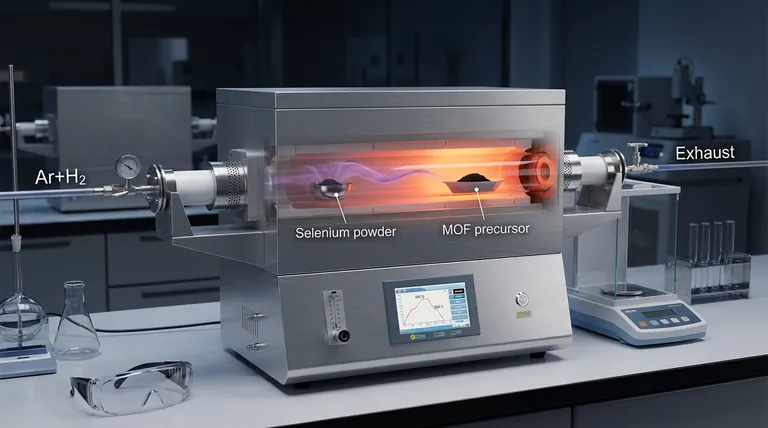
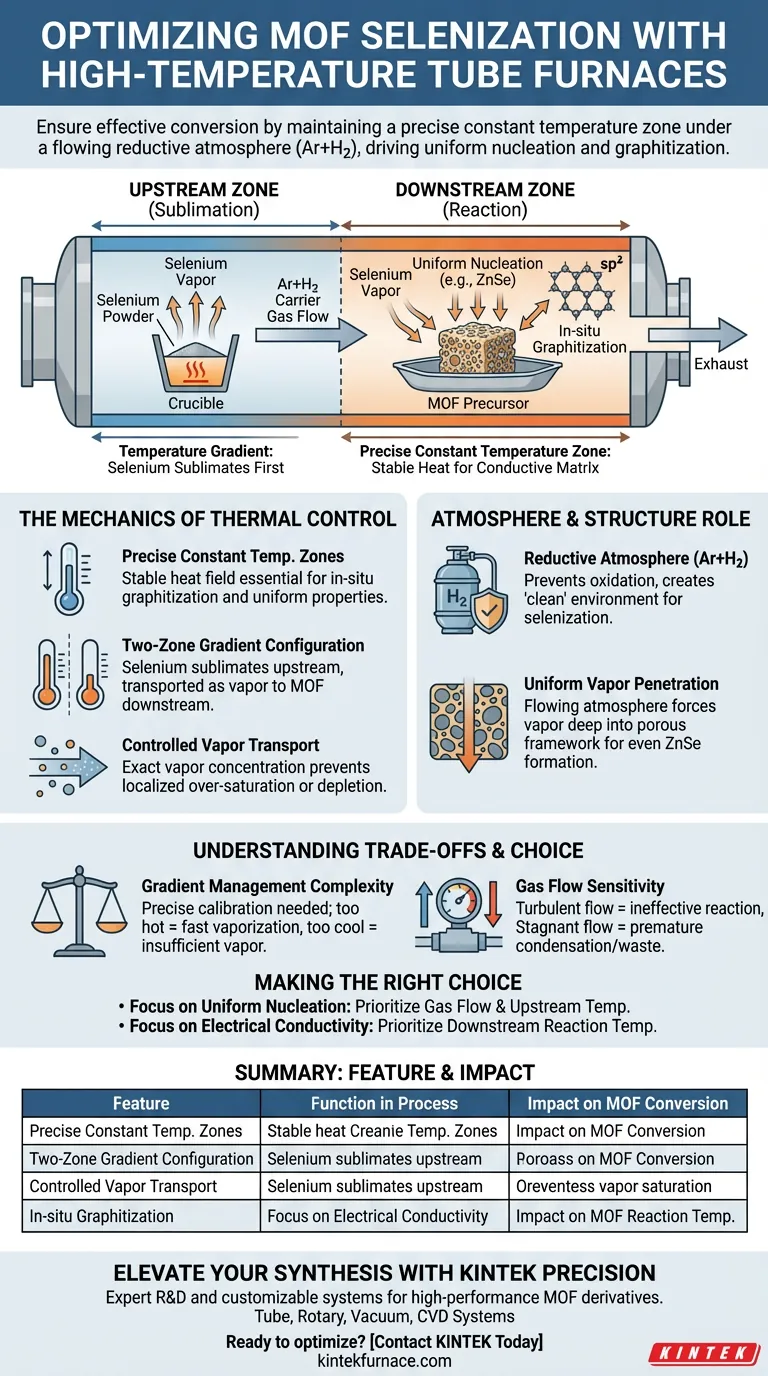
High-temperature tube furnaces ensure effective conversion by maintaining a precise constant temperature zone under a flowing reductive atmosphere, typically a mixture of Argon and Hydrogen (Ar+H2). This controlled thermal environment allows selenium vapor to penetrate the porous carbon framework of the MOF precursor uniformly, driving both the nucleation of metal-selenides (like ZnSe) and the graphitization of the carbon skeleton.
The high-temperature tube furnace acts as a precision reactor that synchronizes two critical processes: the transport of selenium vapor and the structural rearrangement of the MOF precursor. By managing thermal gradients and gas flow, it ensures the selenium reaches the reaction site at the exact concentration required for uniform synthesis.
The Mechanics of Thermal Control
Precise Constant Temperature Zones
The core advantage of this furnace type is its ability to maintain a highly stable heat field.
This stability is essential for the in-situ graphitization of the carbon skeleton.
Without this precise thermal control, the conversion of the organic framework into a conductive carbon matrix would be uneven, compromising the material's final electronic properties.
Two-Zone Gradient Configuration
For effective selenization, the furnace is often configured with two distinct temperature zones.
Selenium powder is placed in the upstream zone, while the MOF precursor sits in the downstream zone.
This gradient ensures the selenium sublimates first, transforming into vapor before it approaches the target material.
Controlled Vapor Transport
Once the selenium sublimates, the furnace utilizes gas flow to transport it to the reaction site.
The spatial arrangement ensures that selenium vapor reaches the MOF precursor at the correct concentration.
This allows for exact control over the degree of selenization on the nanoparticle surfaces, preventing localized over-saturation or depletion.
The Role of Atmosphere and Structure
Reductive Atmosphere Protection
The process typically occurs under a flowing mixture of Argon and Hydrogen (Ar+H2).
This reductive atmosphere serves two purposes: it prevents the oxidation of the metal components and assists in the chemical conversion process.
It effectively creates a "clean" environment where only the desired selenization reactions occur.
Uniform Vapor Penetration
The physical structure of MOFs is inherently porous.
The tube furnace's flowing atmosphere forces selenium vapor to penetrate deep into this porous carbon framework.
This deep penetration is the physical basis for achieving uniform nucleation, ensuring that ZnSe particles form evenly throughout the material rather than just on the surface.
Understanding the Trade-offs
Complexity of Gradient Management
While the two-zone setup is effective, it introduces operational complexity.
You must precisely calibrate the temperature difference between the upstream (sublimation) and downstream (reaction) zones.
If the upstream zone is too hot, selenium may vaporize too quickly; if it is too cool, insufficient vapor reaches the precursor.
Sensitivity to Gas Flow Rates
The transport of selenium vapor relies heavily on the flow rate of the carrier gas (Ar+H2).
If the flow is too turbulent, the vapor may pass the precursor without reacting effectively.
Conversely, if the flow is too stagnant, the selenium may condense prematurely in cooler parts of the tube, leading to material waste and inconsistent coating.
Making the Right Choice for Your Goal
To maximize the efficiency of your MOF selenization process, you must align the furnace parameters with your specific material requirements.
- If your primary focus is Uniform Nucleation: Prioritize the gas flow rate and upstream temperature to ensure a steady, consistent supply of selenium vapor reaches the porous framework without overwhelming it.
- If your primary focus is Electrical Conductivity: Focus on the downstream reaction temperature, ensuring it is high enough to drive deep deoxygenation and the formation of a highly ordered sp2 carbon lattice.
Successful conversion requires balancing the delivery of reactants with the thermal energy needed to lock them into the carbon structure.
Summary Table:
| Feature | Function in Selenization Process | Impact on MOF Conversion |
|---|---|---|
| Dual-Zone Control | Separates selenium sublimation from MOF reaction | Ensures steady vapor supply and prevents premature condensation |
| Constant Temperature Zone | Provides stable heat for in-situ graphitization | Creates a highly conductive carbon matrix with uniform properties |
| Ar+H2 Reductive Atmosphere | Prevents oxidation and assists chemical conversion | Maintains material purity and facilitates clean selenization reactions |
| Controlled Gas Flow | Transports selenium vapor into porous frameworks | Enables deep, uniform nucleation of metal-selenides throughout the structure |
Elevate Your Material Synthesis with KINTEK Precision
Achieving the perfect balance of vapor transport and thermal gradients is critical for high-performance MOF derivatives. Backed by expert R&D and world-class manufacturing, KINTEK offers specialized Tube, Rotary, Vacuum, and CVD systems designed to meet the rigorous demands of advanced selenization and carbonization processes.
Our lab high-temperature furnaces are fully customizable to your unique research needs, ensuring precise control over every variable of your synthesis.
Ready to optimize your lab's efficiency and material quality?
Contact KINTEK today to discuss your custom furnace solution!
Visual Guide
References
- Sainan Luo, Limin Wu. Enhancing Conversion Kinetics through Electron Density Dual‐Regulation of Catalysts and Sulfur toward Room‐/Subzero‐Temperature Na–S Batteries. DOI: 10.1002/advs.202308180
This article is also based on technical information from Kintek Furnace Knowledge Base .
Related Products
- 1400℃ High Temperature Laboratory Tube Furnace with Alumina Tube
- 1700℃ High Temperature Laboratory Tube Furnace with Alumina Tube
- 1200℃ Split Tube Furnace Laboratory Quartz Tube Furnace with Quartz Tube
- Vertical Laboratory Quartz Tube Furnace Tubular Furnace
- 1700℃ High Temperature Muffle Oven Furnace for Laboratory
People Also Ask
- How does zone-melting in tube furnaces synthesize bismuth micro-wires? Master Single-Crystal Thermoelectric Growth
- How are high-temp tube furnaces used to measure diffusion coefficients per Fick's law? Master Precision Annealing
- How are high-temperature laboratory tube furnaces applied in long-term vacuum homogenization heat treatments for intermetallic samples?
- How do high-temperature laboratory tube furnaces ensure environmental stability? Precision Thermal Reduction Tips
- How are high-temperature tube furnaces applied in testing ceramic-supported alloy membranes? Insights



















