
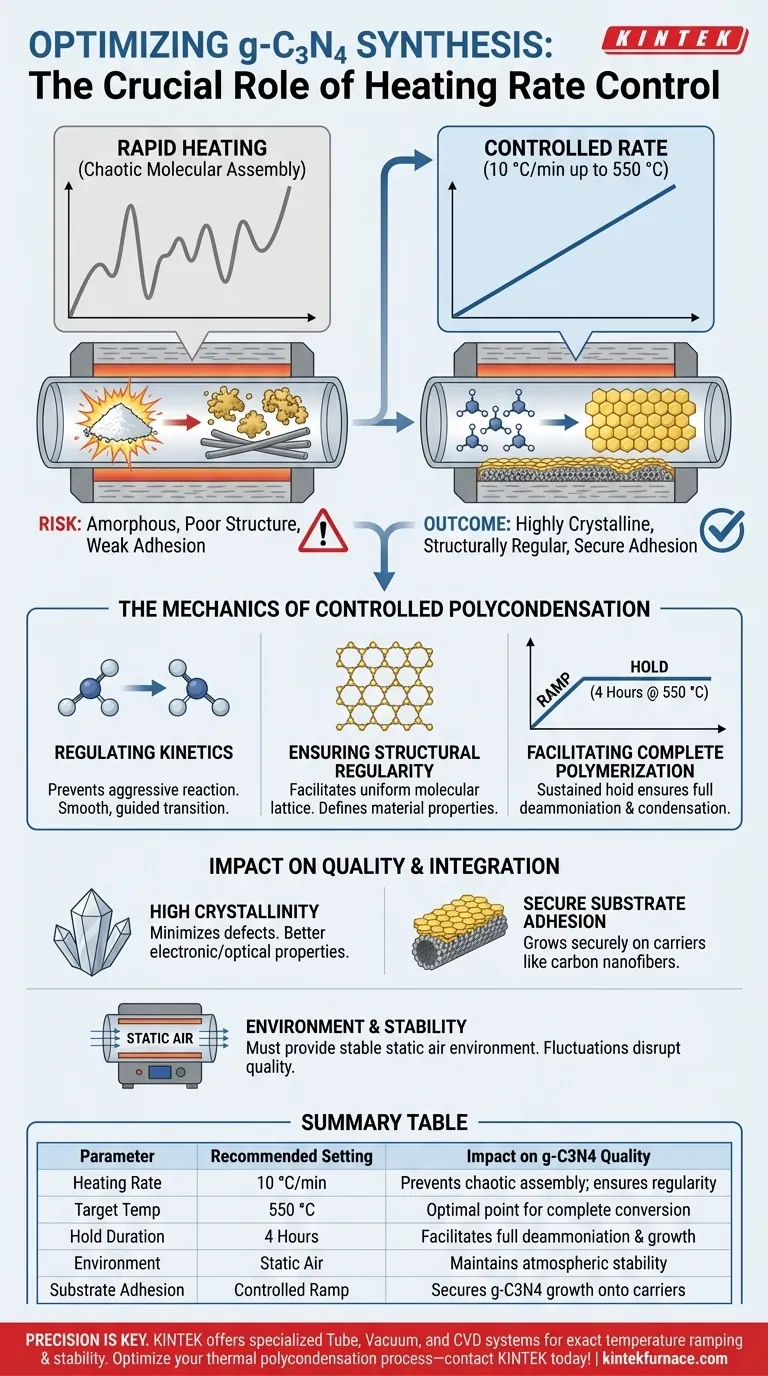
Controlling the heating rate is the decisive factor in guiding the smooth thermal polycondensation of melamine into graphitic carbon nitride (g-C3N4). A precise ramp, specifically 10 °C/min up to 550 °C, ensures the formation of a highly crystalline layer that is structurally regular and adheres securely to carrier substrates like carbon nanofibers.
Precise temperature ramping governs the kinetics of polymerization, preventing chaotic molecular assembly. This controlled approach yields a structurally ordered, two-dimensional carbon nitride framework that integrates robustly with underlying surfaces.
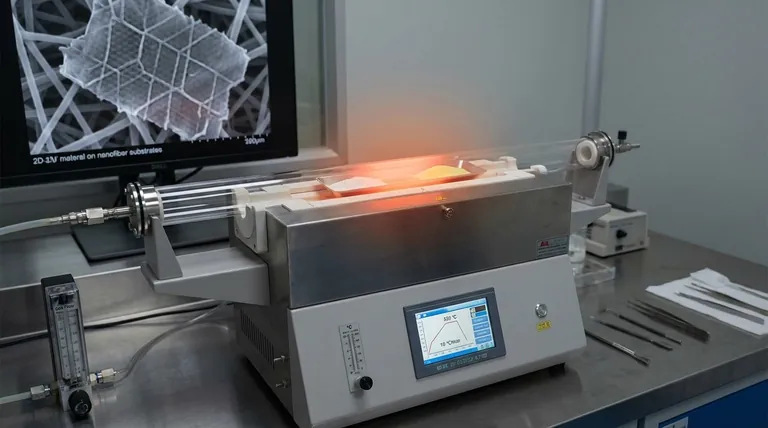
The Mechanics of Controlled Polycondensation
Regulating Reaction Kinetics
The transformation of melamine into g-C3N4 involves a complex series of chemical reactions, including deammoniation and condensation.
By strictly limiting the heating rate to 10 °C/min, you prevent the reaction from proceeding too aggressively.
This accurate control allows the melamine molecules to undergo a smooth, guided transition rather than a chaotic thermal shock.
Ensuring Structural Regularity
A stable heating ramp is essential for creating a uniform molecular lattice.
When the furnace temperature increases steadily, it facilitates the formation of a structurally regular g-C3N4 layer.
This regularity is defined by the material's two-dimensional layered structure, which is critical for its final properties.
Facilitating Complete Polymerization
The process requires not just reaching a target temperature, but arriving there in a way that supports the entire reaction cycle.
Once the target of 550 °C is reached, a holding duration (typically 4 hours) ensures the completion of the condensation reactions.
This combination of a controlled ramp and a sustained hold allows for the full development of the carbon nitride framework.
Impact on Material Quality and Integration
Achieving High Crystallinity
The crystallinity of the final product is directly tied to the precision of the thermal treatment.
Accurate temperature control minimizes defects in the crystal lattice, resulting in a highly crystalline material.
Higher crystallinity typically correlates with better electronic and optical properties in the final semiconductor material.
Securing Substrate Adhesion
One of the most critical aspects of rate control is its effect on how g-C3N4 grows on a support structure.
The primary reference indicates that a controlled rate ensures the g-C3N4 layer grows securely on the surface of carbon nanofiber carriers.
Without this "smooth" polycondensation, the coating may be uneven or fail to adhere properly to the nanofibers.
Understanding the Trade-offs
The Risk of Rapid Heating
While faster heating rates might seem efficient, they jeopardize the integrity of the synthesis.
Deviating from a controlled rate like 10 °C/min can disrupt the "smoothness" of the polycondensation, likely leading to amorphous or poorly organized structures.
If the reaction kinetics are too fast, the material may fail to form the necessary ordered, layered structure.
The Necessity of Environmental Stability
Heating rate cannot be viewed in isolation; it depends on the furnace environment.
As noted in the supplementary data, the furnace must provide a stable static air environment.
Even a perfect heating rate will fail to produce high-quality g-C3N4 if the atmospheric conditions fluctuate or if the hold time is insufficient for complete deammoniation.
Optimizing Your Synthesis Protocol
To ensure reproducibility and high material quality in your g-C3N4 synthesis, consider the following based on your specific objectives:
- If your primary focus is Structural Integrity: Adhere strictly to a 10 °C/min ramp to maximize crystallinity and ensure a regular 2D layered structure.
- If your primary focus is Composite Fabrication: Use the controlled heating rate to guarantee the secure, uniform growth of g-C3N4 onto carriers like carbon nanofibers.
Mastering the heating ramp is the difference between a loose, amorphous powder and a high-performance, crystalline semiconductor.
Summary Table:
| Parameter | Recommended Setting | Impact on g-C3N4 Quality |
|---|---|---|
| Heating Rate | 10 °C/min | Prevents chaotic assembly; ensures structural regularity |
| Target Temperature | 550 °C | Optimal point for complete melamine-to-nitride conversion |
| Hold Duration | 4 Hours | Facilitates full deammoniation and crystal growth |
| Environment | Static Air | Maintains atmospheric stability for uniform polymerization |
| Substrate Adhesion | Controlled Ramp | Secures g-C3N4 growth onto carriers like carbon nanofibers |
Precision is the key to high-performance graphitic carbon nitride synthesis. Backed by expert R&D and manufacturing, KINTEK offers specialized Tube, Vacuum, and CVD systems designed for the exact temperature ramping and stability your research demands. Whether you need a standard setup or a customizable high-temp furnace for unique material applications, our systems ensure superior crystallinity and structural integrity. Optimize your thermal polycondensation process—contact KINTEK today!
Visual Guide
References
- Jingjing Liu, Lu Gan. Metal-Free Cellulose Carbon Nanofiber Supported Graphitic Carbon Nitride for High-Efficient BPA Degradation by Photcatalytic Peroxymonosulfate Activation. DOI: 10.3390/catal15080788
This article is also based on technical information from Kintek Furnace Knowledge Base .
Related Products
- Vacuum Sealed Continuous Working Rotary Tube Furnace Rotating Tube Furnace
- 1400℃ High Temperature Laboratory Tube Furnace with Alumina Tube
- 1700℃ High Temperature Laboratory Tube Furnace with Alumina Tube
- Magnesium Extraction and Purification Condensing Tube Furnace
- High Pressure Laboratory Vacuum Tube Furnace
People Also Ask
- What is the purpose of rotary tube furnaces? Achieve Uniform Heat Treatment for Powders and Granules
- What are the key advantages of using a rotary tube furnace? Achieve Dynamic, Uniform Heating for Powders
- What are the advantages of rotary tube furnaces in fuel compatibility? Boost Efficiency and Cut Costs
- How does the amount of material processed vary between batch and continuous rotary tube furnaces? Scale Your Production Efficiently
- What is the temperature range of some rotary tube furnaces? Achieve Uniform Heating Up to 1200°C



















