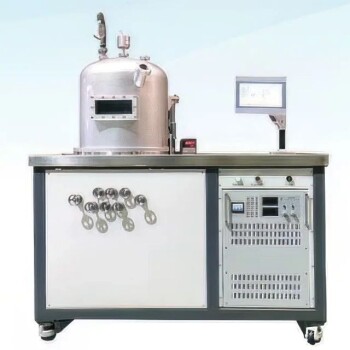
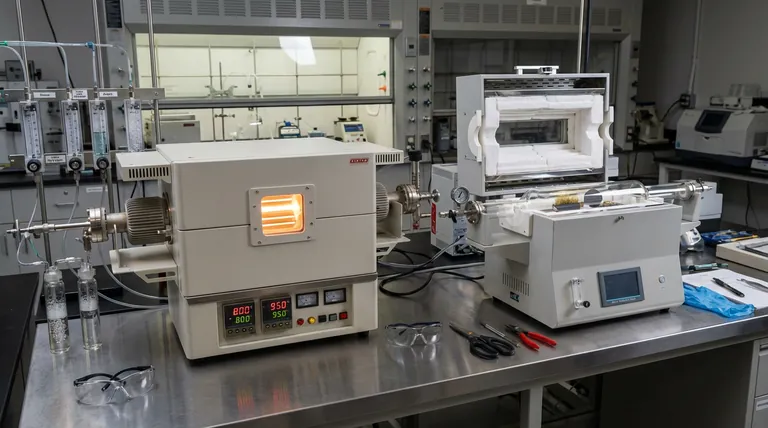
The tube furnace serves as the thermal reactor necessary to trigger and sustain the chemical kinetics of silicon nanowire (SiNW) growth. It provides a precisely controlled high-temperature environment, typically between 300°C and 1000°C, which is required to decompose gaseous precursors like silane and drive the Vapor-Liquid-Solid (VLS) synthesis mechanism.
Core Takeaway The tube furnace functions as a precise environmental chamber that synchronizes high temperatures with gas flow. Its primary role in Chemical Vapor Deposition (CVD) is to maintain a stable thermal field that forces silicon atoms to saturate catalyst droplets and precipitate in a single direction, thereby creating the one-dimensional nanowire structure.
The Mechanism of Synthesis
Enabling Precursor Decomposition
For silicon nanowires to form, the source material must first be released from its gaseous state. The tube furnace heats the reaction chamber to specific temperatures (300°C–1000°C) to break down gaseous precursors, such as silane. This thermal decomposition liberates silicon atoms, making them available for the growth process.
Facilitating the VLS Mechanism
The defining role of the furnace in this application is supporting the Vapor-Liquid-Solid (VLS) mechanism. The furnace maintains the exact temperature required to keep catalyst particles (often gold) in a liquid or semi-liquid state. This allows the liberated silicon atoms to diffuse into the catalyst droplets until they reach saturation.
Driving Anisotropic Growth
Once the catalyst droplet is saturated with silicon, the furnace's stable thermal environment forces the silicon to precipitate out of the droplet. Crucially, this precipitation happens anisotropically (in a specific direction). This controlled precipitation at the solid-liquid interface is what builds the silicon crystal structure upwards, forming a one-dimensional nanowire rather than a thin film.
The Physical Environment
Creating a Stable Temperature Field
Success in CVD synthesis relies on thermal uniformity. The tube furnace, utilizing a quartz or ceramic tube, establishes a stable temperature field around the substrates. Fluctuations in this field can disrupt the saturation levels of the catalyst droplets, leading to structural defects or the cessation of nanowire growth.
Atmospheric Isolation
While the primary reaction is thermal, the tube furnace also acts as a sealed vessel. It isolates the reaction from the ambient environment, allowing only specific carrier gases and precursors to flow over the substrate. This isolation prevents contamination that could poison the catalyst or oxidize the silicon prematurely.
Understanding the Trade-offs
The Risk of Thermal Gradients
While tube furnaces provide high heat, horizontal models can sometimes exhibit thermal gradients (temperature differences) along the length of the tube. In nanowire synthesis, if the substrate is placed outside the "flat zone" (the area of perfectly uniform temperature), the VLS mechanism may fail, resulting in inconsistent wire diameters or lengths.
Batch Process Limitations
Standard horizontal tube furnaces operate on a batch logic: load, ramp up, process, and cool down. As noted in the standard operating procedures, the furnace must often cool down significantly before samples can be removed. This ensures safety and sample integrity but limits throughput compared to continuous industrial processes.
Making the Right Choice for Your Goal
Depending on your specific requirements for silicon nanowire production, consider the following:
- If your primary focus is Growth Quality: Prioritize a furnace with a verified "flat zone" length that exceeds the size of your substrate to ensure uniform VLS activity across the entire wafer.
- If your primary focus is Diameter Control: Ensure your furnace allows for rapid, precise temperature adjustments; slight variations in temperature can alter the catalyst droplet size and, consequently, the nanowire diameter.
- If your primary focus is Device Reliability: Consider using the furnace for post-synthesis oxidation (at 500°C or 850°C) to create a passivation layer that reduces interface trap density.
The tube furnace is the critical instrument that translates raw chemical potential into structured nanomaterials through precise thermal regulation.
Summary Table:
| Feature | Role in SiNW Synthesis | Impact on Quality |
|---|---|---|
| Thermal Range | 300°C – 1000°C | Triggers silane decomposition and VLS mechanism |
| Temperature Field | Stable Thermal Uniformity | Prevents structural defects and ensures consistent wire diameter |
| Atmospheric Control | Sealed Isolation | Prevents catalyst poisoning and premature silicon oxidation |
| Flat Zone | Homogeneous Reaction Area | Ensures uniform growth across the entire substrate surface |
Elevate Your Nanomaterial Research with KINTEK
Precision is the heartbeat of nanotechnology. Backed by expert R&D and world-class manufacturing, KINTEK provides high-performance Tube, Muffle, Rotary, Vacuum, and CVD systems designed to meet the rigorous demands of silicon nanowire synthesis. Whether you require a verified 'flat zone' for growth uniformity or customizable configurations for unique chemical kinetics, our lab high-temp furnaces deliver the stability your research deserves.
Ready to optimize your CVD process? Contact us today to discuss your specific needs with our technical specialists.
References
- Xinyu Chen, Lin Zeng. Advancing high‐performance one‐dimensional Si/carbon anodes: Current status and challenges. DOI: 10.1002/cnl2.118
This article is also based on technical information from Kintek Furnace Knowledge Base .
Related Products
- Split Chamber CVD Tube Furnace with Vacuum Station CVD Machine
- Custom Made Versatile CVD Tube Furnace Chemical Vapor Deposition CVD Equipment Machine
- Multi Heating Zones CVD Tube Furnace Machine for Chemical Vapor Deposition Equipment
- Slide PECVD Tube Furnace with Liquid Gasifier PECVD Machine
- Inclined Rotary Plasma Enhanced Chemical Deposition PECVD Tube Furnace Machine
People Also Ask
- What role does a Tube Furnace play in the CVD growth of carbon nanotubes? Achieve High-Purity CNT Synthesis
- How does a CVD tube furnace achieve high purity in gate media preparation? Master Precision Control for Flawless Films
- What are the advantages of using a CVD tube furnace for preparing gate dielectrics? Achieve High-Quality Thin Films for Transistors
- What are the operational and maintenance requirements for a CVD tube furnace? Ensure Precision for Thin Film Deposition
- What future trends are expected in the development of CVD tube furnaces? Discover Smarter, More Versatile Systems