
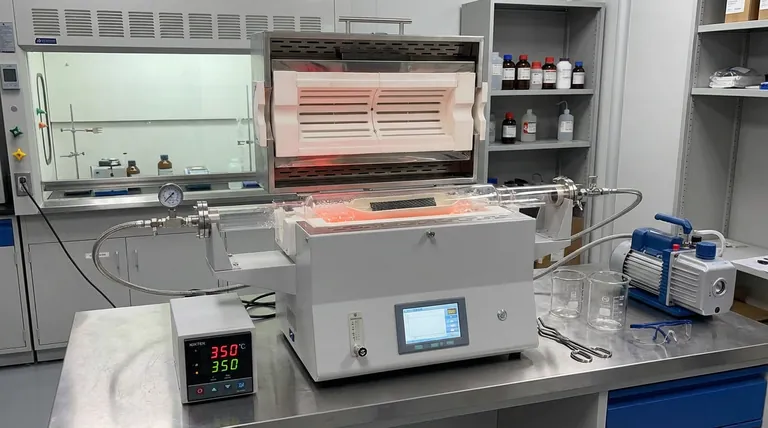
The electric tubular furnace serves as the precise thermal control vessel for the chemical recycling of Carbon Fiber Reinforced Polymer (CFRP). Its primary function is to create and maintain a stable, high-temperature environment that allows alkali metal hydroxides to dissolve the resin matrix surrounding the carbon fibers. By providing a uniform thermal field, the furnace ensures the reaction proceeds efficiently without damaging the valuable fibers inside.
The success of carbon fiber recovery relies on selective decomposition. The electric tubular furnace enables this by maintaining a specific thermal window that liquefies salts to break down the resin matrix while preserving the mechanical properties of the carbon fiber.
The Critical Role of Thermal Precision
The recovery process using alkali metal molten hydroxides is chemically aggressive and temperature-sensitive. The electric tubular furnace manages the physical conditions required for this reaction to occur.
Pre-preparation of Molten Salts
Before the recovery reaction begins, the furnace is responsible for the phase change of the chemical agents.
It heats the mixture of alkali metal hydroxides—specifically NaOH and KOH—until they transition from solid to liquid. This creates the molten salt bath necessary to penetrate the composite material.
Maintaining Reaction Stability
Once the salts are molten, the furnace must maintain a rigorous temperature profile.
The system keeps the environment at a constant temperature, strictly between 200 and 400 degrees Celsius. This specific range is vital for sustaining the reaction kinetics required to degrade the polymer matrix.
Balancing Decomposition and Preservation
The deep value of the electric tubular furnace lies in its ability to balance two competing goals: destroying the resin and saving the fiber.
Ensuring Complete Resin Decomposition
The furnace provides a uniform thermal field distribution across the tube-shaped cavity.
This uniformity ensures that the CFRP material is heated evenly, preventing "cold spots" where resin might remain attached to the fiber. Complete removal of the resin matrix is essential for producing clean, reusable carbon fiber.
Protecting Fiber Integrity
Carbon fibers are resilient, but they are not immune to thermal or chemical degradation if conditions become too extreme.
By utilizing a precise temperature control system, the furnace prevents thermal spikes that could damage the mechanical properties of the fibers. This control preserves the tensile strength and modulus of the recovered material, making it viable for reuse.
Understanding the Trade-offs
While the electric tubular furnace is effective, the process requires careful management of operational variables.
The Temperature Window
Operating at the lower end of the 200-400°C range protects the fiber but may result in slower or incomplete resin removal.
Conversely, operating at the higher end accelerates decomposition but increases the risk of damaging the carbon fiber surface. The furnace's precision is the only safeguard against these extremes.
Uniformity vs. Throughput
The tube-shaped cavity offers excellent thermal uniformity, which is high priority for quality.
However, the physical geometry of a tubular furnace can limit the volume of material processed at one time compared to other industrial heating methods.
Making the Right Choice for Your Process
Optimizing the use of an electric tubular furnace depends on your specific recovery goals.
- If your primary focus is Fiber Quality: Prioritize the precision of the temperature control system to ensure the heat remains stable near the lower effective limit, minimizing thermal stress on the fibers.
- If your primary focus is Process Efficiency: Focus on the furnace's ability to maintain uniform heat distribution at the higher end of the temperature spectrum (closer to 400°C) to accelerate the breakdown of the resin matrix.
By leveraging the precise thermal control of the electric tubular furnace, you turn a hazardous waste product into a valuable material resource.
Summary Table:
| Feature | Role in Carbon Fiber Recovery | Benefit |
|---|---|---|
| Temperature Range | Maintains stable 200°C - 400°C window | Ensures efficient resin decomposition without fiber damage |
| Thermal Field | Uniform distribution within tube cavity | Prevents cold spots for complete resin removal |
| Phase Control | Heats NaOH/KOH to liquid state | Creates the necessary molten salt bath for penetration |
| Process Stability | Precise kinetic control | Preserves mechanical properties (tensile strength) of fibers |
Elevate Your CFRP Recycling Efficiency with KINTEK
Recover high-value carbon fibers with the precision they demand. Backed by expert R&D and manufacturing, KINTEK offers high-performance Tubular, Muffle, Rotary, Vacuum, and CVD systems—all fully customizable to meet your specific thermal processing needs. Whether you are optimizing resin decomposition or preserving fiber integrity, our lab high-temp furnaces provide the uniform thermal field and rigorous control essential for success.
Ready to transform your recovery process? Contact KINTEK today to discuss your custom solution.
Visual Guide

References
- Takaaki Wajima, K. Yamashita. Recovery of carbon fiber from carbon fiber reinforced plastics using alkali molten hydroxide. DOI: 10.1038/s41598-024-84293-4
This article is also based on technical information from Kintek Furnace Knowledge Base .
Related Products
- Vertical Laboratory Quartz Tube Furnace Tubular Furnace
- Laboratory Quartz Tube Furnace RTP Heating Tubular Furnace
- High Pressure Laboratory Vacuum Tube Furnace
- Multi Zone Laboratory Quartz Tube Furnace Tubular Furnace
- Electric Rotary Kiln Continuous Working Small Rotary Furnace Kiln for Pyrolysis Plant Heating
People Also Ask
- What are the key differences between single-zone and multi-zone vertical tube furnaces? Choose the Right Furnace for Your Lab
- What is a vertical tube furnace and how does it function? Optimize Material Processing with Precision
- What is the purpose of using an industrial-grade vertical tube furnace in phosphorus recovery? High-Fidelity Simulation
- How do heat treatment processes influence the configuration of a vertical tube furnace? Optimize for Quenching, Annealing, and More
- What physical conditions does a vertical tube furnace provide for desulfurization experiments? Precision Heat Control



















