
A PID programmable controller delivers precise thermal management by utilizing auto-tuning algorithms to regulate the power output of heating elements, such as iron-chromium-aluminum alloy wires. It enables complex, multi-segment temperature profiles—defining specific heating rates, dwell times, and cooling curves—which are critical for simulating industrial combustion environments and ensuring accurate thermal decomposition studies.
Core Takeaway The true value of a PID controller in a tube furnace is the transition from simple on/off heating to dynamic, feedback-driven regulation. By continuously adjusting power output to eliminate fluctuations, it guarantees the precise thermodynamic conditions necessary for reproducible pyrolysis and material analysis.
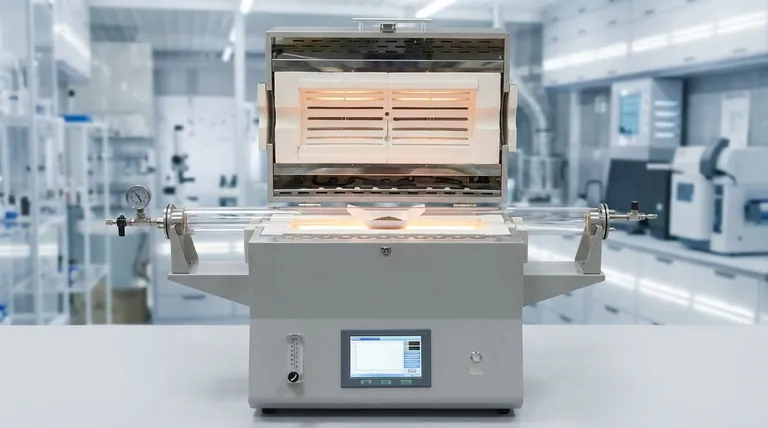
Achieving Precision via Dynamic Control
The Role of Auto-Tuning and Feedback
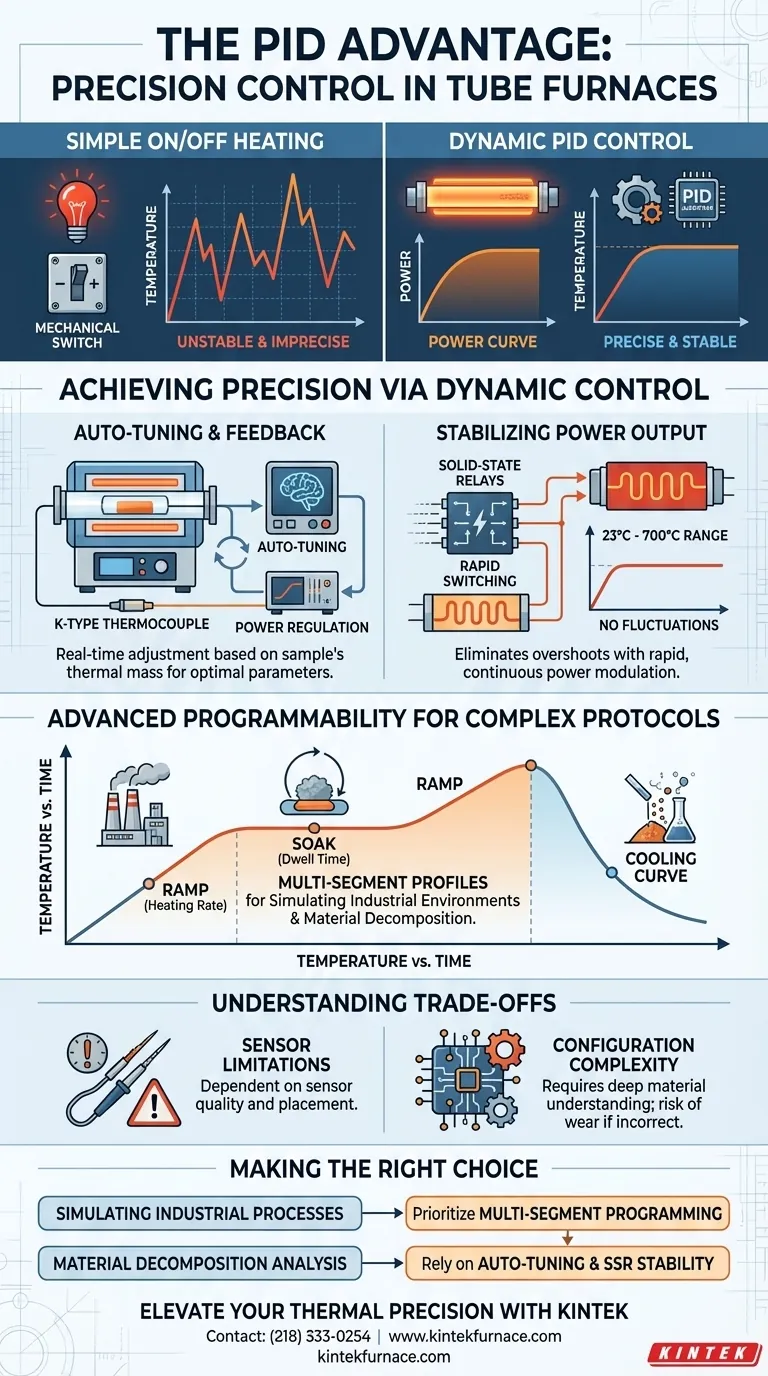
The foundation of this technology is the auto-tuning function. This feature automatically calculates the optimal control parameters required to regulate the power output of the heating elements.
By monitoring real-time feedback from a K-type thermocouple located inside the heater, the controller adjusts the system to match the specific thermal mass of your sample.
Stabilizing Power Output
Unlike basic thermostats that cycle power fully on or off, a PID algorithm uses solid-state relays to modulate power dynamically.
This rapid adjustment eliminates the temperature overshoots and fluctuations common in simpler systems. It ensures stable setpoints across a wide range, typically from 23°C to 700°C, maintaining the integrity of the thermal environment.
Advanced Programmability for Complex Protocols
Multi-Segment Temperature Profiles
For advanced research, maintaining a single temperature is often insufficient. PID controllers in these modules support multi-segment programs.
You can program specific heating rates (ramp), precise dwell times (soak), and controlled cooling curves. This capability allows you to replicate exact thermal histories rather than just reaching a peak temperature.
Simulating Industrial Environments
This programmability is essential for simulating industrial combustion environments.
By controlling the exact rate of temperature change, researchers can study the thermal decomposition characteristics of materials under realistic conditions. This is particularly vital for experiments involving the pyrolysis of materials in specific combustion modes.
Understanding the Trade-offs
Sensor Limitations and Thermal Lag
While PID algorithms are highly accurate, they are dependent on the quality of their input data. The system relies on a K-type thermocouple; if this sensor is poorly positioned or degraded, the controller’s precision is compromised regardless of the algorithm's quality.
Complexity of Configuration
The flexibility of multi-segment programming introduces complexity. Designing an effective thermal profile requires a deep understanding of the material's properties. Incorrectly setting ramp rates that exceed the physical capabilities of the iron-chromium-aluminum alloy wires can lead to system wear or inaccurate test data.
Making the Right Choice for Your Experiment
To maximize the utility of a PID-controlled tube furnace, align the controller's features with your specific research goals:
- If your primary focus is Simulating Industrial Processes: Prioritize the multi-segment programming features to replicate exact heating rates and cooling curves found in large-scale combustion.
- If your primary focus is Material Decomposition Analysis: Rely on the auto-tuning and solid-state relay integration to ensure the stable, fluctuation-free temperatures required for precise pyrolysis data.
By leveraging these programmable features, you transform a standard heating element into a high-precision instrument capable of rigorous thermodynamic verification.
Summary Table:
| Feature | Technical Advantage | Research Benefit |
|---|---|---|
| Auto-Tuning | Automatically calculates optimal control parameters | Eliminates temperature overshoots and manual calibration |
| Multi-Segment Programming | Defines specific ramp rates, dwell times, and cooling curves | Enables simulation of complex industrial combustion environments |
| Solid-State Relays | Rapid, dynamic modulation of power output | Ensures high stability across a 23°C to 700°C range |
| Feedback Loop | Real-time monitoring via K-type thermocouples | Guarantees reproducible pyrolysis and decomposition data |
Elevate Your Thermal Precision with KINTEK
Maximize your research accuracy with advanced PID-controlled systems tailored for complex thermal profiles. Backed by expert R&D and manufacturing, KINTEK offers high-performance Muffle, Tube, Rotary, Vacuum, and CVD systems, all fully customizable to meet your unique laboratory needs. Whether you are simulating industrial environments or conducting precise material analysis, our high-temp furnaces provide the stability and control you demand.
Ready to optimize your lab's efficiency? Contact KINTEK today to discuss your custom furnace solution!
Visual Guide
References
- Beata Brzychczyk, L. J. Sikora. Modernization of a Tube Furnace as Part of Zero-Waste Practice. DOI: 10.3390/su17198940
This article is also based on technical information from Kintek Furnace Knowledge Base .
Related Products
- Vacuum Sealed Continuous Working Rotary Tube Furnace Rotating Tube Furnace
- 1400℃ High Temperature Laboratory Tube Furnace with Alumina Tube
- 1700℃ High Temperature Laboratory Tube Furnace with Alumina Tube
- Magnesium Extraction and Purification Condensing Tube Furnace
- High Pressure Laboratory Vacuum Tube Furnace
People Also Ask
- What is the purpose of rotary tube furnaces? Achieve Uniform Heat Treatment for Powders and Granules
- What are the key advantages of using a rotary tube furnace? Achieve Dynamic, Uniform Heating for Powders
- How does the amount of material processed vary between batch and continuous rotary tube furnaces? Scale Your Production Efficiently
- What are the advantages of rotary tube furnaces in fuel compatibility? Boost Efficiency and Cut Costs
- What is the temperature range of some rotary tube furnaces? Achieve Uniform Heating Up to 1200°C



















