
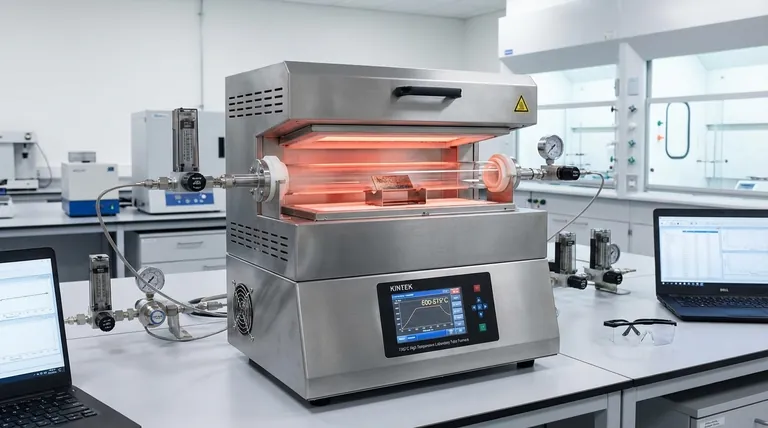
A laboratory horizontal tube furnace creates a controlled environment by nesting a gas-tight quartz reaction tube within a robust alumina inner tube. This physical separation, combined with precise gas flow systems, isolates the sample to ensure that corrosion occurs under strictly regulated atmospheric and thermal conditions.
Core Takeaway The system achieves reliability by physically decoupling the reaction chamber from the heating elements using a sealed quartz vessel. This allows researchers to introduce specific reactive gases while maintaining isothermal stability, ensuring that corrosion data reflects true chemical kinetics rather than environmental fluctuations or ambient leaks.
The Physical Architecture of Isolation
The Dual-Tube Configuration
The foundation of the controlled environment is a "tube-within-a-tube" design. A gas-tight quartz reaction tube is inserted into a structural alumina inner tube. This creates a sealed chamber that physically separates the experimental samples from the furnace's heating elements and external insulation.
Chemical Inertness and Protection
The outer alumina lining provides essential protection for the equipment. Its chemical inertness and high thermal shock resistance prevent the furnace body from being damaged by acidic byproducts, such as HCl or SO2, which may generate during high-temperature corrosion or combustion simulations.
Atmospheric Precision
Managing Gas Flow and Composition
Dedicated gas inlets and outlets allow for the precise regulation of the reaction atmosphere. Operators can manipulate gas flow rates to switch seamlessley between environments, such as transitioning from inert nitrogen to compressed air.
Simulating Complex Environments
This sealed configuration enables the simulation of specific industrial conditions, such as fire-side boiler corrosion. By introducing specific ratios of gases like CO and H2S, researchers can replicate high-temperature reducing atmospheres found in low-nitrogen combustion zones.
Thermal Stability and Uniformity
Isothermal Exposure
For valid corrosion data, samples must undergo isothermal exposure, typically in the range of 500 to 575 °C. The furnace maintains this constant temperature to ensure that thermodynamic equilibrium reactions, such as the formation of metal chlorides, occur predictably.
Precision Control Systems
To achieve this stability, modern furnaces utilize PID (Proportional-Integral-Derivative) control algorithms. These systems allow for self-tuning and fuzzy control, regulating heating power to maintain temperature stability within ±1℃ and field uniformity within ±5℃.
Eliminating Cold Spots
Heating elements are arranged specifically around the tube container to ensure uniform temperature distribution. This prevents thermal gradients across the sample surface, which is critical for accurate annealing, sintering, and determining corrosion kinetics.
Understanding the Trade-offs
Material Limitations of Quartz
While the quartz reaction tube offers a superior gas seal, it has lower thermal limits than high-purity alumina ceramics. Operating near the upper limits of quartz's thermal resistance can risk deformation, especially if the experiment requires vacuum or high pressure.
The "Zone" Restriction
Horizontal tube furnaces do not have uniform temperature across the entire length of the tube. The isothermal zone—where the temperature is truly stable—is typically located only in the center. Placing samples outside this specific zone will result in inaccurate data due to thermal drop-off near the tube ends.
Making the Right Choice for Your Experiment
- If your primary focus is corrosion kinetics: Prioritize a furnace with advanced PID control to ensure the temperature stability (±1℃) required for precise reaction rate analysis.
- If your primary focus is aggressive acidic atmospheres: Ensure your setup relies on the alumina inner lining's chemical inertness to protect the furnace body from corrosive gases like HCl.
- If your primary focus is deep thermal decomposition: Utilize the gas-tight quartz seal to maintain a strictly oxygen-free environment to prevent unwanted oxidation during pyrolysis.
By isolating the atmosphere and locking in the temperature, you transform variable conditions into exact, reproducible data points.
Summary Table:
| Feature | Implementation | Benefit for Corrosion Experiments |
|---|---|---|
| Atmospheric Isolation | Gas-tight quartz reaction tube | Prevents leaks; ensures pure reactive gas concentration. |
| Equipment Protection | Alumina inner lining | Protects furnace body from acidic gases like HCl or SO2. |
| Thermal Precision | PID control algorithms | Maintains stability within ±1℃ for accurate kinetic data. |
| Atmosphere Control | Dedicated inlets/outlets | Enables seamless switching between inert and reactive gases. |
| Thermal Uniformity | Strategic heating arrangement | Prevents cold spots; ensures isothermal sample exposure. |
Elevate Your Research Precision with KINTEK
Don't let environmental fluctuations compromise your corrosion data. Backed by expert R&D and manufacturing, KINTEK offers Muffle, Tube, Rotary, Vacuum, and CVD systems designed for the rigorous demands of material science. Our laboratory high-temp furnaces are fully customizable to meet your unique atmospheric and thermal requirements, ensuring isothermal stability and chemical resistance.
Ready to optimize your high-temperature experiments? Contact our technical experts today to find the perfect furnace solution for your lab.
Visual Guide

References
- Jan-Erik Eriksson, Juho Lehmusto. Comparison of Laboratory-Scale Methods for Assessing Deposit-Induced Corrosion of Boiler Materials in Biomass Combustion and Recovery Boilers. DOI: 10.1007/s11085-025-10339-1
This article is also based on technical information from Kintek Furnace Knowledge Base .
Related Products
- 1400℃ High Temperature Laboratory Tube Furnace with Alumina Tube
- 1700℃ High Temperature Laboratory Tube Furnace with Alumina Tube
- Laboratory Quartz Tube Furnace RTP Heating Tubular Furnace
- 1200℃ Split Tube Furnace Laboratory Quartz Tube Furnace with Quartz Tube
- Vertical Laboratory Quartz Tube Furnace Tubular Furnace
People Also Ask
- How does zone-melting in tube furnaces synthesize bismuth micro-wires? Master Single-Crystal Thermoelectric Growth
- How do high-temperature laboratory tube furnaces ensure environmental stability? Precision Thermal Reduction Tips
- How are high-temp tube furnaces used to measure diffusion coefficients per Fick's law? Master Precision Annealing
- How are high-temperature laboratory tube furnaces applied in long-term vacuum homogenization heat treatments for intermetallic samples?
- How are high-temperature tube furnaces applied in testing ceramic-supported alloy membranes? Insights



















