
Precision temperature control is the absolute prerequisite for annealing platinum-decorated ruthenium catalysts because the physical arrangement of platinum atoms is dictated by exact thermal energy thresholds. A high-precision tube furnace is required to provide a stable thermal environment that drives specific surface diffusion processes without the interference of temperature drift.
The morphology of platinum on a ruthenium surface changes distinctively at specific temperature points. Without a high-precision control system to maintain these exact setpoints, you cannot reliably trigger the formation of thermodynamically stable structures like Pt-strings.

The Physics of Surface Diffusion
Thermal Energy as a Switch
Temperature is not merely a background condition in this process; it is the primary driver of atomic movement. Platinum atoms require specific amounts of kinetic energy to overcome the energy barriers binding them to their initial positions.
Controlling Atomic Migration
The goal of annealing is to manipulate how platinum atoms migrate across the ruthenium substrate. A tube furnace with a high-precision controller ensures that the energy supplied corresponds exactly to the activation energy required for the desired diffusion, rather than a random or fluctuating amount.
The Danger of Temperature Drift
If the temperature drifts even slightly, the diffusion rate changes unpredictably. This results in a heterogeneous surface where some areas have evolved into the desired structure while others remain in an intermediate, less active state.
Temperature-Dependent Structural Evolution
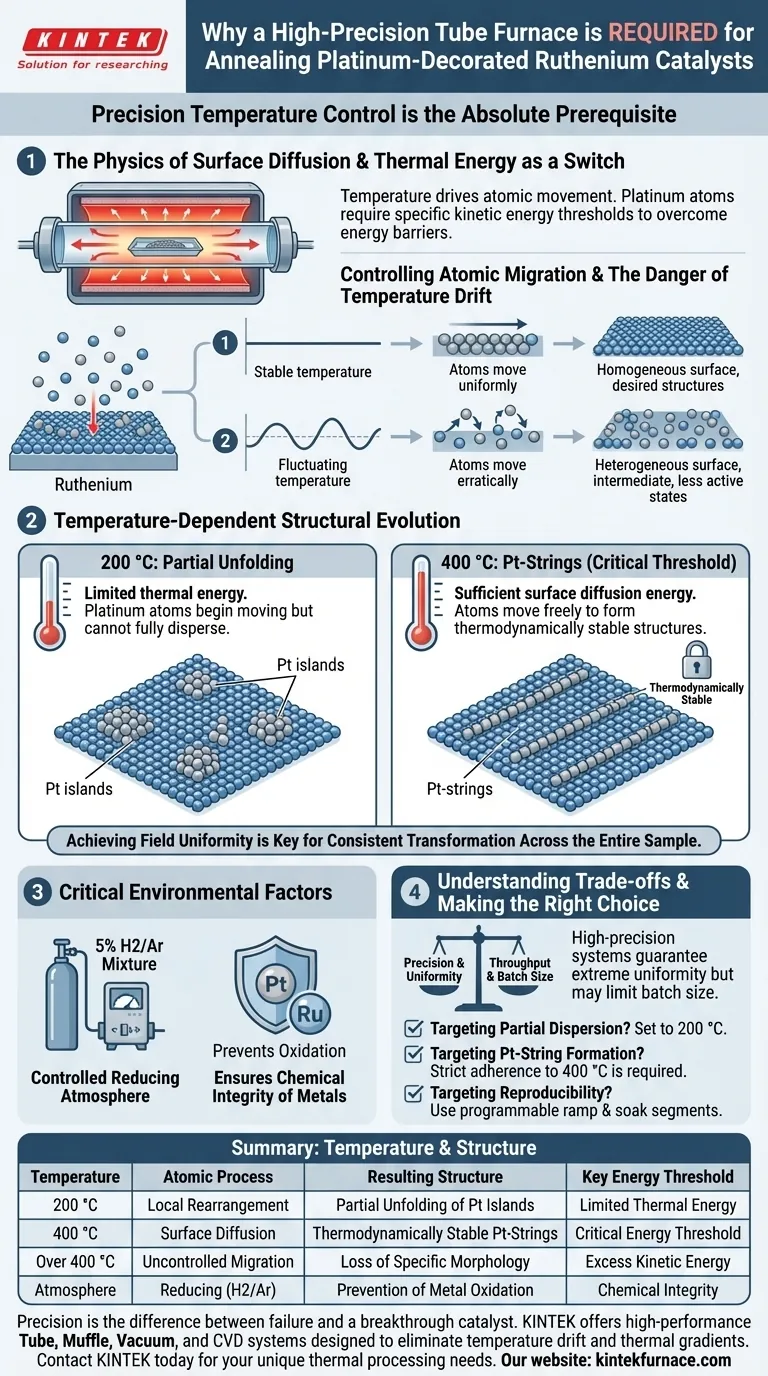
The 200 °C Threshold: Partial Unfolding
At lower temperatures, specifically around 200 °C, the thermal energy provided is limited. At this stage, platinum atoms have enough energy to begin moving but not enough to fully disperse.
This results in the partial unfolding of platinum islands. The atoms rearrange locally but do not yet possess the energy to traverse the surface distances required for more complex structures.
The 400 °C Transformation: Pt-Strings
When the temperature is raised to 400 °C, the system crosses a critical energy threshold. The platinum atoms acquire sufficient surface diffusion energy to move freely across the ruthenium lattice.
This specific energy level allows the atoms to settle into a thermodynamically stable configuration. Instead of isolated islands, they form continuous atomic chain structures known as Pt-strings.
Achieving Field Uniformity
The formation of Pt-strings requires the entire sample to experience 400 °C simultaneously. A high-quality tube furnace provides superior thermal field uniformity, ensuring that the catalyst at the edge of the sample boat undergoes the same morphological transformation as the catalyst in the center.
Critical Environmental Factors
Controlled Reducing Atmosphere
Beyond temperature, the chemical environment is vital. Tube furnaces allow for the introduction of a controlled reducing atmosphere, such as a 5% H2/Ar mixture.
Preventing Oxidation
While temperature drives diffusion, the atmosphere ensures the chemical integrity of the metals. Maintaining a precise reducing environment prevents oxidation during the high-temperature annealing process, ensuring the final catalyst retains its metallic character.
Understanding the Trade-offs
Precision vs. Throughput
High-precision tube furnaces often require smaller heating zones to guarantee extreme uniformity. This limits the batch size of the catalyst you can produce at one time compared to industrial, lower-precision ovens.
Hysteresis and Overshoot
Standard controllers may overshoot the target temperature during ramp-up, potentially providing too much energy too quickly. High-precision systems utilize advanced algorithms (like PID control) to eliminate overshoot, but they require careful tuning to match the thermal mass of the load.
Making the Right Choice for Your Goal
To maximize the performance of your platinum-decorated ruthenium catalysts, you must align your equipment settings with your specific morphological targets.
- If your primary focus is Partial Dispersion: Set your furnace to 200 °C to achieve the partial unfolding of platinum islands without triggering full migration.
- If your primary focus is Pt-String Formation: strict adherence to 400 °C is required to provide the exact diffusion energy needed for thermodynamically stable atomic chains.
- If your primary focus is Reproducibility: Ensure your furnace offers programmable ramp and soak segments to standardize the thermal history of every batch.
Select a furnace that prioritizes thermal stability over heating speed to guarantee the consistent formation of high-performance catalytic structures.
Summary Table:
| Temperature | Atomic Process | Resulting Structure | Key Energy Threshold |
|---|---|---|---|
| 200 °C | Local rearrangement | Partial unfolding of Pt islands | Limited thermal energy |
| 400 °C | Surface diffusion | Thermodynamically stable Pt-strings | Critical energy threshold |
| Over 400 °C | Uncontrolled migration | Loss of specific morphology | Excess kinetic energy |
| Atmosphere | Reducing (H2/Ar) | Prevention of metal oxidation | Chemical integrity |
Precision is the difference between a failed experiment and a breakthrough catalyst. Backed by expert R&D and manufacturing, KINTEK offers high-performance Tube, Muffle, Vacuum, and CVD systems designed to eliminate temperature drift and thermal gradients. Whether you are targeting Pt-string formation or complex material synthesis, our customizable lab high-temp furnaces provide the stability your research demands. Contact KINTEK today to discuss your unique thermal processing needs.
Visual Guide
References
- Qinyu Li, Richard D. Tilley. How the Arrangement of Platinum Atoms on Ruthenium Nanoparticles Improves Hydrogen Evolution Activity. DOI: 10.1002/adma.202509610
This article is also based on technical information from Kintek Furnace Knowledge Base .
Related Products
- Vacuum Sealed Continuous Working Rotary Tube Furnace Rotating Tube Furnace
- 1400℃ High Temperature Laboratory Tube Furnace with Alumina Tube
- 1700℃ High Temperature Laboratory Tube Furnace with Alumina Tube
- Magnesium Extraction and Purification Condensing Tube Furnace
- High Pressure Laboratory Vacuum Tube Furnace
People Also Ask
- What is the purpose of rotary tube furnaces? Achieve Uniform Heat Treatment for Powders and Granules
- What are the key advantages of using a rotary tube furnace? Achieve Dynamic, Uniform Heating for Powders
- What are the advantages of rotary tube furnaces in fuel compatibility? Boost Efficiency and Cut Costs
- How does the amount of material processed vary between batch and continuous rotary tube furnaces? Scale Your Production Efficiently
- What is the temperature range of some rotary tube furnaces? Achieve Uniform Heating Up to 1200°C



















