
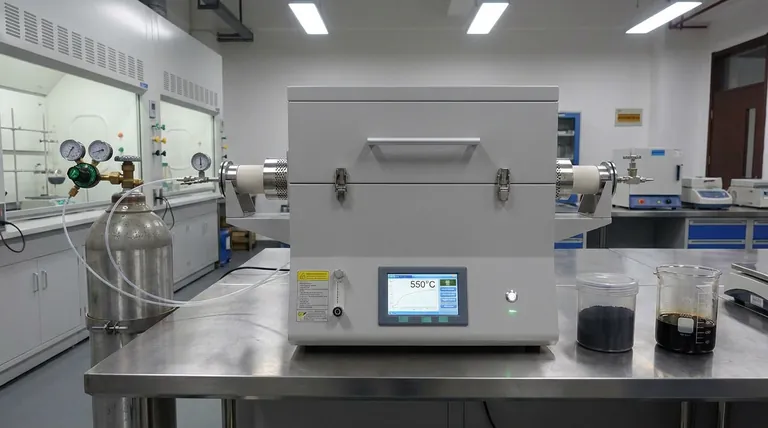
An industrial tube furnace establishes two fundamental physical conditions for biomass catalytic pyrolysis: a strictly anaerobic atmosphere and a precise, uniform thermal environment. By maintaining nitrogen protection and stabilizing heat conduction between 400°C and 750°C, the furnace enables the controlled thermal decomposition required to convert solid biomass into valuable bio-oil, bio-char, and fuel gases.
The core function of the tube furnace is to facilitate bond breaking without combustion. It achieves this by rigorously excluding oxygen while delivering the high, stable heat energy necessary to cleave the chemical bonds within biomass macromolecules.
Creating the Optimal Reaction Environment
The Necessity of an Anaerobic State
For pyrolysis to occur rather than combustion, oxygen must be removed from the equation. An industrial tube furnace provides a strictly anaerobic environment, typically maintained through the use of nitrogen protection.
This oxygen-free atmosphere ensures that the biomass undergoes thermal decomposition rather than burning. It allows the material to break down into its constituent chemical parts—bio-oil and bio-char—without reacting with oxygen to form ash and CO2.
Uniform Heat Conduction
Biomass pyrolysis is highly sensitive to temperature gradients. The furnace provides a highly stable heat conduction path, ensuring that thermal energy is applied evenly across the feedstock.
Uniform heating is critical for process consistency. Without it, different sections of the biomass would react at different rates, leading to unpredictable yields and lower-quality end products.
Thermal Dynamics and Chemical Transformation
The Critical Temperature Window
The industrial tube furnace operates within a specific temperature range, generally from 400°C to 750°C.
This range is not arbitrary; it covers the thermal decomposition requirements of various biomass components. While some reactions may optimize between 400°C and 550°C, the broader industrial capacity up to 750°C allows for versatile processing strategies.
Driving Bond Cleavage
The primary goal of this thermal environment is to drive the cleavage of chemical bonds in biomass macromolecules.
Heat energy targets the complex structures of cellulose, hemicellulose, and lignin. As these bonds break, the solid biomass transforms into bio-oil vapors, solid bio-char, and non-condensable fuel gases.
Operational Considerations and Trade-offs
Balancing Temperature and Product Yield
While the furnace can reach 750°C, operating at the higher end of this spectrum alters the product distribution.
Higher temperatures generally favor the production of gases and char at the expense of liquid bio-oil. Operators must balance the heat input against the desired output, as "more heat" does not always equal "better product" for all applications.
Heating Rate Sensitivity
The equipment allows for the adjustment of heating rates (e.g., 10-20 °C/min in laboratory settings), which significantly impacts the depth of decomposition.
Rapid heating tends to maximize liquid yields (bio-oil), while slower heating rates often promote char formation. The trade-off lies in the complexity of control: achieving fast, uniform heating in a large industrial tube is mechanically more challenging than in a small laboratory unit.
Making the Right Choice for Your Process
The physical conditions provided by the furnace must be tuned to your specific production targets.
- If your primary focus is maximizing liquid Bio-oil: Target the lower temperature range (400°C - 550°C) to facilitate deep thermal decomposition without secondary cracking of the vapors.
- If your primary focus is Syngas or Bio-char production: Utilize the furnace's capacity to reach higher temperatures (up to 750°C) to drive more complete gasification and carbonization.
Success in biomass pyrolysis depends not just on having the equipment, but on precisely calibrating the inert atmosphere and thermal window to match the chemical composition of your feedstock.
Summary Table:
| Condition | Requirement | Impact on Process |
|---|---|---|
| Atmosphere | Anaerobic (Nitrogen Protection) | Prevents combustion; ensures decomposition into bio-oil/char. |
| Temperature Range | 400°C to 750°C | Targets specific bond cleavage in cellulose and lignin. |
| Thermal Path | Uniform Heat Conduction | Ensures consistent yields and prevents unpredictable reactions. |
| Heating Rate | 10-20 °C/min (Adjustable) | High rates maximize bio-oil; slow rates promote char formation. |
Maximize Your Bio-Energy Yield with KINTEK Precision
Achieving the perfect balance between bio-oil, bio-char, and syngas requires uncompromising thermal precision. Backed by expert R&D and manufacturing, KINTEK offers high-performance Tube, Muffle, Rotary, Vacuum, and CVD systems tailored for the rigorous demands of biomass catalytic pyrolysis. Our customizable high-temperature furnaces provide the strictly anaerobic environments and uniform heat distribution essential for your lab or industrial scaling.
Ready to optimize your thermal decomposition process? Contact our technical experts today to discover how KINTEK’s advanced heating solutions can transform your research and production efficiency.
References
- Sivashunmugam Sankaranarayanan, Wangyun Won. Catalytic pyrolysis of biomass to produce bio‐oil using layered double hydroxides (<scp>LDH</scp>)‐derived materials. DOI: 10.1111/gcbb.13124
This article is also based on technical information from Kintek Furnace Knowledge Base .
Related Products
- Magnesium Extraction and Purification Condensing Tube Furnace
- High Pressure Laboratory Vacuum Tube Furnace
- 1400℃ High Temperature Laboratory Tube Furnace with Alumina Tube
- Vertical Laboratory Quartz Tube Furnace Tubular Furnace
- Vacuum Sealed Continuous Working Rotary Tube Furnace Rotating Tube Furnace
People Also Ask
- What are the advantages of using a condensing tube furnace for magnesium extraction? Achieve High Purity and Efficient Metal Recovery
- What is a tube furnace and what is its primary use? Achieve Precision High-Temp Processing for Your Lab
- Why is an argon atmosphere protection critical during the selenization of CoO/CoSe? Key to High-Purity Heterostructures
- What is the heating rate of a tube furnace? Balancing Speed with Safety for Your Lab
- What critical role does a tube furnace play in the final stage of catalyst preparation for FeOx@KCC-1? Expert Insights



















