
The maximum sample size for the 3-Zone tube furnace is 60mm, or approximately 2 inches, in diameter. This dimension represents the physical inner diameter of the process tube, establishing a hard limit on the size of any substrate, wafer, or sample boat that can be loaded into the system.
While the furnace can physically accommodate a 60mm sample, your effective maximum size is often smaller. The true limit is dictated by the "uniform hot zone" required for your specific process, whether it's annealing or chemical vapor deposition (CVD).
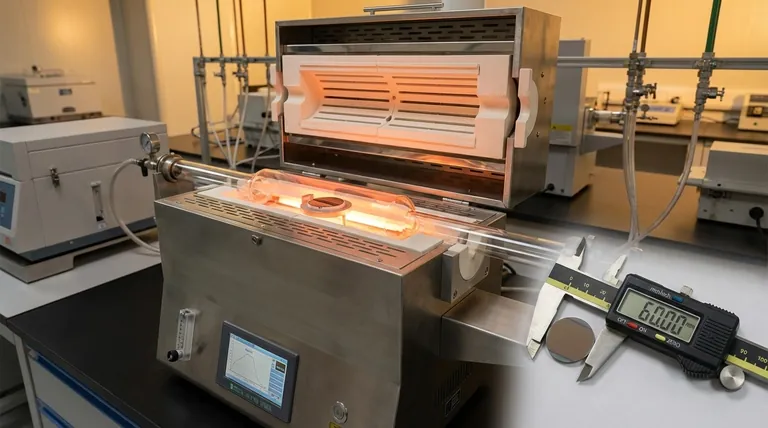
Physical Limit vs. Effective Processing Zone
Understanding the distinction between the physical tube size and the usable processing area is critical for achieving repeatable, high-quality results.
The Physical Constraint: 60mm
The 60mm measurement is a simple geometric limit. It refers to the inner diameter of the quartz or ceramic tube running through the furnace. Any sample or sample holder with a dimension larger than this will not fit.
The Thermal Constraint: The "Uniform Hot Zone"
A tube furnace loses heat at its ends. The "hot zone" is the central region of the tube that maintains the most stable and uniform temperature. Your sample must reside within this zone for consistent processing.
The purpose of a 3-zone design is to extend the length of this uniform hot zone. The two outer heating zones can be set to a slightly higher temperature to compensate for end losses, creating a much larger area of thermal stability in the center zone compared to a single-zone furnace.
How Your Process Dictates Sample Size
The ideal sample size is not a fixed number; it is a function of your experimental goals and the sensitivity of your materials.
For High-Uniformity Annealing
Annealing processes often demand exceptional temperature uniformity across the entire sample to ensure consistent grain growth, stress relief, or diffusion. To achieve this, the sample should be kept comfortably within the most stable part of the hot zone, making your practical sample size smaller than the 60mm limit.
For Chemical Vapor Deposition (CVD)
CVD is sensitive to both temperature and gas flow dynamics. Placing a large, 60mm sample inside the tube can significantly alter the intended laminar gas flow, potentially creating turbulence and leading to non-uniform film deposition. For CVD, a smaller sample size often yields better results.
Understanding the Trade-offs
Using this equipment effectively requires balancing competing priorities. Be aware of the following trade-offs.
Maximizing Size vs. Ensuring Uniformity
The most common trade-off is size versus quality. While you can process a 60mm sample, you risk having the edges experience a different temperature profile than the center. This can lead to inconsistent material properties across your sample.
Throughput vs. Consistency
Placing multiple smaller samples (batching) can increase throughput. However, this requires careful positioning to ensure every sample experiences the same thermal and atmospheric conditions. Processing one larger sample is simpler but may not be uniform at its edges.
Gas Flow in Reactive Processes
For processes using reactive gases, like CVD, a sample that nearly fills the tube's diameter can act as a blockage. This can starve the downstream end of the sample of precursor gas, leading to a thickness gradient in the deposited film.
Making the Right Choice for Your Goal
Base your sample size on the specific requirements of your experiment.
- If your primary focus is processing the largest possible sample with some tolerance for edge effects: You can design your experiment around samples approaching the 60mm physical limit.
- If your primary focus is achieving the highest process uniformity for sensitive materials: Plan to use samples significantly smaller than 60mm to ensure they fit entirely within the most stable region of the hot zone.
- If your primary focus is a gas-dependent process like CVD: Prioritize maintaining uniform gas flow by using a smaller sample size that does not obstruct the process tube.
Ultimately, understanding the relationship between physical space, the uniform thermal zone, and your process demands is the key to successful results.
Summary Table:
| Aspect | Details |
|---|---|
| Physical Max Sample Size | 60mm (2 inches) diameter |
| Key Constraint | Uniform hot zone for temperature stability |
| Common Applications | Annealing, Chemical Vapor Deposition (CVD) |
| Trade-offs | Size vs. uniformity, throughput vs. consistency, gas flow impact |
Need a high-temperature furnace tailored to your lab's unique sample requirements? KINTEK leverages exceptional R&D and in-house manufacturing to provide advanced solutions like Tube Furnaces, Muffle Furnaces, Rotary Furnaces, Vacuum & Atmosphere Furnaces, and CVD/PECVD Systems. With strong deep customization capabilities, we precisely meet your experimental needs for uniform heating, gas flow optimization, and more. Contact us today to discuss how our furnaces can enhance your research and production outcomes!
Visual Guide

Related Products
- Split Multi Heating Zone Rotary Tube Furnace Rotating Tube Furnace
- Multi Heating Zones CVD Tube Furnace Machine for Chemical Vapor Deposition Equipment
- Multi Zone Laboratory Quartz Tube Furnace Tubular Furnace
- Magnesium Extraction and Purification Condensing Tube Furnace
- Vacuum Sealed Continuous Working Rotary Tube Furnace Rotating Tube Furnace
People Also Ask
- What are the main applications of multi zone tube furnaces in university laboratories? Unlock Precision in Material Science and Energy Research
- How are multi zone tube furnaces used in ceramics, metallurgy and glass research? Unlock Precise Thermal Control for Advanced Materials
- What environmental protection applications utilize multi zone tube furnaces? Unlock Precision in Waste Treatment and Green Tech
- What role do multi zone tube furnaces play in new energy research? Unlock Precise Thermal Control for Innovation
- What temperature-related capabilities make multi zone tube furnaces valuable for research? Unlock Precision Thermal Control



















