
Optimizing the electrochemical performance of (RuIr)O2/C catalysts relies fundamentally on the precise annealing environment provided by a tube sintering furnace. Precise programmed temperature control prevents rapid thermal spikes that cause grain coarsening, ensuring the RuIr alloys slowly convert to rutile-type oxides, while atmosphere regulation (specifically N2/O2 ratios) dictates the oxidation degree and crystal phase purity required for high catalytic activity.
The key to high-performance electrocatalysts lies in achieving an atomically mixed rutile structure without increasing particle size. The tube furnace acts as a precision instrument to balance full oxidation against the risk of grain growth.
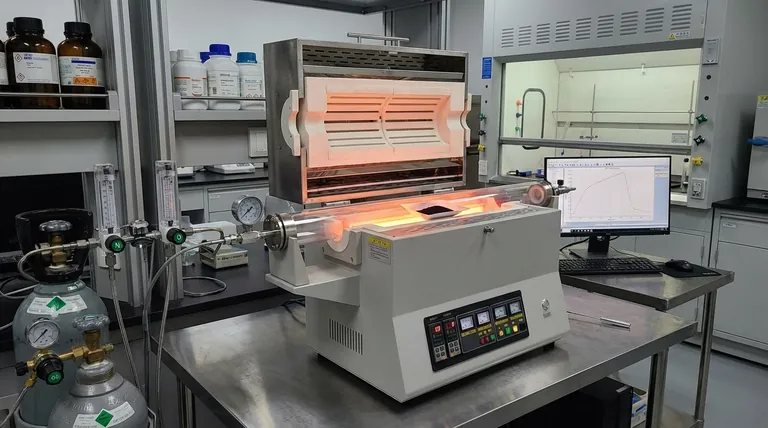
The Critical Role of Temperature Dynamics
Preventing Grain Coarsening
The primary chemical risk during annealing is grain coarsening, where small particles merge into larger ones. This process reduces the active surface area of the catalyst, significantly lowering its performance.
Programmed temperature control ensures that RuIr alloys are converted to oxides slowly and deliberately. By managing the heating rate, the furnace avoids "instantaneous high temperatures" that trigger rapid grain growth.
Target Phase Transformation
The specific goal is to convert the alloy into rutile-type oxides. This transformation must occur within a stable thermal window, specifically identified as a 400 °C environment in your primary protocol.
Precision Through PID Control
To maintain this stability, modern tube furnaces utilize PID (Proportional-Integral-Derivative) algorithms. This system continuously adjusts heating power based on real-time data from high-precision sensors (like K-type thermocouples).
This technology ensures the temperature remains uniform throughout the holding time. It eliminates thermal fluctuations that could lead to heterogeneous crystal formation.
The Necessity of Atmosphere Regulation
Controlling Oxidation Degree
Temperature alone is insufficient; the chemical environment is equally critical. You must regulate the flow ratios of Nitrogen (N2) and Oxygen (O2) inside the tube.
By adjusting these ratios, you strictly control the oxidation degree of the material. This prevents under-oxidation (leaving unstable metallic phases) or uncontrolled oxidation kinetics.
Ensuring Crystal Phase Purity
The interaction between the controlled atmosphere and the RuIr precursor dictates crystal phase purity. Precise gas regulation ensures the formation of the specific rutile phase required for the catalyst.
Achieving Atomic Mixing
The ultimate objective of combining temperature and atmosphere control is an atomically mixed (RuIr)O2 structure. This specific structural arrangement is directly responsible for the material's high catalytic activity.
Common Pitfalls and Trade-offs
The Risk of Thermal Overshoot
Without a programmed heating rate, furnaces can "overshoot" the target temperature. Even a brief spike above the target window can irreversibly coarsen the catalyst grains.
Atmosphere Imbalance
Failing to precisely meter the N2/O2 ratio creates a trade-off between reaction speed and quality. An atmosphere that is too oxygen-rich may accelerate the process but can alter the surface defects needed for catalysis.
Making the Right Choice for Your Goal
To maximize the potential of your (RuIr)O2/C electrocatalyst, apply these control principles based on your specific synthesis targets:
- If your primary focus is maximizing catalytic activity: Prioritize the precise adjustment of N2/O2 flow ratios to ensure the formation of a pure, atomically mixed rutile structure.
- If your primary focus is maximizing surface area: Prioritize slow, programmed heating rates and strict PID control to prevent thermal spikes and inhibit grain coarsening.
Success in catalyst preparation is not just about reaching a temperature, but about controlling the path the material takes to get there.
Summary Table:
| Parameter | Role in Catalyst Preparation | Impact on (RuIr)O2/C |
|---|---|---|
| Programmed Temp | Prevents rapid thermal spikes | Inhibits grain coarsening & maximizes surface area |
| PID Control | Maintains uniform thermal stability | Ensures homogeneous crystal formation |
| Atmosphere (N2/O2) | Regulates oxidation kinetics | Dictates crystal phase purity & atomic mixing |
| Hold Time at 400°C | Facilitates phase transformation | Converts alloys to high-activity rutile-type oxides |
Elevate Your Electrocatalyst Research with KINTEK
Precision is the difference between a high-performance catalyst and a failed experiment. KINTEK provides industry-leading Tube, Vacuum, and CVD systems designed for the rigorous demands of material science. Our furnaces feature advanced PID programmed temperature control and integrated atmosphere regulation to help you achieve perfect crystal phase purity every time.
Whether you need customizable high-temp solutions or expert-backed manufacturing for your lab, KINTEK is your partner in innovation. Contact us today to find the perfect furnace for your research!
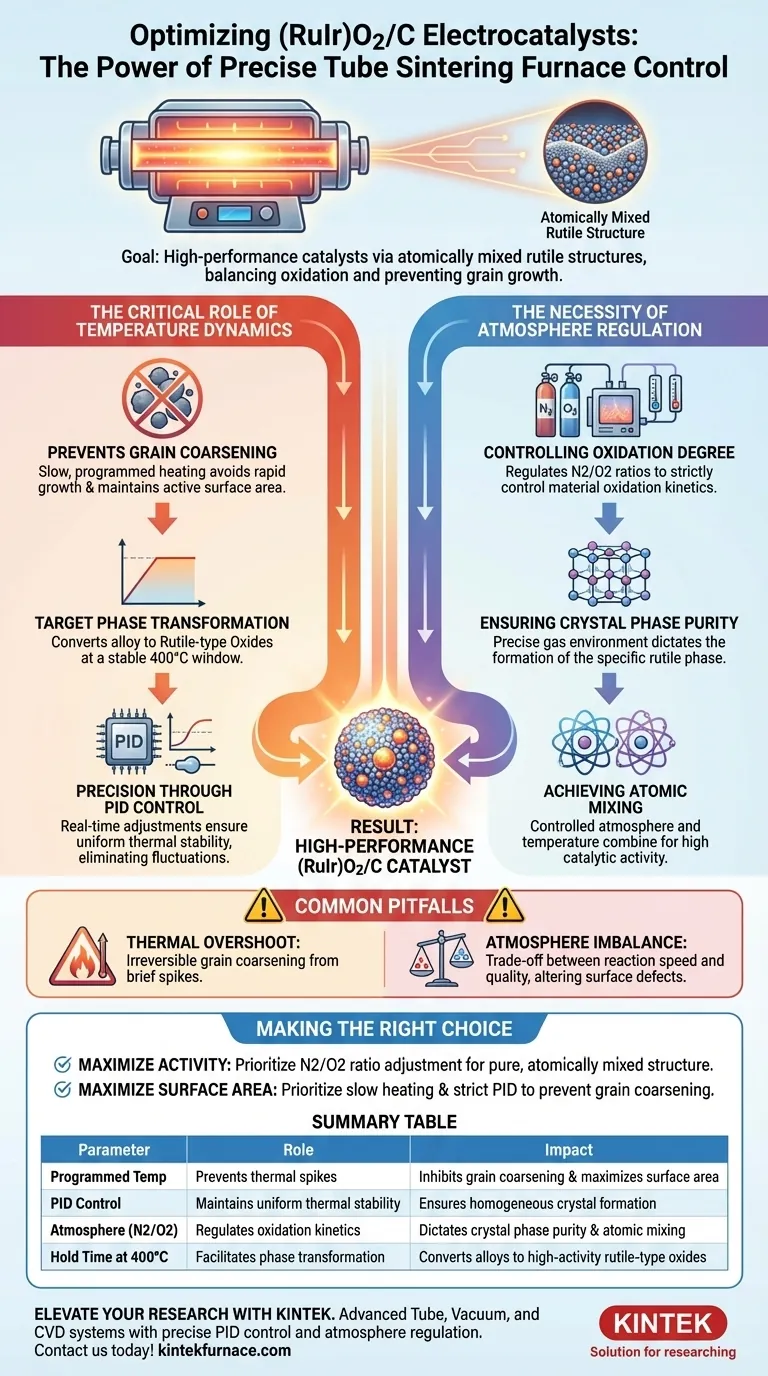
Visual Guide
References
- Yeji Park, Kwangyeol Lee. Atomic-level Ru-Ir mixing in rutile-type (RuIr)O2 for efficient and durable oxygen evolution catalysis. DOI: 10.1038/s41467-025-55910-1
This article is also based on technical information from Kintek Furnace Knowledge Base .
Related Products
- Vacuum Hot Press Furnace Machine Heated Vacuum Press Tube Furnace
- Vacuum Heat Treat Sintering Furnace Molybdenum Wire Vacuum Sintering Furnace
- Vacuum Heat Treat Sintering Furnace with Pressure for Vacuum Sintering
- Small Vacuum Heat Treat and Tungsten Wire Sintering Furnace
- Vacuum Sealed Continuous Working Rotary Tube Furnace Rotating Tube Furnace
People Also Ask
- Why use Vacuum Hot Press (VHP) for ZnS Ceramics? Achieve Superior IR Transparency and Mechanical Strength
- What safety features are incorporated in vacuum hot press furnaces? Ensure Operator and Equipment Protection
- What are the benefits of the vacuum environment system in a vacuum hot press furnace? Unlock High-Density Sintering
- What is the significance of the vacuum environment for sintering stainless steel? Unlock High-Density Purity
- Which process parameters must be optimized for specific materials in a vacuum hot press furnace? Achieve Optimal Density and Microstructure



















