The vacuum-sealed quartz tube functions as the primary reaction vessel and isolation chamber. It creates a closed, chemically inert environment that contains the Tantalum and Sulfur precursors alongside the Iodine transport agent. This containment is essential for maintaining the specific pressure and temperature gradient required to precipitate and grow high-quality 1T-TaS2 single crystals without atmospheric contamination.
Core Takeaway The quartz tube is not merely a container; it is a closed thermodynamic system. By sealing the reaction under vacuum, it allows a transport agent (Iodine) to continuously cycle raw materials across a thermal gradient, enabling the precise gas-phase transport necessary for high-purity crystal formation.
The Critical Functions of the Vessel
Chemical Stability and Inertness
The growth of 1T-TaS2 utilizes Iodine as a transport agent, which is highly reactive. The quartz tube provides high chemical stability, ensuring the vessel itself does not react with the transport agent or the raw materials (Tantalum and Sulfur).
This inertness is vital. If the vessel were to react with the contents, it would introduce impurities, compromising the stoichiometry and electronic properties of the final 1T-TaS2 crystal.
High-Temperature Resistance
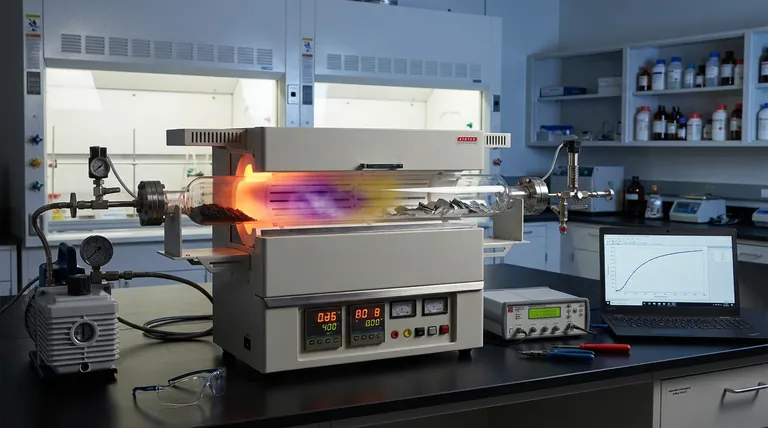
The Chemical Vapor Transport (CVT) process requires sustained heating within a dual-zone furnace. The quartz tube is designed to withstand these high processing temperatures without softening, deforming, or devitrifying.
It acts as a robust physical barrier that maintains its structural integrity even while subjected to the thermal stress of the furnace's heating zones.
Facilitating the Temperature Gradient
The tube is positioned to span across two distinct temperature zones in the furnace. It enables the establishment of a stable temperature gradient inside the reaction volume.
This internal gradient is the driving force of the entire operation. It causes the solid raw materials to volatilize at the hot end and re-deposit as crystals at the cooler end.
The Role of the Vacuum Seal
Prevention of Oxidation
Sealing the tube under vacuum eliminates oxygen and moisture from the growth environment. Tantalum and Sulfur can easily oxidize or react with atmospheric gases at high temperatures.
By removing these contaminants, the vacuum seal ensures that the chemical interaction remains exclusively between the precursors and the transport agent.
Controlling Internal Pressure
The vacuum seal creates a closed system. As the furnace heats up, the transport agent (Iodine) and precursors vaporize, generating internal pressure.
Because the system is sealed, this creates a specific vapor pressure environment. This controlled pressure is strictly required for the gas-phase components to migrate efficiently and nucleate into single crystals.
Understanding the Trade-offs
Pressure Limits and Explosion Risks
While the quartz tube must contain the vapor pressure, it has physical limits. If the amount of transport agent is too high relative to the tube's volume, the internal pressure at growth temperatures can exceed the quartz's tensile strength.
This can lead to tube rupture or explosion. Careful calculation of the transport agent quantity relative to the tube volume is required to balance efficient transport with safety.
Thermal Conductivity Lag
Quartz is a thermal insulator compared to metals. While it allows the furnace heat to penetrate, there can be a lag or discrepancy between the set furnace temperature and the actual temperature inside the tube.
Operators must account for this thermal resistance when programming the dual-zone furnace to ensure the internal gradient matches the theoretical requirements for 1T-TaS2 growth.
Making the Right Choice for Your Goal
To ensure the successful growth of 1T-TaS2, consider how you prepare and position your quartz ampoule:
- If your primary focus is Crystal Purity: Ensure the quartz tubing is thoroughly cleaned and etched before use to remove any surface contaminants that could integrate into the lattice.
- If your primary focus is Transport Efficiency: Verify the vacuum level is sufficient (high vacuum) before sealing; residual gases can impede the migration of the Iodine-complexed species.
- If your primary focus is Structural Safety: Calculate the theoretical internal pressure at the peak reaction temperature to ensuring it remains well within the quartz's safety margin.
The quartz tube is the defining boundary of your experiment; its integrity determines the quality of the physics inside.
Summary Table:
| Feature | Function in CVT Process | Impact on 1T-TaS2 Quality |
|---|---|---|
| Chemical Inertness | Prevents reaction with Iodine transport agent | Ensures high stoichiometry & purity |
| Thermal Resistance | Sustains high-temp dual-zone furnace stress | Maintains structural integrity |
| Vacuum Seal | Eliminates oxygen and moisture | Prevents oxidation of Ta and S |
| Closed System | Controls internal vapor pressure | Facilitates efficient gas-phase nucleation |
| Gradient Support | Spans hot and cold furnace zones | Drives material transport and deposition |
Maximize Your Material Synthesis with KINTEK
Precise crystal growth requires more than just a container; it demands a perfectly controlled thermodynamic environment. Backed by expert R&D and manufacturing, KINTEK offers high-performance Muffle, Tube, Rotary, Vacuum, and CVD systems, along with customizable lab high-temp furnaces tailored to your unique research needs.
Whether you are synthesizing 1T-TaS2 single crystals or developing next-generation semiconductors, our equipment provides the thermal stability and precision necessary for success. Contact us today to optimize your lab setup and see how our customizable solutions can enhance your manufacturing efficiency.
References
- Yihao Wang, Liang Cao. Dualistic insulator states in 1T-TaS2 crystals. DOI: 10.1038/s41467-024-47728-0
This article is also based on technical information from Kintek Furnace Knowledge Base .
Related Products
- Split Chamber CVD Tube Furnace with Vacuum Station CVD Machine
- Vacuum Sealed Continuous Working Rotary Tube Furnace Rotating Tube Furnace
- Vertical Laboratory Quartz Tube Furnace Tubular Furnace
- Laboratory Quartz Tube Furnace RTP Heating Tubular Furnace
- Multi Zone Laboratory Quartz Tube Furnace Tubular Furnace
People Also Ask
- What role does a Tube Furnace play in the CVD growth of carbon nanotubes? Achieve High-Purity CNT Synthesis
- What are the operational and maintenance requirements for a CVD tube furnace? Ensure Precision for Thin Film Deposition
- How does a CVD tube furnace achieve high purity in gate media preparation? Master Precision Control for Flawless Films
- What are the advantages of using a CVD tube furnace for preparing gate dielectrics? Achieve High-Quality Thin Films for Transistors
- What are the benefits of developing new precursor materials for CVD tube furnaces? Unlock Advanced Thin-Film Synthesis