
At their core, high-temperature tube furnaces are critical because they provide an unmatched ability to create extreme and stable thermal environments. This precision allows scientists and engineers to reliably test, synthesize, and treat advanced materials in ways that are simply not possible with other heating methods.
A tube furnace's true value lies in its unique combination of three factors: achieving extreme temperatures, maintaining uniform heat distribution, and enabling precise control over the internal atmosphere. This trifecta is essential for developing and processing the high-performance materials that define modern technology.
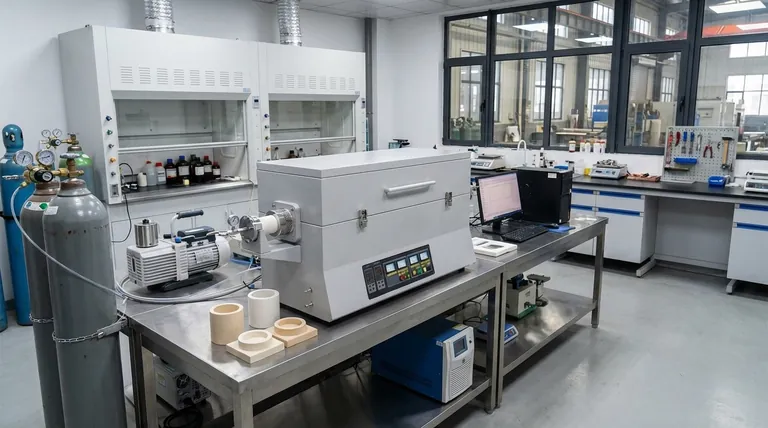
What Defines a Tube Furnace's Capabilities?
The importance of a tube furnace stems from a set of specific design features that work in concert to create a highly controlled processing environment.
Extreme and Uniform Temperature
Tube furnaces are engineered to reach very high temperatures, often up to 1800°C (3272°F) or even higher.
More importantly, they are designed to create a uniform heating zone along the length of the tube. This ensures that the entire sample receives the exact same thermal treatment, which is critical for consistent and repeatable results.
Precise Atmosphere Control
Perhaps the most significant advantage is the ability to control the atmosphere inside the processing tube.
Operations can be conducted under a vacuum to remove reactive gases or under a flow of a specific inert gas (like argon or nitrogen). This prevents unwanted oxidation and allows for the synthesis of highly pure materials that would be impossible to create in open air.
Efficient and Reliable Design
The technology behind tube furnaces is mature and robust. Their cylindrical design offers high thermal efficiency and allows for rapid heating and cooling cycles, improving productivity.
Their relatively simple structure makes them reliable, easy to operate, and space-efficient compared to other types of industrial furnaces.
Key Applications in Science and Industry
These core capabilities directly enable a wide range of critical processes in both research laboratories and industrial manufacturing floors.
For Advanced Scientific Research
In academic and R&D settings, precision is paramount. Tube furnaces are indispensable for material synthesis, where new compounds are created under specific thermal and atmospheric conditions.
They are also essential for thermal analysis (studying how materials behave at high temperatures) and testing the performance of components like catalysts.
For Industrial Production and Heat Treatment
In manufacturing, tube furnaces are workhorses for heat treatment processes like annealing, sintering, and brazing. These processes are used to alter the properties of metals, ceramics, and composites to improve their strength and durability.
They are also integral to the production of semiconductors, batteries, and advanced ceramics used in aerospace and electronics. Some models are designed for continuous production, increasing the yield of specific chemical products.
For Quality Control and Calibration
Industries rely on tube furnaces for critical quality assurance tasks. This includes the accelerated aging of components to test their long-term reliability.
They are also used for the precise calibration of thermocouples and other temperature sensors, ensuring that measurements across an entire facility are accurate.
Understanding the Operational Realities
While powerful, a tube furnace is a specialized tool. Understanding its practical limitations is key to using it effectively.
The Critical Role of Safety
Operating at extreme temperatures requires robust safety features. High-quality furnaces include multi-layer insulation and secure enclosures to protect operators and the surrounding environment from intense heat.
Sample Size and Throughput
The primary limitation of a standard tube furnace is its processing volume. While ideal for high-value samples and research, the diameter of the tube restricts the size of individual parts.
While some designs allow for continuous flow, many are batch-oriented, which can be a bottleneck in high-volume manufacturing compared to larger, open-chamber ovens.
The Cost-Capability Balance
The cost of a tube furnace is directly related to its capabilities. Models capable of reaching higher temperatures, holding a tighter vacuum, or using high-purity materials are a significant investment. Justifying the cost requires a clear understanding of the process requirements.
Aligning the Furnace with Your Objective
Choosing and utilizing a tube furnace effectively means matching its specific strengths to your primary goal.
- If your primary focus is fundamental research: Prioritize a furnace with the most precise temperature and atmosphere control to ensure your experimental results are valid and repeatable.
- If your primary focus is industrial process development: Look for versatility, efficiency, and a design that can potentially be scaled from the lab to production.
- If your primary focus is quality control and testing: Emphasize thermal uniformity, stability, and data logging capabilities to guarantee consistent and auditable test conditions.
Ultimately, mastering the controlled environment of a tube furnace is fundamental to pushing the boundaries of material science and engineering.
Summary Table:
| Feature | Benefit | Application |
|---|---|---|
| Extreme temperatures (up to 1800°C+) | Enables synthesis and treatment of high-performance materials | Material synthesis, heat treatment |
| Uniform heating zone | Ensures consistent, repeatable results | Thermal analysis, quality control |
| Precise atmosphere control (vacuum/inert gas) | Prevents oxidation, allows pure material creation | Semiconductor production, catalyst testing |
| Efficient, reliable design | Improves productivity with rapid heating/cooling cycles | Industrial manufacturing, R&D |
Ready to elevate your material processing with precision and reliability? At KINTEK, we leverage exceptional R&D and in-house manufacturing to provide advanced high-temperature furnace solutions tailored to your needs. Our product line, including Tube Furnaces, Muffle Furnaces, Rotary Furnaces, Vacuum & Atmosphere Furnaces, and CVD/PECVD Systems, is backed by strong deep customization capabilities to meet your unique experimental and industrial requirements. Contact us today to discuss how our furnaces can drive innovation and efficiency in your lab or production line!
Visual Guide

Related Products
- 1400℃ High Temperature Laboratory Tube Furnace with Alumina Tube
- 1700℃ High Temperature Laboratory Tube Furnace with Alumina Tube
- 1200℃ Split Tube Furnace Laboratory Quartz Tube Furnace with Quartz Tube
- Vertical Laboratory Quartz Tube Furnace Tubular Furnace
- 1700℃ High Temperature Muffle Oven Furnace for Laboratory
People Also Ask
- How are high-temperature laboratory tube furnaces applied in long-term vacuum homogenization heat treatments for intermetallic samples?
- How do high-temperature laboratory tube furnaces ensure environmental stability? Precision Thermal Reduction Tips
- How are high-temperature tube furnaces applied in testing ceramic-supported alloy membranes? Insights
- What is the mechanism of a high-temperature furnace in Bi-2223 sintering? Achieve Precision Phase Transformation
- How does a laboratory high-temperature tube furnace contribute to the conversion of electrospun fibers? Expert Insights



















