
A vacuum/atmosphere tube furnace creates a high-temperature, controlled-atmosphere environment typically operating around 1400°C for the synthesis of Ti2AlN ceramics. While it successfully creates the necessary thermal conditions for solid-phase reactions, it operates entirely without external mechanical pressure, relying solely on thermal energy for consolidation.
The vacuum/atmosphere tube furnace is effective for chemical synthesis, successfully generating the main crystalline phase of Ti2AlN. However, due to the lack of pressure assistance, it yields a relatively porous material with a density of approximately 2.891 g/cm³, making it suitable for preliminary research rather than high-performance structural applications.
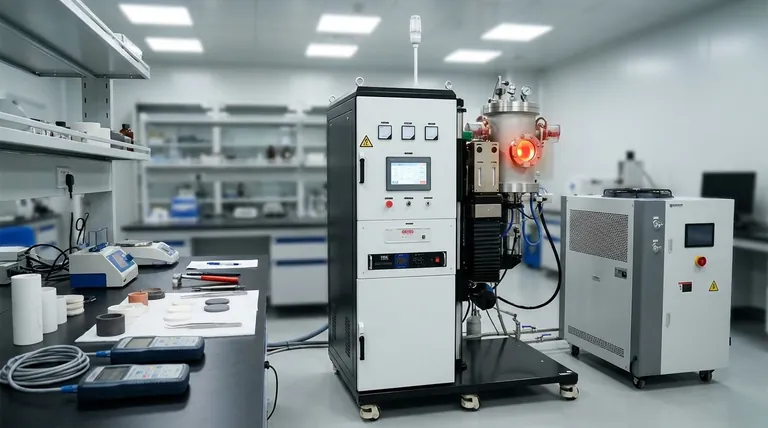
Defining the Reaction Environment
High-Temperature Capability
The primary function of the tube furnace in this context is to provide a stable thermal environment capable of reaching 1400°C.
This temperature is sufficient to activate the internal energy of the raw materials. It drives the solid-phase reactions necessary to form the Ti2AlN crystal structure from precursor powders.
Atmospheric Control
As implied by the name, this equipment allows for precise control over the gaseous environment surrounding the sample.
By operating in a vacuum or controlled atmosphere, the furnace protects the material from unwanted oxidation or contamination during the high-temperature dwell time.
The Mechanism of Synthesis
In this environment, the synthesis relies purely on chemical reaction kinetics and thermal diffusion.
The heat induces the formation of the main crystalline phase, ensuring the chemical identity of the material is correct, even if the physical density is low.
Understanding the Trade-offs: Pressureless Sintering
The Absence of Mechanical Force
The defining characteristic of this process is that it is pressureless.
Unlike a hot press furnace, the tube furnace does not apply uniaxial mechanical pressure (e.g., 10 MPa) to the powder compact during heating.
Limitations on Densification
Because there is no external force to assist in particle rearrangement, the material cannot easily overcome internal friction to close voids.
Consequently, the finished product achieves a density of only 2.891 g/cm³, which is significantly lower than the theoretical maximum.
Comparison to Pressure-Assisted Methods
To understand the deficit, compare this to vacuum hot pressing, which can achieve densities around 4.15 g/cm³ for similar materials.
Pressure-assisted methods trigger mechanisms like plastic deformation and creep, effectively eliminating pores. The tube furnace lacks these driving forces, leaving residual porosity in the final ceramic.
Making the Right Choice for Your Goal
When selecting a sintering method for Ti2AlN, your choice depends entirely on whether you need chemical purity or structural integrity.
- If your primary focus is Preliminary Synthesis: The vacuum/atmosphere tube furnace is the appropriate choice for verifying phase formation and reaction mechanics without the complexity of pressure equipment.
- If your primary focus is Structural Performance: You must utilize a pressure-assisted method (like a vacuum hot press) to achieve the high density (>4 g/cm³) required for mechanical strength.
Choose the tube furnace when validating the chemistry, but upgrade to pressure-assisted sintering when the application demands a fully dense, pore-free material.
Summary Table:
| Feature | Pressureless Sintering (Tube Furnace) | Pressure-Assisted (Hot Press) |
|---|---|---|
| Temperature | ~1400°C | ~1400°C |
| Atmosphere | Vacuum or Inert Gas | Vacuum or Inert Gas |
| Mechanical Pressure | 0 MPa (None) | Typically 10+ MPa |
| Typical Density | ~2.891 g/cm³ | ~4.15 g/cm³ |
| Primary Use | Chemical Phase Synthesis | High-Performance Structural Parts |
| Porosity | Relatively High | Low (Fully Dense) |
Elevate Your Material Research with KINTEK
Ready to achieve precise control over your ceramic synthesis? Whether you are conducting preliminary phase research or require high-density structural materials, KINTEK provides the advanced thermal solutions you need.
Backed by expert R&D and manufacturing, we offer a comprehensive range of Muffle, Tube, Rotary, Vacuum, and CVD systems, as well as Vacuum Hot Press furnaces for high-performance densification. All our lab high-temp furnaces are fully customizable to meet your unique sintering requirements.
Don't settle for less than perfection in your results. Contact KINTEK today to consult with our experts and find the ideal system for your laboratory.
Visual Guide

Related Products
- 1200℃ Controlled Inert Nitrogen Atmosphere Furnace
- 1400℃ Controlled Inert Nitrogen Atmosphere Furnace
- Vacuum Heat Treat Furnace with Ceramic Fiber Liner
- 1700℃ Controlled Inert Nitrogen Atmosphere Furnace
- Vacuum Sealed Continuous Working Rotary Tube Furnace Rotating Tube Furnace
People Also Ask
- What controlled-atmosphere furnace conditions are required for sintering powder metallurgy copper alloy compacts? Ideal Setup
- What are the advantages of a controlled atmosphere furnace over tube furnaces? Superior Process Control for Sensitive Materials
- What are the key benefits of precise temperature control in a controlled atmosphere furnace? Unlock Superior Quality and Efficiency
- What types of gases are used in controlled atmosphere furnaces? Optimize Material Protection and Transformation
- What factors should be considered when choosing a controlled atmosphere furnace? Ensure Optimal Performance for Your Materials



















