
A Vertical Tube Furnace serves as the primary reaction vessel for simulating the complex thermodynamics of ferronickel reduction smelting. It creates a tightly controlled environment capable of reaching 1550°C, allowing researchers to replicate industrial metallurgical conditions on a manageable laboratory scale. By integrating precise heating elements and atmospheric controls, this equipment bridges the gap between theoretical chemistry and practical process development.
Core Takeaway The Vertical Tube Furnace is not merely a heating device; it is a precision simulator that allows for the exact replication of industrial thermal cycles and chemical atmospheres to optimize ferronickel reduction strategies.
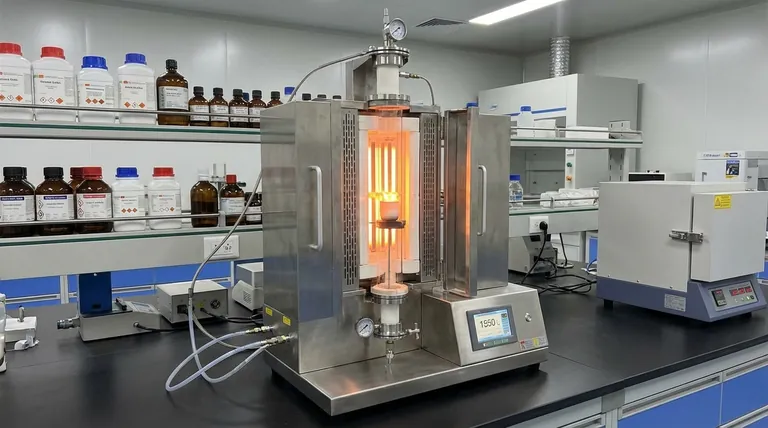
Simulating Industrial Metallurgy
To understand how ferronickel ore reduces, you must replicate the extreme conditions of a smelter. The Vertical Tube Furnace achieves this through specific high-temperature components.
Achieving Extreme Temperatures
Standard laboratory heating elements often fail at the temperatures required for smelting.
This furnace utilizes molybdenum disilicide (MoSi2) heating elements. These robust components allow the unit to reach operational temperatures up to 1550°C, which is critical for melting and reducing ferronickel ores.
Precision Thermal Monitoring
High heat is useless without accurate measurement.
The system employs B-type thermocouples. These sensors are specifically calibrated for stability and accuracy at very high temperatures, ensuring the internal environment matches your experimental parameters exactly.
Control Over Reaction Kinetics
Beyond raw heat, the success of reduction smelting depends on controlling how the material is heated and the environment surrounding it.
Managing the Chemical Atmosphere
Reduction smelting is a chemical process that requires specific atmospheric conditions.
The Vertical Tube Furnace allows for the introduction of controlled atmospheres, such as argon gas protection. This prevents unwanted oxidation and creates the necessary inert environment to isolate the reduction reactions.
Regulating Heating Profiles
Industrial smelting involves complex thermal cycles, not just a straight ramp to maximum temperature.
The furnace provides control over heating rates and isothermal holding. This allows researchers to study how long ore must be held at specific temperatures to achieve optimal reduction, mimicking the residence time in industrial kilns.
Understanding the Context and Limitations
While these furnaces are powerful, it is important to recognize their specific utility within the broader scope of metallurgical research.
The Scope of Application
In research and development laboratories, these furnaces are utilized for small-scale material synthesis and process development.
They allow for the exploration of new materials and catalytic research without the massive overhead of pilot-plant operations.
Educational Utility vs. Industrial Scale
In educational settings, these units are standard for basic experiments in materials science and physical chemistry.
However, they represent a "batch" process on a small scale. While they simulate the conditions of industry, they do not replicate the continuous throughput or volume dynamics of a full-scale industrial electric arc furnace.
Making the Right Choice for Your Goal
When determining if a Vertical Tube Furnace is the right tool for your project, consider your specific objectives.
- If your primary focus is Process Optimization: You need this furnace to precisely define the heating rates and holding times required to maximize ferronickel recovery.
- If your primary focus is Fundamental Research: You should leverage the controlled argon atmosphere to isolate specific reduction reactions without environmental interference.
By providing exact control over temperature, time, and atmosphere, the Vertical Tube Furnace transforms raw data into actionable metallurgical insight.
Summary Table:
| Feature | Specification/Capability | Benefit for Smelting |
|---|---|---|
| Max Temperature | Up to 1550°C | Replicates industrial smelting heat requirements |
| Heating Elements | Molybdenum Disilicide (MoSi2) | Ensures durability and stability at extreme temperatures |
| Atmosphere Control | Argon/Inert Gas Protection | Prevents oxidation; isolates specific reduction reactions |
| Thermal Monitoring | B-type Thermocouples | Provides high-precision accuracy for metallurgical data |
| Process Control | Isothermal Holding & Ramp Rates | Mimics industrial kiln residence times and thermal cycles |
Optimize Your Metallurgical Research with KINTEK
Ready to bridge the gap between theoretical chemistry and industrial smelting? KINTEK provides high-performance Vertical Tube Furnaces designed for precision. Backed by expert R&D and manufacturing, we offer customizable Muffle, Tube, Rotary, Vacuum, and CVD systems tailored for your unique laboratory needs. Whether you are conducting fundamental research or process development for ferronickel reduction, our high-temperature lab furnaces deliver the reliability you demand.
Contact KINTEK Today for a Custom Solution
Visual Guide

References
- Erdenebold Urtnasan, Jei‐Pil Wang. Relationship Between Thermodynamic Modeling and Experimental Process for Optimization Ferro-Nickel Smelting. DOI: 10.3390/min15020101
This article is also based on technical information from Kintek Furnace Knowledge Base .
Related Products
- Vertical Laboratory Quartz Tube Furnace Tubular Furnace
- Custom Made Versatile CVD Tube Furnace Chemical Vapor Deposition CVD Equipment Machine
- 1700℃ High Temperature Laboratory Tube Furnace with Alumina Tube
- Vacuum Induction Melting Furnace
- 1400℃ High Temperature Laboratory Tube Furnace with Alumina Tube
People Also Ask
- What are the key differences between single-zone and multi-zone vertical tube furnaces? Choose the Right Furnace for Your Lab
- What are the main characteristics of vertical tube furnaces? Optimize Your Lab with Space-Saving, Uniform Heating
- What is the purpose of using an industrial-grade vertical tube furnace in phosphorus recovery? High-Fidelity Simulation
- How are wafers loaded and unloaded in a vertical tube furnace? Achieve Precision and Purity in Wafer Processing
- What physical conditions does a vertical tube furnace provide for desulfurization experiments? Precision Heat Control



















