
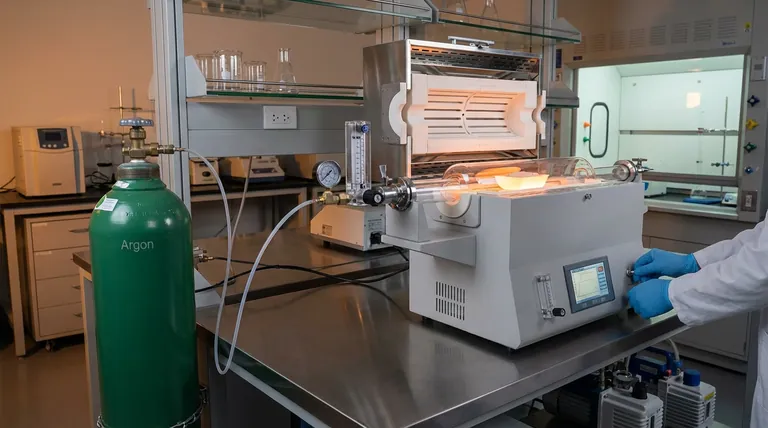
The necessity of using a tube vacuum furnace with an argon atmosphere for aluminum-based composites is dictated by the material's extreme sensitivity to oxygen. Aluminum and rare earth elements rapidly form oxide layers when exposed to air, which acts as a barrier to successful sintering. This specialized setup creates a controlled, inert environment that prevents these layers from forming, enabling the atomic diffusion required to create a cohesive, high-strength material.
Core Takeaway The primary role of this equipment is to eliminate oxygen to prevent the formation of interfacial oxide barriers on particle surfaces. By maintaining a high-purity argon environment, the process facilitates atomic diffusion and ensures robust bonding between the aluminum matrix and reinforcement materials.
The Critical Challenge: Controlling Oxidation
The Reactivity of Aluminum and Rare Earths
Aluminum is highly reactive and naturally forms a tough oxide skin instantly upon contact with air. When sintering composites containing rare earth elements—such as samarium or gadolinium—this sensitivity is amplified.
Preventing Oxide Barrier Formation
If these materials oxidize during the heating process, a stable interfacial oxide layer forms between particles. This layer physically separates the materials, preventing them from fusing together effectively.
The Role of High-Purity Argon
Introducing high-purity argon into a vacuum tube furnace displaces residual oxygen. This creates an inert protective environment that neutralizes the threat of oxidation throughout the high-temperature cycle.
Mechanisms of Improved Material Performance
Facilitating Atomic Diffusion
Sintering relies on atoms moving across particle boundaries to fuse the material into a solid mass. Oxide layers act as "walls" that block this movement.
Ensuring Ideal Interfacial Bonding
By preventing oxidation, the argon atmosphere keeps the surfaces of the aluminum and additive powders clean. This allows for direct contact between the matrix and the reinforcements, leading to ideal interfacial bonding strength.
Optimizing Physical Properties
When atomic diffusion is unhindered and bonds are strong, the final composite achieves higher density. This directly translates to improved mechanical properties and physical stability in the final part.
Understanding the Trade-offs
Equipment Complexity and Cost
Using a vacuum tube furnace with precision atmosphere control is significantly more complex than standard air sintering. It requires specialized pumps, sealing systems, and consumable gases, which increases operational costs.
Sensitivity to Process Variables
The success of this method relies entirely on the integrity of the seal and the purity of the gas. Even a minor leak or a batch of low-quality argon can reintroduce enough oxygen to ruin the material properties of the entire batch.
Making the Right Choice for Your Goal
To maximize the quality of your aluminum-based composites, align your processing parameters with your specific performance targets:
- If your primary focus is mechanical strength: Prioritize high-purity argon flow to completely prevent interfacial oxides, ensuring maximum load transfer between particles.
- If your primary focus is material density: Ensure the vacuum system effectively removes adsorbed gases and volatiles from the powder surface before backfilling with argon.
The combination of vacuum capability and argon protection is not merely a feature; it is a fundamental requirement for unlocking the true potential of aluminum-rare earth composites.
Summary Table:
| Feature | Impact on Aluminum Sintering |
|---|---|
| Vacuum Environment | Removes adsorbed gases and volatiles from powder surfaces. |
| Argon Atmosphere | Provides an inert shield to prevent reactive oxide layer formation. |
| Oxide Prevention | Facilitates atomic diffusion for superior interfacial bonding. |
| Sintering Result | High-density composites with maximized mechanical strength. |
Elevate Your Composite Material Research with KINTEK
Don't let oxidation compromise your material integrity. KINTEK's high-precision Tube, Vacuum, and CVD systems are engineered to provide the ultra-pure, controlled environments required for aluminum-rare earth sintering and other sensitive processes.
Backed by expert R&D and world-class manufacturing, we offer fully customizable high-temperature lab furnaces tailored to your unique research or production needs.
Ready to achieve superior density and bonding? Contact our technical experts today to find the perfect sintering solution for your lab.
References
- Seyit Çağlar. Influence of Gd2O3 reinforcement on the mechanical, physical and radiation shielding properties of Al-30Sm2O3 composites. DOI: 10.54187/jnrs.1569548
This article is also based on technical information from Kintek Furnace Knowledge Base .
Related Products
- 1200℃ Controlled Inert Nitrogen Atmosphere Furnace
- 1400℃ Controlled Inert Nitrogen Atmosphere Furnace
- Mesh Belt Controlled Atmosphere Furnace Inert Nitrogen Atmosphere Furnace
- High Pressure Laboratory Vacuum Tube Furnace
- Vacuum Hot Press Furnace Machine Heated Vacuum Press Tube Furnace
People Also Ask
- What controlled-atmosphere furnace conditions are required for sintering powder metallurgy copper alloy compacts? Ideal Setup
- What factors should be considered when choosing a controlled atmosphere furnace? Ensure Optimal Performance for Your Materials
- What Roles Do a Controlled Atmosphere Furnace and Oil Quenching Tank Play in AISI 5140 Steel Heat Treatment?
- What are the operational advantages of using a controlled atmosphere furnace? Boost Quality and Efficiency in Heat Treatment
- What are the operational considerations for a controlled atmosphere furnace? Master Key Factors for Material Processing



















