
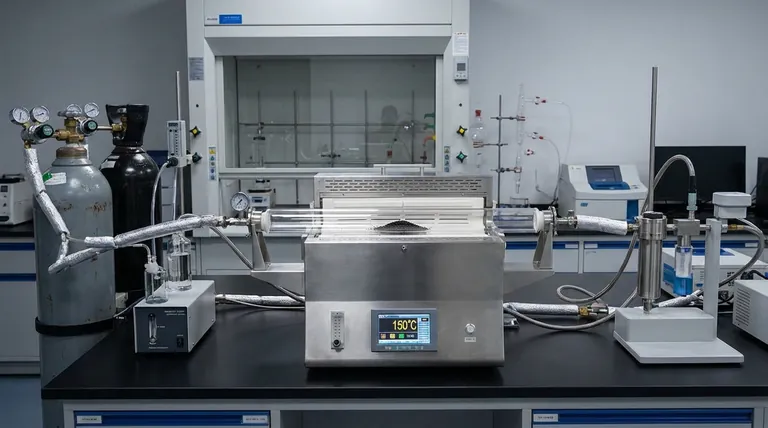
In the context of evaluating Selenium-functionalized Polyphenylene Sulfide (Se/PPS), the tube furnace functions as the critical environmental control unit within a fixed-bed adsorption system. It provides programmed temperature regulation—specifically between 25°C and 150°C—to simulate the thermal conditions of industrial flue gas. Beyond simple heating, this thermal environment is essential for activating the chemical mechanisms required for mercury capture.
The tube furnace is not merely a heater; it is a kinetic activator. It simulates realistic operating temperatures to verify thermal stability while simultaneously energizing sulfur sites within the polymer to accelerate mercury capture.
Simulating Industrial Environments
To accurately evaluate how Se/PPS will perform in a coal-fired power plant, you must replicate the specific thermal environment of the exhaust stream.
Programmed Temperature Control
The tube furnace allows for precise, programmed heating within a cylindrical chamber. For Se/PPS evaluation, the critical operating window is typically 25°C to 150°C.
Environmental Replication
By maintaining this specific temperature range, the furnace simulates the conditions of actual industrial flue gas. This allows researchers to move beyond theoretical models and observe how the adsorbent behaves under realistic operating stresses.
Verifying Thermal Stability
A primary function of the furnace in this setup is to validate the structural integrity of the adsorbent. It proves whether the Se/PPS material can maintain its efficacy and structural bonds when exposed to continuous heat over time.
Driving the Chemical Adsorption Mechanism
The most sophisticated role of the tube furnace is its contribution to the internal kinetics of the adsorption process.
Activation of Sulfur Sites
The heat generated by the furnace serves a chemical purpose: it activates the sulfur sites inherent in the Polyphenylene Sulfide (PPS) backbone.
The "Transfer Buffer" Effect
Once thermally activated, these sulfur sites act as transfer buffers. They do not just passively hold mercury; they facilitate its movement.
Accelerating Mercury Migration
The thermal energy accelerates the migration of mercury atoms. The mercury moves from the transfer buffers (sulfur) to the high-affinity selenium sites. This mimics the kinetic behavior found in actual emissions control scenarios, ensuring the evaluation data is relevant to real-world applications.
Understanding the Trade-offs
While the tube furnace is essential for simulation, precise operation is required to avoid compromising the data.
Temperature Sensitivity
While general tube furnaces can reach temperatures between 800°C and 1200°C for combustion reactions, Se/PPS evaluation requires significantly lower temperatures (up to 150°C). Exceeding this specific range can lead to the thermal degradation of the polymer matrix rather than activation.
Uniformity vs. Complexity
The tube furnace excels at providing a uniform thermal atmosphere. However, it focuses on temperature and airflow; it does not inherently simulate the complex chemical abrasion or particulate matter found in dirty flue gas without additional upstream components.
Making the Right Choice for Your Goal
When configuring your fixed-bed adsorption system for Se/PPS, consider these specific objectives:
- If your primary focus is Kinetics: Ensure your furnace ramp rates are precise to observe the activation of sulfur sites and the subsequent migration to selenium.
- If your primary focus is Durability: Run the furnace at the upper limit of the target range (150°C) for extended periods to stress-test the thermal stability of the adsorbent.
By strictly controlling the thermal environment, you transform your fixed-bed system from a simple filter into a dynamic simulator of industrial mercury removal.
Summary Table:
| Feature | Role in Se/PPS Evaluation | Key Impact |
|---|---|---|
| Thermal Simulation | Replicates flue gas (25°C - 150°C) | Validates performance in industrial conditions |
| Kinetic Activation | Energizes sulfur sites in PPS backbone | Facilitates mercury transfer to selenium sites |
| Stability Testing | Consistent long-term heat exposure | Verifies structural integrity of the polymer matrix |
| Process Control | Programmed temperature ramping | Allows precise observation of adsorption kinetics |
Optimize Your Adsorption Research with KINTEK
Maximize the accuracy of your mercury capture studies with precision-engineered thermal solutions. Backed by expert R&D and manufacturing, KINTEK offers high-performance Tube, Muffle, Rotary, Vacuum, and CVD systems—all fully customizable to meet the specific temperature profiles and atmospheric controls required for Se/PPS and polymer research.
Whether you need precise low-temperature stability or rapid thermal cycling, our lab furnaces provide the uniform environment essential for your breakthrough discoveries. Contact us today to discuss your unique laboratory needs and request a quote.
References
- Hailong Li, Jianping Yang. Biomimetic mercury immobilization by selenium functionalized polyphenylene sulfide fabric. DOI: 10.1038/s41467-024-45486-7
This article is also based on technical information from Kintek Furnace Knowledge Base .
Related Products
- Vacuum Sealed Continuous Working Rotary Tube Furnace Rotating Tube Furnace
- 1400℃ High Temperature Laboratory Tube Furnace with Alumina Tube
- 1700℃ High Temperature Laboratory Tube Furnace with Alumina Tube
- Magnesium Extraction and Purification Condensing Tube Furnace
- High Pressure Laboratory Vacuum Tube Furnace
People Also Ask
- What is the purpose of rotary tube furnaces? Achieve Uniform Heat Treatment for Powders and Granules
- What are the key advantages of using a rotary tube furnace? Achieve Dynamic, Uniform Heating for Powders
- How does the amount of material processed vary between batch and continuous rotary tube furnaces? Scale Your Production Efficiently
- What are the advantages of rotary tube furnaces in fuel compatibility? Boost Efficiency and Cut Costs
- What is the temperature range of some rotary tube furnaces? Achieve Uniform Heating Up to 1200°C



















