
The defining characteristic of a 70mm tube furnace is its role as a versatile middle ground. This internal diameter is large enough to accommodate a useful range of sample sizes for research and pilot-scale work, yet small enough to retain the efficiency benefits—like faster heating and lower gas consumption—typically associated with smaller laboratory equipment. It strikes a crucial balance between capacity and operational performance.
The choice of a tube furnace is not just about its diameter. The core decision rests on understanding how that size impacts thermal efficiency, sample throughput, and suitability for your specific process, whether it's simple heat treatment or complex material deposition.
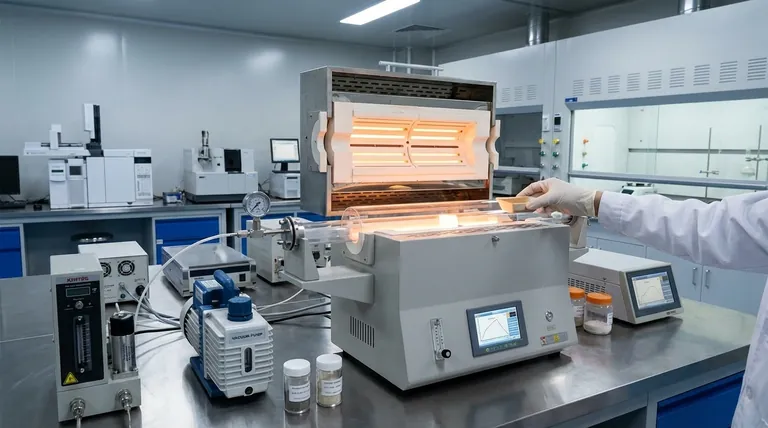
The Core Principle: How Diameter Influences Performance
A tube furnace's diameter is the primary variable that dictates its operational characteristics. A 70mm furnace represents a specific set of trade-offs that make it ideal for certain applications and less suitable for others.
Thermal Efficiency and Heating Rate
A smaller internal volume, like that in a 70mm tube, requires less energy to heat. This results in a faster heating rate and quicker cool-down times compared to larger furnaces.
This efficiency is critical for experiments requiring rapid thermal cycling or for labs where energy consumption and turnaround time are important factors.
Sample Throughput and Batch Size
The 70mm diameter directly limits the physical size and volume of the material you can process. It is perfectly suited for smaller samples, powders, and wafers common in materials science research.
While it can handle larger batches than a 30mm or 50mm furnace, it is not intended for high-volume industrial production.
Temperature Uniformity
Achieving a stable and consistent temperature across the entire sample is crucial for reliable results. It is inherently easier to maintain excellent temperature uniformity within a smaller diameter tube.
This makes the 70mm size a reliable choice for processes sensitive to thermal gradients, such as crystal growth or annealing sensitive components.
Atmosphere Control
Many processes require a specific, controlled atmosphere (e.g., inert, vacuum, or reactive gas). A smaller tube volume allows for faster purging of ambient air and requires less gas to maintain the desired environment.
This reduces operational costs and improves the purity of the internal atmosphere, which is vital for high-purity material synthesis.
Beyond Size: General vs. Specialized Furnaces
While size is a key factor, the furnace's internal systems are equally important. A 70mm tube can be part of a simple system or a highly complex one.
The Standard Laboratory Furnace
Most general-purpose tube furnaces have a relatively simple structure. They consist of a heating element, a ceramic tube, and basic controls for temperature and, sometimes, gas flow.
These are the workhorses of research labs, used for calcination, sintering, and general heat treatment. A 70mm version is a popular, versatile option.
The Specialized CVD Furnace
In contrast, a furnace designed for Chemical Vapor Deposition (CVD) is far more complex, even if it has a 70mm tube. It will feature a multi-zone temperature controller, sophisticated gas mixing and delivery systems, high-vacuum components, and often a double-layer shell for rapid cooling.
In this context, the 70mm diameter is just one specification among many. The decision is driven by the demands of the CVD process, not the size alone.
Understanding the Trade-offs
Choosing a 70mm furnace involves accepting its limitations in exchange for its benefits. Objectivity is required to make the right decision.
The Clear Limitation of Sample Size
The most obvious trade-off is capacity. A 70mm furnace is fundamentally unsuitable for processing large components or running high-throughput manufacturing operations. Attempting to do so will create a significant bottleneck.
Versatility vs. Throughput
The 70mm furnace excels in versatility for research and development, where different materials and processes are tested. However, for a dedicated, repetitive process, a furnace sized specifically for that task (either larger or smaller) may be more efficient.
Cost and Complexity
While a standard 70mm furnace is a cost-effective tool, adding specialized features like advanced vacuum or gas systems increases complexity and cost significantly. It is crucial to distinguish between the needs of the process and the desire for unnecessary features.
Making the Right Choice for Your Application
To select the correct furnace, align its characteristics with your primary goal.
- If your primary focus is fundamental research and development: The 70mm furnace offers an ideal balance of sample capacity for experimentation and the operational efficiency needed for rapid iteration.
- If your primary focus is pilot-scale testing or small-batch production: The 70mm diameter provides a sensible middle ground to validate a process before investing in larger, industrial-scale equipment.
- If your primary focus is high-volume manufacturing: A 70mm furnace is almost certainly too small; you should investigate larger-diameter batch or continuous furnaces designed for production.
- If your primary focus is a specialized process like CVD: Prioritize the furnace's technical systems—gas control, vacuum level, and temperature uniformity—over the tube diameter itself.
Ultimately, selecting the right tube furnace is about matching the equipment's physical and technical capabilities to your specific process requirements.
Summary Table:
| Feature | Advantage of 70mm Tube Furnace |
|---|---|
| Thermal Efficiency | Faster heating and cool-down, lower energy use |
| Sample Throughput | Suitable for small samples, powders, and wafers |
| Temperature Uniformity | Excellent consistency for sensitive processes |
| Atmosphere Control | Quick purging, reduced gas consumption |
| Application Fit | Versatile for R&D and pilot-scale work |
Ready to optimize your lab's thermal processing? At KINTEK, we leverage exceptional R&D and in-house manufacturing to provide advanced high-temperature furnace solutions tailored for materials science and research laboratories. Our product line includes Muffle, Tube, Rotary Furnaces, Vacuum & Atmosphere Furnaces, and CVD/PECVD Systems, all backed by strong deep customization capabilities to precisely meet your unique experimental needs. Contact us today to discuss how our 70mm tube furnace or other solutions can enhance your efficiency and results!
Visual Guide

Related Products
- Vertical Laboratory Quartz Tube Furnace Tubular Furnace
- Vacuum Sealed Continuous Working Rotary Tube Furnace Rotating Tube Furnace
- Magnesium Extraction and Purification Condensing Tube Furnace
- Split Multi Heating Zone Rotary Tube Furnace Rotating Tube Furnace
- High Pressure Laboratory Vacuum Tube Furnace
People Also Ask
- What are the key differences between single-zone and multi-zone vertical tube furnaces? Choose the Right Furnace for Your Lab
- How are metal support wires selected for sample suspension? Expert Guide to High-Temp Furnace Materials
- What is a vertical tube furnace and how does it function? Optimize Material Processing with Precision
- How are wafers loaded and unloaded in a vertical tube furnace? Achieve Precision and Purity in Wafer Processing
- What is the purpose of using an industrial-grade vertical tube furnace in phosphorus recovery? High-Fidelity Simulation



















