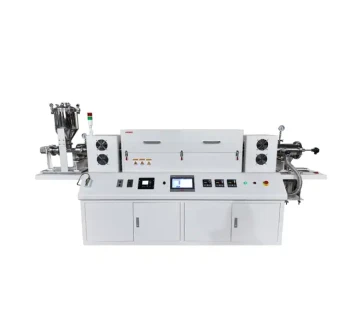
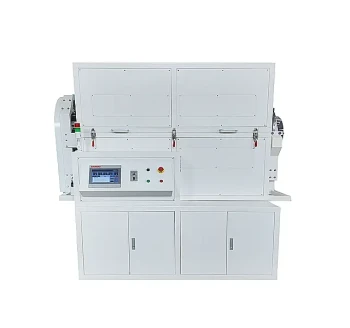
The primary process advantage of a horizontal tube pyrolysis reactor is its ability to provide a stable, sealed environment that facilitates the precise separation and collection of reaction products. By combining a high-temperature furnace with a specialized carrier gas flow, this reactor design drives oil and gas mixtures into a condensation system, allowing for the accurate, quantitative analysis of pyrolysis oil, gas, and solid residues.
Core Takeaway The horizontal tube reactor excels at ensuring data integrity during the pyrolysis process. Its design prioritizes the classified collection of all product phases—liquid, gas, and solid—making it the ideal instrument for establishing precise mass balances and product distribution profiles in experimental settings.
Optimizing Product Collection and Analysis
Facilitated Flow Dynamics
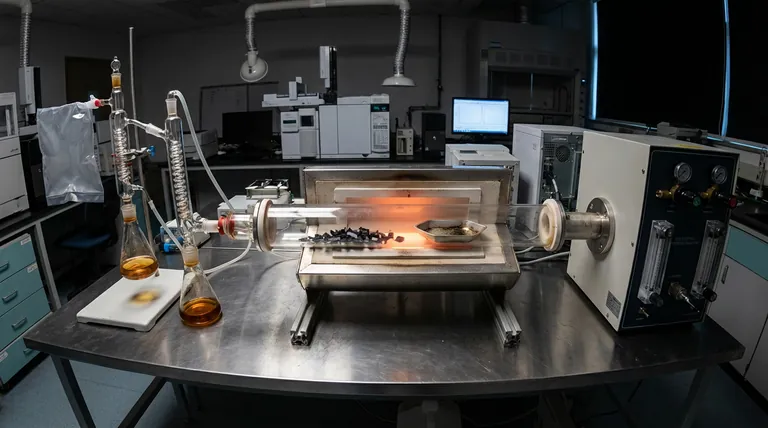
The structural design of the horizontal tube is engineered to optimize the movement of volatiles. As the plastic decomposes, the generated oil and gas mixtures are swept along by a carrier gas.
This continuous flow prevents secondary reactions that might occur if the vapors lingered in the hot zone. It ensures the products move efficiently from the heating zone into the condensation system.
Quantitative Data Integrity
For researchers and process engineers, the ability to measure output accurately is paramount. This reactor allows for classified collection, meaning liquids, gases, and solids are harvested separately.
This separation enables rigorous quantitative analysis. You can determine the exact yield of each fraction, ensuring that the product distribution data is reliable for experimental verification.
Creating a Controlled Reaction Environment
Stable Thermal Conditions
A horizontal tube furnace acts as the primary heat source, enveloping the reaction vessel. This configuration ensures uniform heat transfer to the plastic sample inside.
By maintaining a consistent temperature profile—typically between 400°C and 900°C depending on the material—the reactor triggers reliable thermal decomposition. This uniformity helps break long-chain hydrocarbons into specific fuel precursors without the unpredictability of hot spots.
Strictly Inert Atmosphere
The reactor uses a sealed reaction tube to maintain a high-temperature space free of oxygen. This anaerobic environment is critical for true pyrolysis.
By preventing combustion, the system ensures that the plastic waste undergoes chemical decomposition rather than burning. This preserves the chemical value of the resulting oil and gas products.
Material Versatility and Interaction
High-Temperature Purity (Quartz)
When high purity is required, quartz tubes are utilized for their chemical inertness and heat resistance (up to 1200°C).
Quartz prevents side reactions between the reactants and the reactor walls, which can happen with metal interfaces. Additionally, the transparency of quartz allows for real-time observation of material changes during the process.
Durability and Catalysis (Stainless Steel)
For processes involving substantial thermal stress or specific catalytic interactions, stainless steel vessels are often employed. These are durable up to approximately 500°C.
The horizontal design accommodates specialized internal structures, such as baskets. These baskets enable a specific contact mode between the plastic and catalyst, facilitating efficient molecular chain shearing for targeted product conversion.
Understanding the Trade-offs
Batch vs. Continuous Limitations
While excellent for analysis and defined experiments, horizontal tube reactors described here are often geared toward batch or semi-batch processing.
Loading and unloading solid residues (char) requires breaking the seal or cooling the system. This makes them highly effective for accurate data collection but potentially less efficient for continuous, high-throughput industrial production compared to fluidized beds or rotary kilns.
Material Constraints
The choice of tube material imposes strict operational limits. Stainless steel offers durability but limits the upper temperature range to around 500°C.
Conversely, while quartz handles higher temperatures (1200°C) and ensures purity, it is more fragile and less suited for heavy mechanical handling. Selecting the wrong vessel material can compromise the reactor's longevity or the experiment's maximum temperature.
Making the Right Choice for Your Goal
To maximize the value of a horizontal tube pyrolysis reactor, align your equipment configuration with your specific experimental objectives:
- If your primary focus is rigorous mass balance data: Prioritize the efficient flow and condensation setup to ensure complete capture and quantitative analysis of oil, gas, and solids.
- If your primary focus is high-temperature study (>500°C): Utilize high-purity quartz tubes to withstand the heat and prevent metallic side reactions.
- If your primary focus is catalytic efficiency: Choose a stainless steel configuration with internal basket structures to optimize contact between the plastic and the catalyst.
Ultimately, the horizontal tube reactor is your best tool when the precision of product distribution data outweighs the need for massive throughput.
Summary Table:
| Feature | Advantage | Benefit |
|---|---|---|
| Flow Dynamics | Carrier gas sweeping | Prevents secondary reactions & improves oil yield |
| Product Collection | Classified/Quantitative | Enables accurate mass balance & product distribution |
| Atmosphere Control | Sealed Anaerobic Environment | Prevents combustion & preserves chemical value of fuels |
| Material Options | Quartz or Stainless Steel | High-temperature purity (1200°C) or catalytic durability |
| Thermal Stability | Uniform heat transfer | Consistent decomposition without unpredictable hot spots |
Elevate Your Pyrolysis Research with KINTEK
Precision in plastic pyrolysis starts with the right equipment. Backed by expert R&D and manufacturing, KINTEK offers high-performance Tube, Muffle, Vacuum, and CVD systems tailored for your most demanding lab requirements. Whether you need high-purity quartz tubes for real-time observation or durable stainless steel configurations for catalytic studies, our customizable high-temperature furnaces provide the stable environment necessary for accurate data integrity and product analysis.
Ready to optimize your experimental mass balance? Contact KINTEK today to discuss your unique research needs!
References
- Yong Li, Fengfu Yin. Synergistic Effects Between Mixed Plastics and Their Impact on Pyrolysis Behavior and Pyrolysis Products. DOI: 10.3390/molecules29246059
This article is also based on technical information from Kintek Furnace Knowledge Base .
Related Products
- Multi Heating Zones CVD Tube Furnace Machine for Chemical Vapor Deposition Equipment
- 1700℃ High Temperature Laboratory Tube Furnace with Alumina Tube
- 1400℃ High Temperature Laboratory Tube Furnace with Alumina Tube
- Electric Rotary Kiln Small Rotary Furnace Biomass Pyrolysis Plant Rotating Furnace
- 1200℃ Split Tube Furnace Laboratory Quartz Tube Furnace with Quartz Tube
People Also Ask
- Why are high-purity quartz boats used for graphene oxide reduction? Ensure Chemical Purity & Thermal Stability
- What are 2D heterostructures and how are they created using CVD tube furnaces? Unlock Atomic-Scale Material Engineering
- What future trends are expected in the development of CVD tube furnaces? Discover Smarter, More Versatile Systems
- What functions does glucose perform in lithium-ion sieve synthesis? Enhance Carbothermal Reduction for LiMnO2 Purity
- How are hexagonal boron nitride (h-BN) films processed using CVD tube furnaces? Optimize Growth for High-Quality 2D Materials