
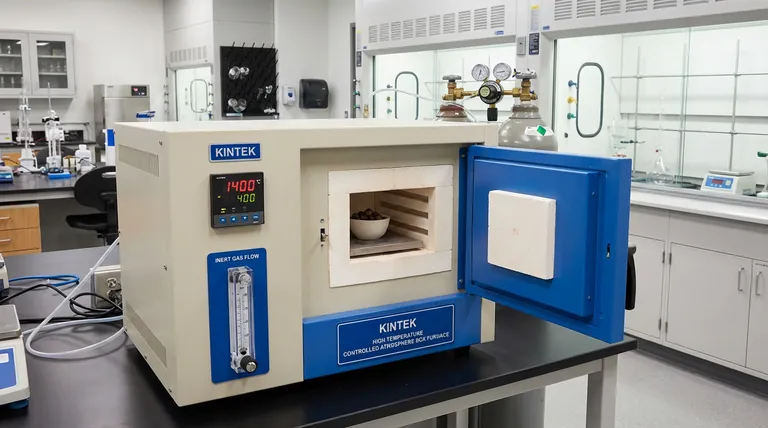
A horizontal tube furnace controls the reaction environment by integrating precise thermal programming with a strictly regulated inert atmosphere. By using programmable logic controllers (PLCs) and flow meters, the furnace maintains a constant temperature zone—typically around 500 °C to 800 °C—while purging the internal volume with high-purity nitrogen or argon to eliminate oxygen and facilitate the structural evolution of the biomass.
Core Takeaway: The horizontal tube furnace serves as a controlled micro-reactor that prevents material loss via oxidation while enabling the precise thermal decomposition and chemical etching required to transform raw cherry pits into high-surface-area activated carbon.
Atmospheric Isolation and Gas Dynamics
The Role of Inert Gas Purging
The furnace utilizes a flow meter to regulate a continuous purge of high-purity nitrogen (N2) or argon (Ar), often at rates like 100 mL/min. This constant flow creates an oxygen-free environment, which is critical for the pyrolysis of lignocellulosic components without the risk of combustion. Excluding oxygen ensures that the carbon skeleton is preserved and subsequently transformed rather than being lost to CO2 production.
Pressure and Byproduct Removal
The continuous flow of inert gas does more than just exclude oxygen; it also carries away volatile organic compounds (VOCs) and moisture. As the cherry pits undergo dehydration and condensation, these byproducts must be removed to prevent secondary reactions that could clog the emerging pore structure. Maintaining a steady gas velocity ensures that the reaction equilibrium favors the formation of the desired carbon matrix.
Thermal Precision and Material Transformation
Programmed Heating Profiles
Modern tube furnaces allow for segmented thermal treatments, where the material is heated at specific rates (e.g., 80 °C/min) to various plateaus. Initial stages facilitate dehydration and cyclization, while higher temperatures (up to 1050 °C) drive deep activation and structural hardening. This precision allows the user to dictate the ratio of micropores to mesopores by controlling the duration and intensity of heat exposure.
Establishing the Constant Temperature Zone
The horizontal design is engineered to provide a uniform heat distribution across the center of the tube. This "constant temperature zone" ensures that all cherry pit fragments within the crucible experience identical thermal conditions. Uniformity is essential for achieving a consistent pore size distribution across the entire batch of activated carbon.
Chemical Etching and Activation Control
Facilitating Redox Reactions
When cherry pits are pre-treated with activators like potassium hydroxide (KOH), the tube furnace provides the stable energy required for redox reactions. The high-temperature environment enables the KOH to effectively etch the carbon skeleton, creating a vast network of micropores. The furnace acts as the primary determinant of the final specific surface area by maintaining the exact conditions needed for this chemical erosion.
Inducing Structural Defects and Conductivity
At elevated temperatures (e.g., 800 °C+), the furnace induces the formation of carbon vacancy defects. These defects and the transition to a more amorphous or conductive structure are vital for specific applications, such as electrocatalysis or energy storage. The controlled environment ensures these transitions happen predictably without degrading the material's physical integrity.
Understanding the Trade-offs
Gas Flow Velocity vs. Thermal Stability
High gas flow rates are excellent for maintaining purity but can create thermal gradients by cooling the entry side of the material. Conversely, flow rates that are too low may allow tar vapors to deposit back onto the carbon, significantly reducing the final surface area.
Tube Material Limitations
While high temperatures are necessary for deep activation, repeated cycling to 1050 °C can cause thermal shock or "sagging" in quartz or ceramic tubes. Choosing the wrong tube material for specific chemical activators (like KOH) can lead to corrosion of the furnace tube itself, contaminating the sample.
How to Apply This to Your Process
Recommendations for Process Optimization
- If your primary focus is maximum surface area: Utilize a two-stage heating profile with a KOH activator, ensuring a slow ramp rate to allow for thorough chemical etching.
- If your primary focus is high carbon yield: Maintain a strict nitrogen purge at a moderate flow rate and cap your temperature at 500–600 °C to prevent excessive gasification of the carbon.
- If your primary focus is electrical conductivity: Target higher temperatures (above 800 °C) under an argon atmosphere to promote the development of a conductive graphitic framework.
The horizontal tube furnace is the definitive tool for biomass transformation, providing the atmospheric purity and thermal rigor necessary to engineer carbon at the molecular level.
Summary Table:
| Control Factor | Implementation Mechanism | Impact on Activated Carbon |
|---|---|---|
| Atmosphere | High-purity N2/Ar flow (e.g., 100 mL/min) | Prevents oxidation; preserves carbon skeleton |
| Temperature | PLC-programmed heating (up to 1050 °C) | Dictates pore size distribution and conductivity |
| Byproduct Removal | Continuous inert gas sweep | Prevents VOC re-deposition and pore clogging |
| Activation | Stable heat for KOH redox reactions | Facilitates chemical etching for high surface area |
Scale Your Carbon Research with KINTEK
Maximize the potential of your biomass materials with KINTEK's advanced thermal solutions. Backed by expert R&D and manufacturing, KINTEK offers customizable Muffle, Tube, Rotary, Vacuum, and CVD systems specifically designed to handle the rigorous demands of carbonization and chemical activation.
Whether you require precise multi-zone heating for uniform pore distribution or corrosion-resistant tubes for KOH etching, our high-temperature lab furnaces provide the atmospheric purity and thermal rigor your unique needs deserve.
Ready to optimize your activation process? Contact our experts today to find the perfect furnace for your laboratory.
References
- José M. González‐Domínguez, V. Gómez-Serrano. Surface Chemistry of Cherry Stone-Derived Activated Carbon Prepared by H3PO4 Activation. DOI: 10.3390/pr12010149
This article is also based on technical information from Kintek Furnace Knowledge Base .
Related Products
- Electric Rotary Kiln Small Rotary Furnace for Activated Carbon Regeneration
- 1700℃ High Temperature Laboratory Tube Furnace with Alumina Tube
- Vertical Laboratory Quartz Tube Furnace Tubular Furnace
- Split Chamber CVD Tube Furnace with Vacuum Station CVD Machine
- Custom Made Versatile CVD Tube Furnace Chemical Vapor Deposition CVD Equipment Machine
People Also Ask
- What are the main applications of a rotary kiln electric furnace? Achieve Uniform Heat Treatment for Powders
- What are the key components of a rotary kiln electric furnace? Unlock Efficient Thermal Processing
- What is the significance of the refractory lining in a rotary kiln electric furnace? Unlock Efficiency and Longevity
- What advantages do electric rotary kilns offer over fuel-based kilns? Boost Efficiency and Purity in Your Process
- What materials can be processed in an electric rotary kiln? Versatile Solutions for Advanced Materials



















