
The fundamental difference lies in the sintering environment and its effect on atomic diffusion. While High-Pressure High-Temperature (HPHT) methods introduce stress to alter material properties, a tube furnace operates at atmospheric pressure (specifically around 1200°C for Fe2B-HS). This atmospheric environment allows for unrestricted atomic diffusion, enabling the material to reach its thermodynamic equilibrium.
Core Insight: The tube furnace is not designed to engineer defects, but to eliminate them. By facilitating a "step-growth" mechanism, it produces Fe2B crystals with complete structures and no stacking faults, creating a perfect performance benchmark against which defect-engineered materials can be compared.
The Physics of the Process
Atmospheric Pressure Sintering
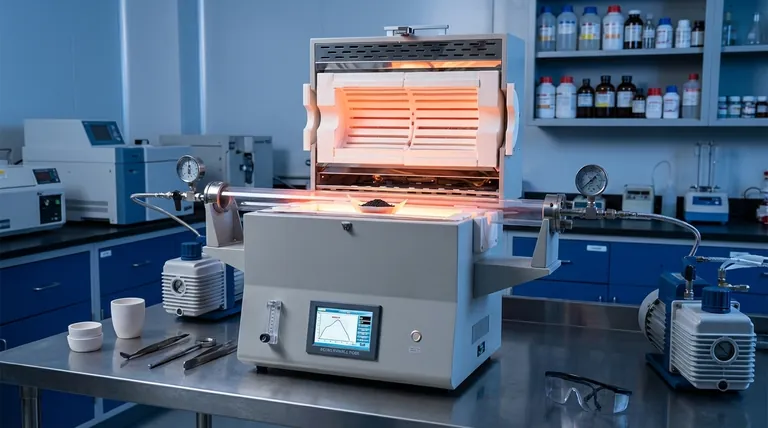
The tube furnace utilizes atmospheric pressure sintering at 1200°C. Unlike HPHT, which compresses the material lattice, the tube furnace maintains a neutral pressure environment. This lack of external compressive stress is the defining variable that dictates how the crystal forms.
Unrestricted Atomic Diffusion
In the high-pressure environment of HPHT, atomic movement is mechanically constrained. Conversely, the tube furnace environment provides sufficient thermal energy without pressure constraints, allowing atoms to diffuse freely. This high mobility is critical for the material to reorganize itself into its most naturally stable configuration.
Impact on Crystal Growth
The Step-Growth Mechanism
Because atomic diffusion is sufficient and unrestricted, grain growth in a tube furnace follows a step-growth mechanism. This is a slower, more orderly process compared to the rapid or forced growth often seen in high-pressure environments. The crystals grow layer by layer, adhering to their natural crystallographic habits.
Reaching the Most Stable State
The objective of the tube furnace process is thermodynamic stability. By allowing the material to "relax" into its preferred structure, the system minimizes internal energy. This results in Fe2B-HS samples that represent the material's most stable theoretical state.
Structural Perfection
The direct result of this growth mode is a crystal with a complete structure and no stacking faults. While HPHT is often used specifically to induce beneficial defects (defect engineering) to enhance hardness or other properties, the tube furnace yields a defect-free lattice.
Operational Control and Trade-offs
Precision vs. Speed
While the primary reference highlights the structural outcome, it is worth noting that tube furnaces excel at precision. They allow for the management of specific atmospheres (such as inert argon or reductive hydrogen mixtures) and precise heating rates. This control ensures the microstructure is dictated purely by thermal dynamics rather than inconsistent environmental factors.
The "Benchmark" Limitation
The "perfect" crystals produced by a tube furnace are not always the end goal for high-performance applications.
- The Trade-off: A defect-free structure often lacks the specific property enhancements (like increased hardness or catalytic activity) that come from lattice strain or stacking faults.
- The Utility: Consequently, the tube furnace sample serves primarily as a control group. It validates that any performance gains seen in HPHT samples are indeed due to defect engineering, rather than impurities or phase changes.
Making the Right Choice for Your Goal
If you are deciding between these two preparation methods, your choice depends entirely on whether you need a reference standard or an enhanced material.
- If your primary focus is establishing a baseline: Use the tube furnace to create defect-free crystals with complete structures to serve as a performance benchmark.
- If your primary focus is material enhancement: Use HPHT methods to induce stacking faults and engage in defect engineering for superior mechanical or catalytic properties.
The tube furnace provides the "perfect" crystal, proving that the imperfections created by other methods are intentional and effective.
Summary Table:
| Feature | Tube Furnace Sintering | HPHT Methods |
|---|---|---|
| Pressure Level | Atmospheric (Neutral) | High Pressure (Compressive) |
| Atomic Diffusion | Unrestricted & High Mobility | Mechanically Constrained |
| Growth Mechanism | Step-growth (Layer by layer) | Rapid / Forced Growth |
| Structural Goal | Complete structure (No faults) | Defect Engineering (Stacking faults) |
| Primary Utility | Thermodynamic Stability & Benchmark | Property Enhancement (e.g., Hardness) |
Optimize Your Material Synthesis with KINTEK Precision
Whether you are establishing a structural benchmark or scaling complex research, KINTEK provides the thermal precision necessary for thermodynamic perfection. Our advanced high-temperature solutions, backed by expert R&D and manufacturing, include Muffle, Tube, Rotary, Vacuum, and CVD systems—all fully customizable to meet your unique laboratory requirements.
Ready to achieve superior crystal growth and structural control? Contact us today to discover how our high-temp furnaces can empower your material science innovations.
Visual Guide

References
- Haoyu Li, Qiang Tao. Unveiling the Stacking Faults in Fe2B Induces a High-Performance Oxygen Evolution Reaction. DOI: 10.3390/catal15010089
This article is also based on technical information from Kintek Furnace Knowledge Base .
Related Products
- Vacuum Sealed Continuous Working Rotary Tube Furnace Rotating Tube Furnace
- 1400℃ High Temperature Laboratory Tube Furnace with Alumina Tube
- 1700℃ High Temperature Laboratory Tube Furnace with Alumina Tube
- Magnesium Extraction and Purification Condensing Tube Furnace
- High Pressure Laboratory Vacuum Tube Furnace
People Also Ask
- What is the purpose of rotary tube furnaces? Achieve Uniform Heat Treatment for Powders and Granules
- What are the key advantages of using a rotary tube furnace? Achieve Dynamic, Uniform Heating for Powders
- What are the advantages of rotary tube furnaces in fuel compatibility? Boost Efficiency and Cut Costs
- How does the amount of material processed vary between batch and continuous rotary tube furnaces? Scale Your Production Efficiently
- What is the temperature range of some rotary tube furnaces? Achieve Uniform Heating Up to 1200°C



















