
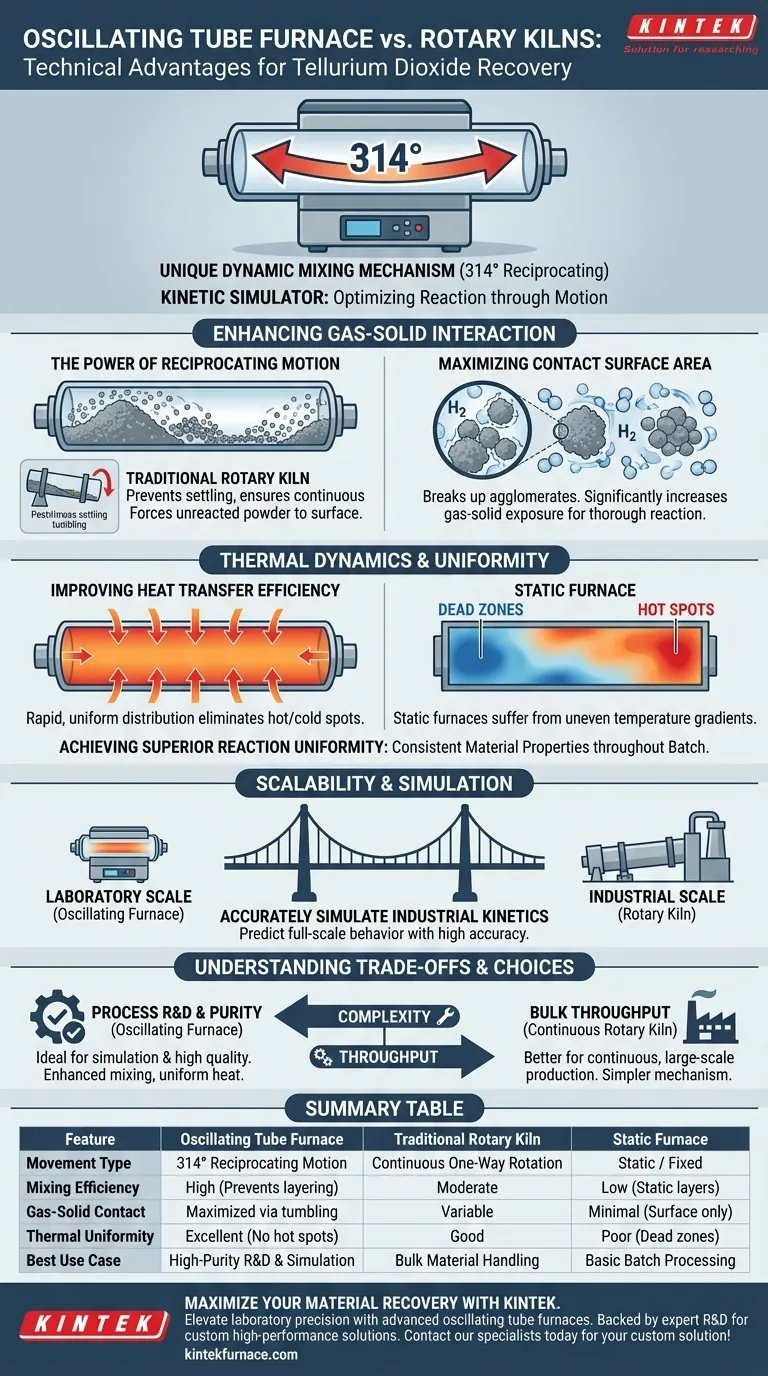
The oscillating tube furnace distinguishes itself through a unique dynamic mixing mechanism that optimizes the reaction between tellurium dioxide and hydrogen. By utilizing large-angle reciprocating movements—specifically up to 314 degrees—this equipment maximizes the contact surface area between the solid powder and the gas. This technical advantage directly translates to superior heat transfer efficiency and a higher degree of reaction uniformity compared to standard methods.
Core Takeaway The oscillating tube furnace is not just a heating vessel; it is a kinetic simulator. By mechanically enforcing thorough gas-solid contact through reciprocating motion, it replicates the efficiency of industrial-scale processing while maintaining the precision required for high-purity recovery.
Enhancing Gas-Solid Interaction
The Power of Reciprocating Motion
Standard rotary kilns typically rotate continuously in one direction. In contrast, the oscillating tube furnace employs a reciprocating movement, rotating back and forth up to 314 degrees.
This specific motion prevents the tellurium dioxide powder from settling into static layers. It forces the material to tumble and cascade repeatedly, ensuring that unreacted powder is constantly brought to the surface.
Maximizing Contact Surface Area
Recovery efficiency relies heavily on how well the reactive hydrogen gas contacts the solid tellurium dioxide. The oscillating action significantly increases the effective contact surface area exposed to the gas stream.
By breaking up agglomerates and constantly refreshing the surface of the powder bed, the furnace ensures the reduction reaction occurs thoroughly throughout the entire batch, not just at the top layer.
Thermal Dynamics and Uniformity
Improving Heat Transfer Efficiency
Static furnaces often suffer from heat accumulation or "dead zones" where temperature gradients vary. The dynamic mixing of the oscillating furnace facilitates rapid and uniform heat distribution.
As the powder moves, it absorbs heat more evenly from the tube walls and the gas environment. This eliminates hot spots that could degrade the material and cold spots that result in incomplete reactions.
Achieving Superior Reaction Uniformity
Uniformity is the ultimate goal in tellurium dioxide recovery. The combination of consistent heat and maximized gas exposure ensures the properties of the processed material are consistent throughout the batch.
This reduces the risk of variability in the final product, a common issue in static mesh belt or push plate furnaces where air leakage and uneven heating occur.
Scalability and Simulation
Bridging Laboratory and Industry
A critical advantage of the oscillating tube furnace is its ability to simulate industrial kinetics at a laboratory scale.
It replicates the mixing dynamics and heat transfer profiles of massive industrial rotary kilns. This allows engineers to predict how the recovery process will behave in a full-scale production environment with high accuracy.
Understanding the Trade-offs
Complexity vs. Throughput
While the oscillating mechanism offers superior mixing, it introduces mechanical complexity compared to simple static furnaces. The moving parts require maintenance to ensure the 314-degree motion remains precise.
Furthermore, while excellent for batch processing and high-precision recovery, an oscillating setup may have lower throughput capabilities compared to a continuous, industrial-scale rotary kiln designed for bulk material handling.
Making the Right Choice for Your Goal
To determine if an oscillating tube furnace is the right fit for your tellurium dioxide recovery process, consider your specific objectives:
- If your primary focus is Process R&D: The oscillating furnace is ideal because it accurately simulates industrial rotary kiln kinetics, allowing you to refine parameters with confidence before scaling up.
- If your primary focus is Product Purity: The enhanced mixing and uniform heat transfer make this the superior choice for ensuring high-quality, consistent material properties.
The oscillating tube furnace transforms the recovery process from a passive heating event into a dynamic, highly controlled reaction environment.
Summary Table:
| Feature | Oscillating Tube Furnace | Traditional Rotary Kiln | Static Furnace |
|---|---|---|---|
| Movement Type | 314° Reciprocating Motion | Continuous One-Way Rotation | Static / Fixed |
| Mixing Efficiency | High (Prevents layering) | Moderate | Low (Static layers) |
| Gas-Solid Contact | Maximized via tumbling | Variable | Minimal (Surface only) |
| Thermal Uniformity | Excellent (No hot spots) | Good | Poor (Dead zones) |
| Best Use Case | High-Purity R&D & Simulation | Bulk Material Handling | Basic Batch Processing |
Maximize Your Material Recovery with KINTEK
Elevate your laboratory precision with KINTEK’s advanced oscillating tube furnaces. Backed by expert R&D and world-class manufacturing, we provide high-performance thermal solutions—including Muffle, Tube, Rotary, Vacuum, and CVD systems—all fully customizable to meet your unique processing requirements. Whether you are refining tellurium dioxide recovery or simulating industrial kinetics, our equipment ensures superior uniformity and efficiency.
Ready to optimize your high-temperature processes?
Contact our specialists today to find your custom solution!
Visual Guide
References
- Hanwen Chung, Bernd Friedrich. Hydrogen Reduction of Tellurium Oxide in a Rotary Kiln, Initial Approaches for a Sustainable Process. DOI: 10.3390/cryst15050478
This article is also based on technical information from Kintek Furnace Knowledge Base .
Related Products
- Laboratory Vacuum Tilt Rotary Tube Furnace Rotating Tube Furnace
- Vacuum Sealed Continuous Working Rotary Tube Furnace Rotating Tube Furnace
- Split Multi Heating Zone Rotary Tube Furnace Rotating Tube Furnace
- Vertical Laboratory Quartz Tube Furnace Tubular Furnace
- Slide PECVD Tube Furnace with Liquid Gasifier PECVD Machine
People Also Ask
- What are the key advantages of using a rotary tube furnace? Achieve Dynamic, Uniform Heating for Powders
- What are the technical advantages of using a rotary tube furnace for hydrochar activation? Achieve Superior Porosity
- What other fields utilize rotary tube furnaces? Discover Versatile Heating Solutions for Multiple Industries
- When are rotary tube furnaces not suitable for a process? Avoid Costly Mistakes in Thermal Processing
- What optional features enhance the processing capabilities of rotary tube furnaces? Boost Efficiency with Advanced Customizations



















