
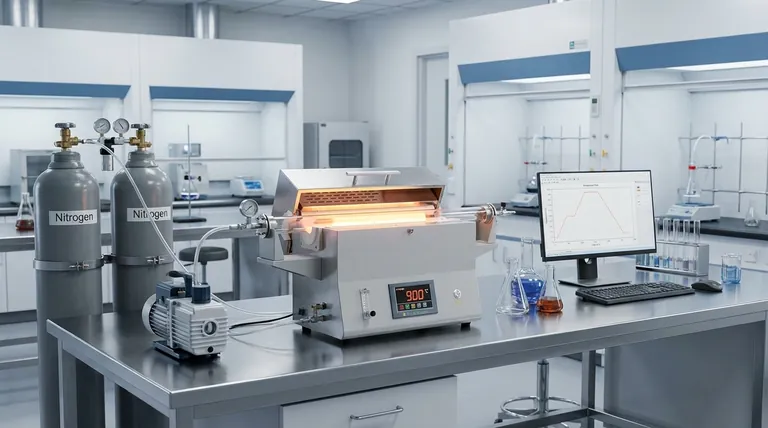
A high-temperature tube furnace serves as the precise reaction chamber required to transform ZIF-8 precursors into functional nitrogen-doped carbon (NC) supports. By maintaining a stable temperature of 900 °C under a protective nitrogen atmosphere, the furnace facilitates a controlled pyrolysis process. This environment enables the carbonization of the organic framework over a typical three-hour duration while simultaneously integrating nitrogen into the carbon structure.
The tube furnace does not merely heat the material; it orchestrates a delicate phase transition. It balances the removal of volatile components with the preservation of the structural framework, converting a non-conductive polymer into a highly conductive, porous carbon material.
The Mechanics of Transformation
Controlled Pyrolysis Environment
The primary function of the furnace is to provide a thermal field capable of reaching and sustaining 900 °C. At this specific temperature, the organic ligands within the ZIF-8 structure begin to decompose and rearrange. This converts the material from an organic metal-organic framework into a stable carbon skeleton.
Protective Inert Atmosphere
The "tube" design allows for the flow of inert gases, specifically nitrogen in this application. This atmosphere is critical to prevent combustion; if oxygen were present at 900 °C, the carbon would burn away completely. The nitrogen flow ensures that the ZIF-8 undergoes carbonization (rearrangement) rather than oxidation (burning).
Simultaneous Nitrogen Doping
The furnace environment facilitates in-situ doping. As the ZIF-8 precursor contains nitrogen within its organic ligands, the controlled heating process retains these nitrogen atoms within the newly forming carbon lattice. This results in a material with modified electronic properties compared to pure carbon.
Structural and Functional Outcomes
Generating High Surface Area
The thermal process drives off volatile elements, leaving behind a highly porous structure. The tube furnace ensures this off-gassing happens at a rate that creates a high specific surface area, which is essential for the material's future use as a catalyst support.
Enhancing Electrical Conductivity
The high-temperature treatment at 900 °C increases the degree of graphitization within the carbon. This structural change significantly boosts the electrical conductivity of the final support. Without the sustained high heat provided by the furnace, the material would remain insulating and ineffective for electrochemical applications.
Morphology Preservation
While the primary reference focuses on the 900 °C set point, supplementary data suggests that the furnace's ability to ramp temperature slowly (e.g., 2 °C per minute) is vital. A gradual heating program helps preserve the original dodecahedral morphology of the ZIF-8 crystals while they convert to carbon.
Understanding the Trade-offs
Heating Rate Sensitivity
The precision of the tube furnace is a double-edged sword. While it allows for exact temperature control, setting the heating ramp rate too high can cause the ZIF-8 structure to collapse rapidly, destroying the porosity. A slow, controlled ramp is necessary to maintain the desired pore structure.
Atmosphere Integrity
The system is entirely dependent on the seal of the tube and the purity of the nitrogen gas. Even a minor leak introducing oxygen into the chamber at 900 °C will degrade the carbon yield and alter the surface chemistry, ruining the nitrogen-doping efficiency.
Making the Right Choice for Your Goal
To optimize the synthesis of nitrogen-doped carbon supports from ZIF-8, align your furnace settings with your specific objectives:
- If your primary focus is Electrical Conductivity: Prioritize the stability of the dwell time at 900 °C to ensure maximum graphitization and carbon ordering.
- If your primary focus is Pore Structure Retention: Focus on programming a conservative heating ramp rate (such as 2 °C/min) to prevent structural collapse during volatile release.
The high-temperature tube furnace is the defining tool that bridges the gap between a raw chemical precursor and a high-performance functional material.
Summary Table:
| Process Parameter | Role in ZIF-8 Synthesis | Impact on NC Support Output |
|---|---|---|
| 900 °C Temperature | Facilitates graphitization & ligands decomposition | Enhances electrical conductivity & carbon skeleton stability |
| Inert N2 Atmosphere | Prevents oxidation and combustion | Ensures high carbon yield and structural integrity |
| Slow Ramp Rate | Manages volatile off-gassing | Preserves dodecahedral morphology and high surface area |
| Nitrogen Doping | In-situ integration of N atoms | Modifies electronic properties for catalytic applications |
Elevate Your Material Synthesis with KINTEK Precision
Unlock the full potential of your ZIF-8 precursors with KINTEK’s high-performance laboratory solutions. Backed by expert R&D and manufacturing, we provide high-temperature Tube, Muffle, Rotary, Vacuum, and CVD systems designed for the rigorous demands of nitrogen-doped carbon production.
Whether you need precise atmosphere control, uniform heating zones, or customizable temperature profiles to maintain critical porosity, KINTEK offers the thermal expertise your research deserves. Our systems are fully customizable to meet your unique lab requirements, ensuring repeatable, high-quality results for all your electrocatalyst and carbon support projects.
Ready to optimize your carbonization process?
Contact our experts today to find your perfect furnace solution!
References
- Bingzhe Yu, Shaowei Chen. Ultrafast preparation of ruthenium nanoparticle/molybdenum oxide/nitrogen-doped carbon nanocomposites by magnetic induction heating for efficient hydrogen evolution reaction. DOI: 10.1039/d4ta00884g
This article is also based on technical information from Kintek Furnace Knowledge Base .
Related Products
- 1700℃ High Temperature Laboratory Tube Furnace with Alumina Tube
- 1400℃ High Temperature Laboratory Tube Furnace with Alumina Tube
- 1700℃ Controlled Inert Nitrogen Atmosphere Furnace
- 1200℃ Split Tube Furnace Laboratory Quartz Tube Furnace with Quartz Tube
- 1400℃ Controlled Inert Nitrogen Atmosphere Furnace
People Also Ask
- How does zone-melting in tube furnaces synthesize bismuth micro-wires? Master Single-Crystal Thermoelectric Growth
- How do high-temperature laboratory tube furnaces ensure environmental stability? Precision Thermal Reduction Tips
- How are high-temperature laboratory tube furnaces applied in long-term vacuum homogenization heat treatments for intermetallic samples?
- How are high-temp tube furnaces used to measure diffusion coefficients per Fick's law? Master Precision Annealing
- How are high-temperature tube furnaces applied in testing ceramic-supported alloy membranes? Insights



















