
In the Chemical Vapor Transport (CVT) synthesis of Fe3GeTe2, the high-purity quartz tube functions as a sealed, chemically inert reaction vessel that creates the isolated environment necessary for crystal growth. It holds the raw powder materials (iron, germanium, and tellurium) and the iodine transport agent, allowing them to withstand temperatures up to 750 °C without reacting with the container itself.
Success in CVT synthesis relies entirely on maintaining a pristine, closed ecosystem. The quartz tube is the critical barrier that preserves the vacuum and facilitates the temperature gradient required to transform raw powders into high-quality single crystals.
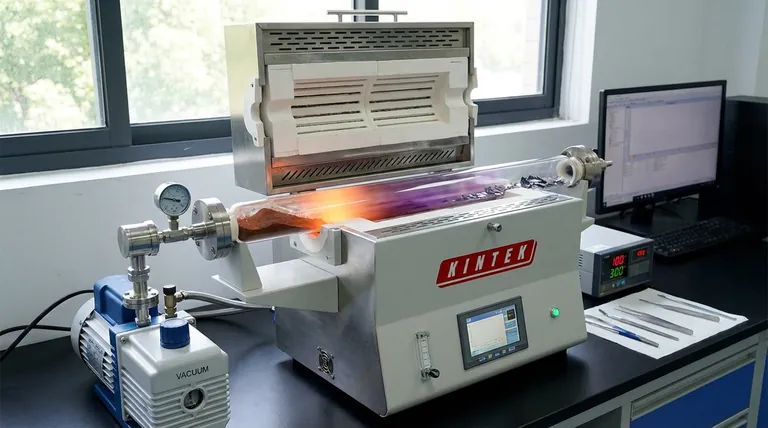
Creating the Conditions for Growth
Withstanding Extreme Temperatures
The primary physical requirement of the tube is thermal resilience. The synthesis of Fe3GeTe2 requires processing temperatures reaching 750 °C.
High-purity quartz is selected specifically because it maintains structural integrity and does not soften or deform under these intense thermal loads.
Maintaining a Vacuum Seal
The tube acts as a vacuum chamber on a micro-scale. Before the heating process begins, the tube is evacuated and sealed.
This seal prevents the introduction of atmospheric oxygen or moisture, which would oxidize the raw materials and ruin the synthesis. It ensures the reaction occurs strictly between the Fe, Ge, Te, and the iodine agent.
Facilitating the Chemical Reaction
Ensuring Chemical Inertness
Beyond simple heat resistance, the "high-purity" aspect of the quartz is vital to preventing contamination.
At high temperatures, standard glass or lower-grade materials could leach impurities into the vapor. High-purity quartz remains chemically inert, ensuring that the final Fe3GeTe2 crystals are composed solely of the intended elements.
Supporting Directional Transport
The tube is the physical runway for the transport mechanism. It is placed inside a furnace that generates a specific temperature gradient along the length of the tube.
This gradient drives the gas-phase components from the hot source zone to the cooler deposition zone. The geometry of the tube facilitates this directional flow, allowing for the controlled nucleation and growth of single crystals at the specific deposition site.
Understanding the Trade-offs
The Fragility of the Closed System
While the quartz tube is robust against heat and chemistry, it introduces a constraint regarding pressure management.
Because the system is a sealed volume, the sublimation of the transport agent (iodine) creates significant internal pressure. If the tube is too thin or the temperature gradient is mismanaged, the internal pressure can rupture the vessel.
Purity vs. Cost
High-purity quartz is distinct from standard silica glass. Using lower-quality tubes to reduce costs is a common pitfall.
Lower-grade tubes may withstand the heat but often fail the inertness test, introducing trace elements that degrade the magnetic or electronic properties of the resulting Fe3GeTe2 crystal.
Making the Right Choice for Your Goal
To ensure the successful synthesis of Fe3GeTe2, consider your specific experimental objectives:
- If your primary focus is crystal purity: Prioritize the highest grade of quartz available to eliminate any risk of silicon or impurity leaching during the high-temperature phase.
- If your primary focus is large crystal growth: Ensure the tube length is sufficient to establish a gradual, stable temperature gradient, preventing rapid nucleation that leads to polycrystals.
The quartz tube is not merely a container; it is the fundamental boundary that defines the quality and success of your crystal growth.
Summary Table:
| Feature | Function in CVT Synthesis | Advantage for Fe3GeTe2 |
|---|---|---|
| Thermal Resilience | Withstands up to 750 °C | Maintains structural integrity under intense thermal loads |
| Chemical Inertness | Prevents leaching of impurities | Ensures high-purity single crystals with precise magnetic properties |
| Vacuum Sealing | Isolates reaction environment | Prevents oxidation and contamination from oxygen or moisture |
| Geometric Design | Facilitates temperature gradient | Enables directional gas flow for controlled crystal nucleation |
Elevate Your Crystal Growth Precision
Precision in CVT synthesis starts with the right environment. KINTEK provides industry-leading high-purity quartz solutions and advanced thermal systems designed to meet the rigorous demands of material science research.
Backed by expert R&D and manufacturing, KINTEK offers Muffle, Tube, Rotary, Vacuum, and CVD systems, all of which are customizable for your unique laboratory needs. Whether you are synthesizing Fe3GeTe2 or developing new 2D materials, our equipment ensures the thermal stability and purity your work requires.
Ready to achieve superior single-crystal quality? Contact KINTEK today for expert guidance and custom solutions.
References
- Microthermoreflectance Characterization of the Band‐Structure Transformations Observed During the Magnetic‐Ordering Transitions of Multilayered 2D Fe <sub>3</sub> GeTe <sub>2</sub> Ferromagnetic Metals. DOI: 10.1002/smsc.202500293
This article is also based on technical information from Kintek Furnace Knowledge Base .
Related Products
- High Pressure Laboratory Vacuum Tube Furnace
- Custom Made Versatile CVD Tube Furnace Chemical Vapor Deposition CVD Equipment Machine
- Vertical Laboratory Quartz Tube Furnace Tubular Furnace
- Magnesium Extraction and Purification Condensing Tube Furnace
- Slide PECVD Tube Furnace with Liquid Gasifier PECVD Machine
People Also Ask
- What role does a high vacuum tube furnace play in Co-Al sintering? Master High-Purity Porous Material Synthesis
- What are the different types of tube furnaces available? Find the Perfect Fit for Your Lab's Needs
- What is the role of a vacuum tube furnace during the final thermal treatment stage of Fe3O4@CSAC catalysts?
- What are the main advantages of vacuum tube furnaces in the market? Achieve Purity and Precision in Material Processing
- Why is control of heating rate and gas flow in a lab tube furnace critical for EM wave absorption materials?












