
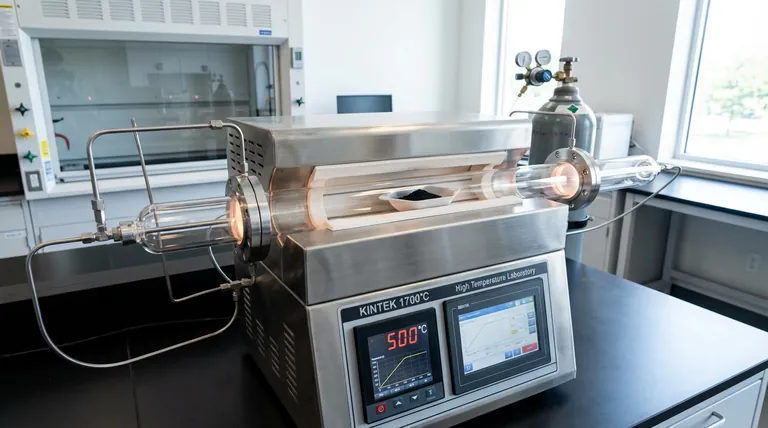
A tube furnace functions as the primary reactor for the controlled carbonization of biomass. It provides a strictly regulated high-temperature environment, typically around 500°C, combined with a continuous flow of inert gas like nitrogen. This ensures the raw biomass is thermally treated in an oxygen-free state, preventing combustion and facilitating the specific thermochemical changes needed to create a stable biochar carrier.
By maintaining a sealed, anaerobic environment with precise thermal distribution, the tube furnace determines the initial pore structure and surface chemistry of the biochar. This process transforms organic material into a rigid carbon skeleton, establishing the physical foundation required for the material to function effectively as a catalyst support.
Establishing the Critical Reaction Environment
Creating a Strictly Anaerobic Atmosphere
The defining feature of a tube furnace is its ability to maintain a strictly inert atmosphere. The sealed tube design allows for the continuous introduction of high-purity nitrogen (or other inert gases like argon) to purge oxygen from the chamber.
This oxygen-free environment is non-negotiable for biochar preparation. It prevents aerobic combustion, ensuring that the biomass undergoes pyrolysis—decomposition by heat—rather than burning into ash.
Precision Thermal Management
A tube furnace provides the stable heat distribution necessary for uniform carbonization. It allows for exact control over heating rates (e.g., 20°C per minute) and maintains specific target temperatures ranging from 300°C to 800°C, with 500°C being a standard baseline for primary carbonization.
At these temperatures, the furnace drives thermochemical reactions such as dehydration and decarbonization. This controlled thermal stress removes volatile components while fixing the carbon into a solid structure.
Determining Carrier Properties
Defining the Physical Skeleton
The thermal treatment provided by the tube furnace dictates the pore structure of the resulting biochar. By removing volatiles in a controlled manner, the furnace leaves behind a carbon skeleton with high porosity.
This preliminary pore network acts as the physical foundation for the carrier. It provides the necessary surface area where catalytic active sites can later be anchored or where further activation processes can take place.
Modifying Surface Chemistry
Beyond physical structure, the furnace environment determines the surface chemical properties of the carrier. The specific temperature and gas atmosphere influence the retention or removal of functional groups on the biochar surface.
These surface properties are essential for the material's future interaction with catalysts. A well-prepared surface ensures better dispersion and stability of the active components supported by the biochar.
Understanding the Trade-offs
Gas Selection Impacts Outcome
While nitrogen is the standard for creating an inert environment to maximize yield, the choice of gas fundamentally alters the biochar. Using Carbon Dioxide (CO2) at high temperatures changes the furnace from a simple carbonization tool into a physical activation chamber.
Nitrogen preserves the carbon skeleton (high yield), whereas CO2 reacts with the surface to expand pores (high surface area). You must choose the atmosphere based on whether you need a stable primary carrier or a highly activated material, as CO2 may reduce the overall carbon yield.
Temperature vs. Stability
There is a trade-off between carbonization temperature and surface functionality. Lower temperatures (around 300-500°C) generally retain more oxygen-containing functional groups, which can be beneficial for certain catalytic interactions.
However, higher temperatures (up to 800°C) produce a more graphitized, stable carbon structure with higher conductivity but fewer reactive surface groups. The tube furnace allows you to dial in this balance, but you cannot maximize both simultaneously.
Making the Right Choice for Your Goal
To optimize your biochar carrier preparation, select your furnace parameters based on the specific requirements of your catalyst:
- If your primary focus is maximum carbon yield and stability: operate the furnace at moderate temperatures (approx. 500°C) under a strict Nitrogen flow to preserve the carbon skeleton.
- If your primary focus is high surface area and pore volume: consider using Carbon Dioxide as the atmosphere or increasing the temperature (up to 800°C) to facilitate physical activation and pore expansion.
Ultimately, the tube furnace is not just a heater; it is the tuning instrument that defines whether your biomass becomes simple charcoal or a high-performance catalytic carrier.
Summary Table:
| Feature | Role in Biochar Preparation | Impact on Carrier Properties |
|---|---|---|
| Inert Atmosphere | Purges oxygen using N2/Ar to prevent combustion. | Facilitates pyrolysis and ensures high carbon yield. |
| Thermal Precision | Controls heating rates and target temperatures (300-800°C). | Defines the physical carbon skeleton and porosity. |
| Gas Versatility | Allows switching between N2 (inert) and CO2 (activation). | Determines pore expansion and surface area levels. |
| Chemical Tuning | Regulates retention of oxygen-containing functional groups. | Enhances dispersion and stability of catalytic sites. |
Elevate Your Biochar Research with KINTEK
Precision is the difference between simple charcoal and a high-performance catalytic carrier. Backed by expert R&D and manufacturing, KINTEK offers specialized Tube, Muffle, Rotary, Vacuum, and CVD systems designed to give you absolute control over your pyrolysis parameters. Whether you need a standard setup or a fully customizable high-temp furnace for unique biomass research, our equipment ensures the stable, anaerobic environment your project demands.
Ready to optimize your material synthesis? Contact KINTEK today to find the perfect thermal solution for your lab!
References
- Ismaila Mudi, Joseph Wood. A Kinetic Model of Furfural Hydrogenation to 2-Methylfuran on Nanoparticles of Nickel Supported on Sulfuric Acid-Modified Biochar Catalyst. DOI: 10.3390/catal14010054
This article is also based on technical information from Kintek Furnace Knowledge Base .
Related Products
- Electric Rotary Kiln Small Rotary Furnace Biomass Pyrolysis Plant Rotating Furnace
- Electric Rotary Kiln Continuous Working Small Rotary Furnace Kiln for Pyrolysis Plant Heating
- Electric Rotary Kiln Pyrolysis Furnace Plant Machine Small Rotary Kiln Calciner
- Vertical Laboratory Quartz Tube Furnace Tubular Furnace
- High Pressure Laboratory Vacuum Tube Furnace
People Also Ask
- What are the key components of a rotary kiln electric furnace? Unlock Efficient Thermal Processing
- What are the main applications of a rotary kiln electric furnace? Achieve Uniform Heat Treatment for Powders
- What is the significance of the refractory lining in a rotary kiln electric furnace? Unlock Efficiency and Longevity
- What is the benefit of adjustable speed control in rotary kilns? Optimize Efficiency and Quality
- What are the two main types of rotary kilns based on heating method? Choose the Right One for Your Process



















