
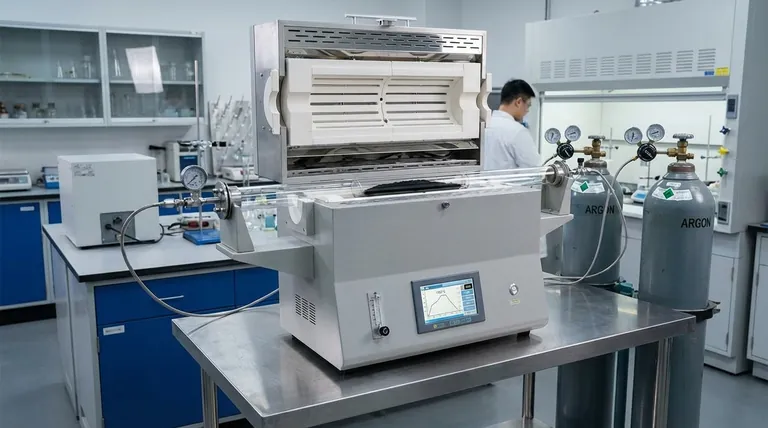
An industrial-grade vacuum tube furnace establishes a strictly controlled environment characterized by precise, constant heating under an inert argon atmosphere. This specialized setting is critical for the preparation of pyrolytic carbon lattices, ensuring that polymer precursors undergo the necessary chemical transformations without oxidation or external contamination.
The furnace creates a processing ecosystem that balances thermal precision with atmospheric protection. By maintaining an inert argon shield and executing specific temperature protocols, it drives essential molecular changes while preventing physical defects caused by volatile gas expansion.
The Components of the Processing Environment
Atmospheric Protection
The fundamental requirement for this process is an inert argon atmosphere.
This protective gas shield prevents oxygen from interacting with the materials during high-temperature processing, which is essential for maintaining chemical purity.
Thermal Precision
The furnace provides a precise heating and constant temperature environment.
Reliable thermal stability is required to ensure consistent results across the entire lattice structure during long processing cycles.
Driving Chemical Transformation
The Pyrolysis Temperature Window
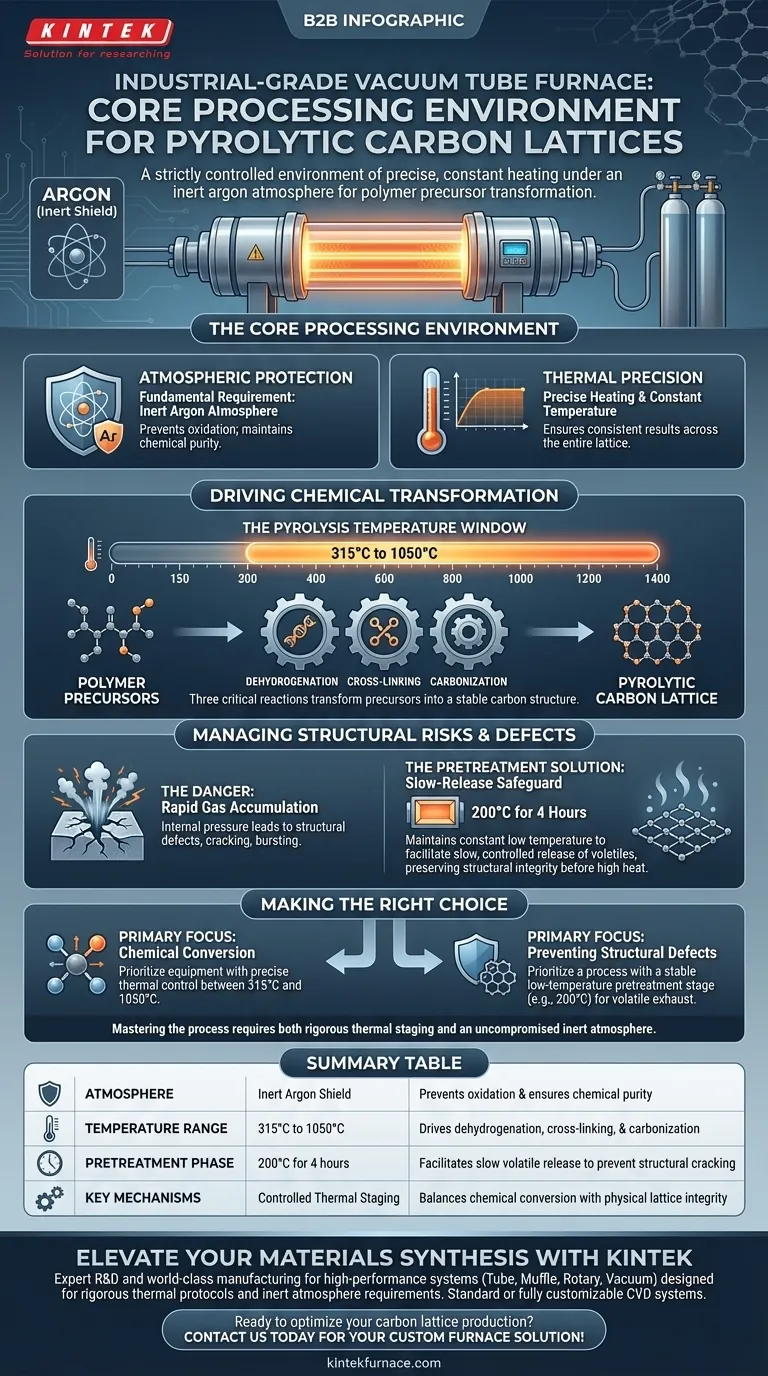
To successfully prepare pyrolytic carbon lattices, the environment must support temperatures ranging from 315 °C to 1050 °C.
Controlling the heat within this specific window is the primary driver for converting the starting material into the final product.
Mechanisms of Change
Within this temperature range, the furnace facilitates three critical chemical reactions: dehydrogenation, cross-linking, and carbonization.
These mechanisms work in tandem to transform the polymer precursors into a stable carbon lattice structure.
Managing Structural Risks and Defects
The Danger of Rapid Gas Accumulation
A common pitfall in pyrolysis is the rapid accumulation of gases released during heating.
If these volatile substances are released too quickly, the internal pressure can lead to structural defects, cracking, or even the bursting of the material.
The Pretreatment Solution
To mitigate this risk, the processing environment must support a low-temperature pretreatment stage.
For example, maintaining a constant temperature of 200 °C for 4 hours facilitates the slow, controlled release of volatiles. This "slow-release" phase acts as a safeguard, preserving the structural integrity of the lattice before higher temperatures are applied.
Making the Right Choice for Your Goal
To optimize the preparation of pyrolytic carbon lattices, you must balance chemical conversion with physical stability.
- If your primary focus is chemical conversion: Ensure your equipment can maintain precise thermal control between 315 °C and 1050 °C to fully drive dehydrogenation and carbonization.
- If your primary focus is preventing structural defects: Prioritize a process that includes a stable low-temperature pretreatment (e.g., 200 °C) to exhaust volatiles before ramping up to pyrolysis temperatures.
Mastering this process requires a furnace that delivers both rigorous thermal staging and an uncompromised inert atmosphere.
Summary Table:
| Feature | Specification/Requirement | Purpose |
|---|---|---|
| Atmosphere | Inert Argon Shield | Prevents oxidation and ensures chemical purity |
| Temperature Range | 315°C to 1050°C | Drives dehydrogenation, cross-linking, and carbonization |
| Pretreatment Phase | 200°C for 4 hours | Facilitates slow volatile release to prevent structural cracking |
| Key Mechanisms | Controlled Thermal Staging | Balances chemical conversion with physical lattice integrity |
Elevate Your Materials Synthesis with KINTEK
Precision is non-negotiable when preparing complex pyrolytic carbon lattices. Backed by expert R&D and world-class manufacturing, KINTEK offers high-performance Tube, Muffle, Rotary, and Vacuum systems specifically designed to handle rigorous thermal protocols and inert atmosphere requirements. Whether you need standard lab high-temp furnaces or a fully customizable CVD system tailored to your unique research goals, our engineering team is ready to deliver the reliability you need.
Ready to optimize your carbon lattice production? Contact us today to discuss your custom furnace solution!
Visual Guide
References
- Ali Naderi, Yeqing Wang. Stiff, lightweight, and programmable architectured pyrolytic carbon lattices via modular assembling. DOI: 10.1038/s43246-025-00739-w
This article is also based on technical information from Kintek Furnace Knowledge Base .
Related Products
- Vacuum Sealed Continuous Working Rotary Tube Furnace Rotating Tube Furnace
- High Pressure Laboratory Vacuum Tube Furnace
- Vacuum Hot Press Furnace Machine Heated Vacuum Press Tube Furnace
- Laboratory Vacuum Tilt Rotary Tube Furnace Rotating Tube Furnace
- Magnesium Extraction and Purification Condensing Tube Furnace
People Also Ask
- What is the purpose of rotary tube furnaces? Achieve Uniform Heat Treatment for Powders and Granules
- What are the key advantages of using a rotary tube furnace? Achieve Dynamic, Uniform Heating for Powders
- What are the advantages of rotary tube furnaces in fuel compatibility? Boost Efficiency and Cut Costs
- How does the amount of material processed vary between batch and continuous rotary tube furnaces? Scale Your Production Efficiently
- What is the temperature range of some rotary tube furnaces? Achieve Uniform Heating Up to 1200°C



















