
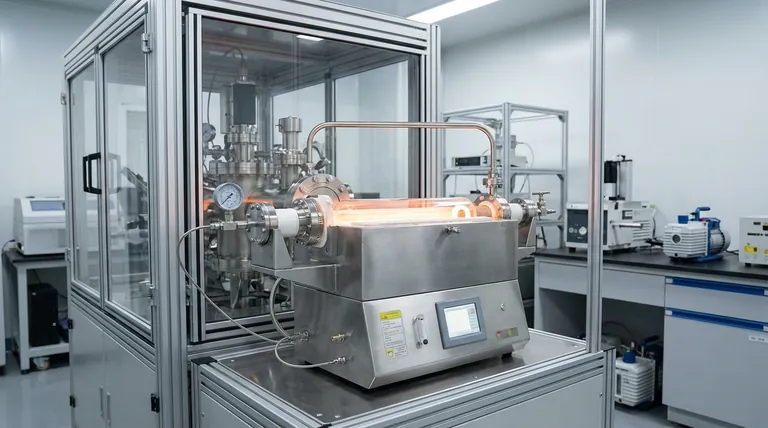
A platinum tube heating device serves as a rigorous purification mechanism specifically designed to generate atomically pure oxygen for high-precision surface science. By heating copper oxide powder encased within the platinum tube, the system releases oxygen into an ultra-high vacuum chamber while strictly preventing the introduction of common contaminants like nitrogen or water vapor found in standard gas cylinders.
Core Takeaway In surface physics, even trace impurities can skew electronic measurements. This device ensures that any observed shift in the tungsten work function is exclusively caused by ordered oxygen adsorption, eliminating false positives from nitrogen or water vapor.
The Challenge of Contamination
Inherent Flaws in Standard Delivery
Traditional methods of gas delivery, such as standard gas cylinders, are insufficient for atomic-level surface studies. These sources frequently introduce unwanted byproducts into the environment.
The Sensitivity of Tungsten
When studying a tungsten single crystal—specifically the (110) plane—the surface is highly reactive. Impurities like nitrogen and water vapor compete with oxygen for adsorption sites.
Obscured Electronic States
If contaminants are present, they alter the surface electronic states (work function) unpredictably. This makes it impossible to distinguish which changes are caused by oxygen and which are caused by the impurities.
How the Platinum Device Ensures Purity
The Copper Oxide Source
The device utilizes copper oxide powder as the chemically bound source of oxygen. This powder is securely contained within the platinum tube structure.
Thermal Release Mechanism
When the device is heated, it triggers the release of oxygen atoms from the copper oxide. Because the oxygen is generated via a chemical reaction inside the vacuum, it bypasses the external atmospheric variables.
Ultra-High Vacuum Compatibility
This method is specifically engineered for ultra-high vacuum (UHV) chambers. It delivers the gas directly to the sample without passing through long, potentially contaminated delivery lines associated with cylinders.
Isolating the Work Function Variable
Attributing Causality
The primary value of this device is the ability to establish cause and effect. Researchers can be certain that changes in the tungsten's work function are purely the result of oxygen interaction.
Ordered Adsorption
The device allows for the study of "ordered" adsorption. Because the oxygen is pure, it forms predictable patterns on the crystal lattice without disruption from foreign atoms.
Understanding the Trade-offs
Complexity vs. Convenience
The platinum tube method is significantly more complex than opening a valve on a gas cylinder. It requires precise temperature control and specialized vacuum hardware.
Specificity of Application
This apparatus is a single-purpose tool. While standard cylinders offer volume and speed, this device sacrifices those for extreme purity. It is not suitable for applications requiring high flow rates or rapid pressurization.
Making the Right Choice for Your Experiment
To determine if this apparatus is necessary for your specific application, evaluate your tolerance for impurity.
- If your primary focus is atomic-level surface physics: You must use the platinum tube device to eliminate nitrogen and water vapor interference, ensuring accurate work function readings.
- If your primary focus is macroscopic oxidation or bulk processing: A standard gas cylinder may suffice, provided the minor variations in surface electronic states do not impact your overall results.
Precision in the delivery system is the only way to guarantee precision in the data.
Summary Table:
| Feature | Platinum Tube Heating Device | Standard Gas Cylinders |
|---|---|---|
| Source Material | Copper Oxide (CuO) powder | Compressed gas bottles |
| Purity Level | Atomically pure (UHV grade) | Contains trace N2, H2O, and CO |
| Mechanism | Thermal decomposition in vacuum | Valve-controlled flow through lines |
| Best For | Surface science & work function studies | Bulk oxidation & macroscopic processing |
| Surface Impact | Ordered adsorption; clear electronic states | Mixed adsorption; obscured data signals |
Elevate Your Surface Science Precision with KINTEK
Don't let trace impurities compromise your atomic-level research. At KINTEK, we understand that precision in data starts with precision in your delivery system. Backed by expert R&D and manufacturing, we provide high-performance solutions including CVD systems, vacuum furnaces, and customizable high-temp lab equipment designed to meet the rigorous demands of ultra-high vacuum environments.
Whether you are studying work functions or developing advanced materials, our customizable systems ensure the purity and control your experiment deserves. Contact KINTEK today to discuss your unique research needs and discover how our specialized laboratory furnaces can empower your next breakthrough.
References
- Sviatoslav Smolnik, E. G. Len. Effect of Deformation on the Electronic Properties of the W(110) Single Crystals Surface Before and After Different Types of Surface Treatment. DOI: 10.15407/mfint.45.09.1083
This article is also based on technical information from Kintek Furnace Knowledge Base .
Related Products
- Multi Heating Zones CVD Tube Furnace Machine for Chemical Vapor Deposition Equipment
- Laboratory Quartz Tube Furnace RTP Heating Tubular Furnace
People Also Ask
- What is the function of a multi-zone tube furnace in CVD synthesis? Master 2D In2Se3 Nanosheet Precision
- Why are multi zone tube furnaces particularly useful for nanomaterial research? Unlock Precise Thermal Control for Advanced Synthesis
- What environmental protection applications utilize multi zone tube furnaces? Unlock Precision in Waste Treatment and Green Tech
- What role do multi zone tube furnaces play in new energy research? Unlock Precise Thermal Control for Innovation
- What temperature-related capabilities make multi zone tube furnaces valuable for research? Unlock Precision Thermal Control

