
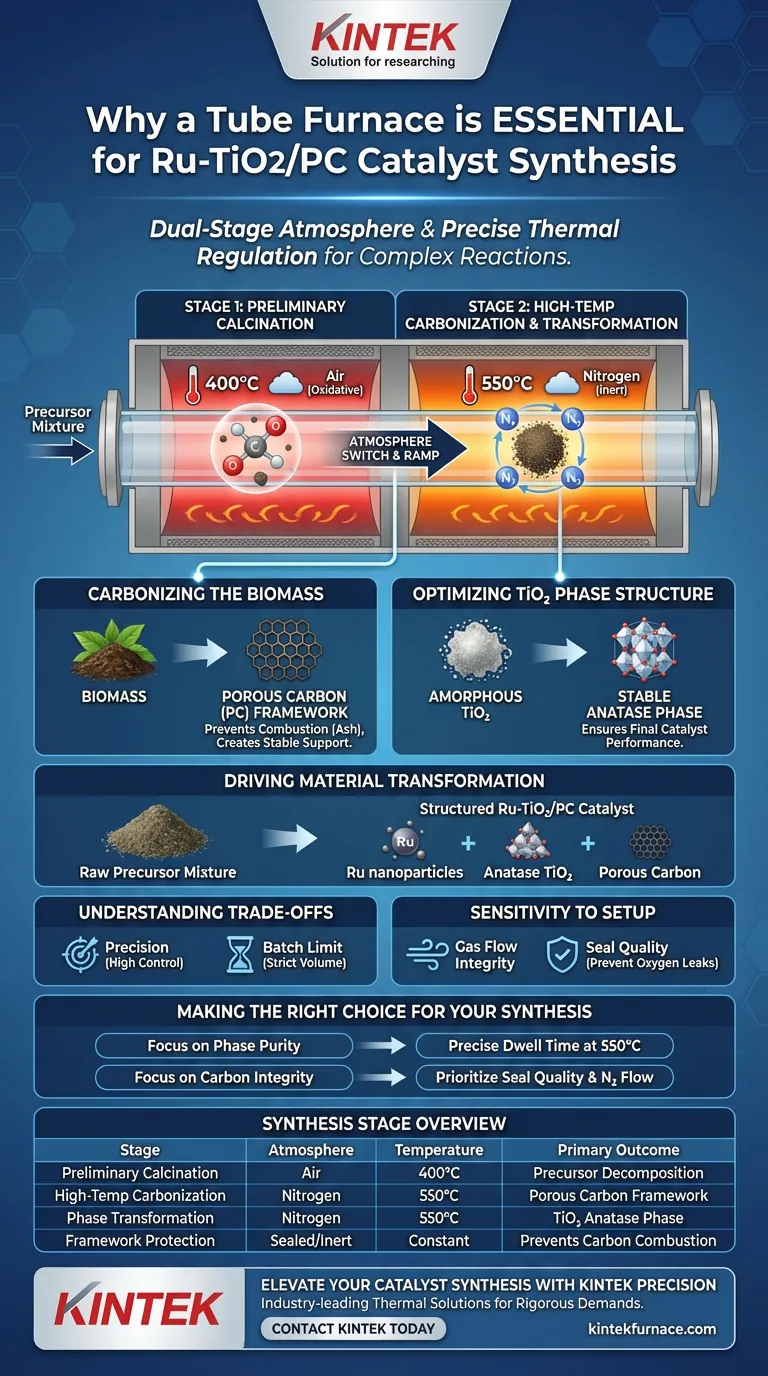
A tube furnace is indispensable for Ru-TiO2/PC catalyst synthesis because it provides the strictly controlled environment necessary to manage complex, multi-stage thermal reactions. It enables a seamless transition from an oxidative atmosphere to an inert protective atmosphere, allowing for preliminary calcination and subsequent high-temperature carbonization within a single equipment setup.
The device’s ability to precisely switch between air and nitrogen atmospheres allows for the simultaneous creation of a porous carbon framework and the stabilization of the TiO2 crystal phase without oxidizing the carbon support.
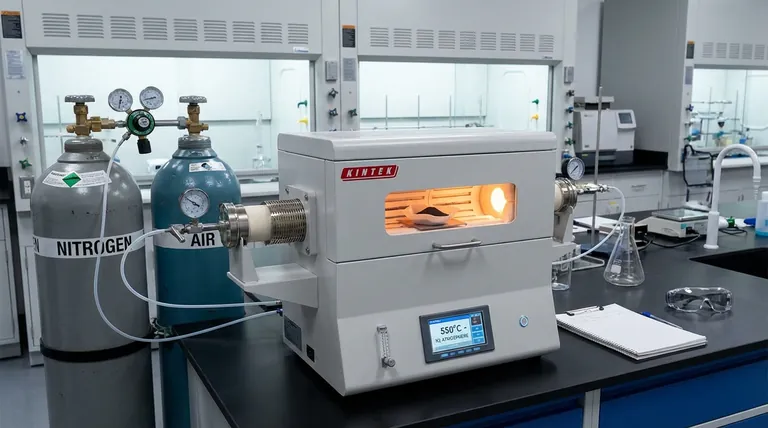
Dual-Stage Atmosphere Management
Switching from Oxidation to Protection
The synthesis of Ru-TiO2/PC is not a single-step heating process; it requires two distinct chemical environments. The tube furnace first facilitates preliminary calcination by heating the mixture to 400°C in an air atmosphere.
Immediately following this, the furnace allows for a safe transition to a protective environment. The system purges the air and replaces it with nitrogen while ramping the temperature to 550°C for a 3-hour duration.
Precise Thermal Regulation
Standard ovens cannot easily switch atmospheres while maintaining high thermal energy. The tube furnace creates a sealed ecosystem where the temperature can be ramped accurately between these two stages.
This precision ensures that the thermal stress applied to the precursor materials is consistent. It prevents thermal shock or uneven heating that could lead to structural defects in the catalyst.
Driving Material Transformation
Carbonizing the Biomass
The switch to a nitrogen atmosphere at 550°C is critical for the biomass component of the precursor. This inert environment facilitates carbonization, converting the biomass into a stable Porous Carbon (PC) framework.
If this step occurred in air, the biomass would simply combust and turn to ash. The tube furnace’s protective atmosphere preserves the carbon structure, which serves as the essential support for the metal catalyst.
Optimizing TiO2 Phase Structure
Simultaneous with carbonization, the thermal treatment dictates the crystalline quality of the titanium dioxide. The process drives the phase transformation of TiO2 from a reactive amorphous state to a stable anatase phase.
Achieving the anatase phase is vital for the catalyst's final performance. The strictly controlled sintering environment ensures this transformation occurs fully, without progressing to less active phases or resulting in mixed-phase impurities.
Understanding the Trade-offs
Throughput vs. Precision
While a tube furnace offers unmatched control over atmosphere and phase purity, it is inherently a batch-processing tool. The strictly controlled volume limits the amount of material you can synthesize in a single run.
Sensitivity to Setup
The quality of the output is heavily dependent on the integrity of the gas flow system. Even a minor leak in the tube seals during the nitrogen phase can introduce oxygen, ruining the porous carbon framework through unintended oxidation.
Making the Right Choice for Your Synthesis
To ensure the successful synthesis of Ru-TiO2/PC catalysts, you must align your equipment settings with your specific structural goals.
- If your primary focus is Phase Purity: Ensure the furnace maintains a precise dwell time at 550°C to guarantee the complete conversion of TiO2 to the anatase phase.
- If your primary focus is Carbon Framework Integrity: Prioritize the seal quality and nitrogen flow rate to absolutely prevent oxygen contamination during the high-temperature carbonization stage.
Ultimately, the tube furnace acts not just as a heater, but as a programmable chemical reactor that dictates the structural destiny of your catalyst.
Summary Table:
| Synthesis Stage | Atmosphere | Temperature | Primary Outcome |
|---|---|---|---|
| Preliminary Calcination | Air (Oxidative) | 400°C | Initial precursor decomposition |
| High-Temp Carbonization | Nitrogen (Inert) | 550°C | Formation of Porous Carbon (PC) framework |
| Phase Transformation | Nitrogen (Inert) | 550°C | Stabilization of TiO2 into Anatase phase |
| Framework Protection | Sealed/Inert | Constant | Prevention of carbon support combustion |
Elevate Your Catalyst Synthesis with KINTEK Precision
Don't let structural defects or unintended oxidation compromise your research. KINTEK provides industry-leading thermal solutions backed by expert R&D and manufacturing. Our high-performance Tube Furnaces, Muffle, Rotary, Vacuum, and CVD systems are engineered for the rigorous demands of multi-stage thermal reactions.
Whether you need precise atmosphere switching for Ru-TiO2/PC synthesis or custom-tailored heating profiles for unique lab applications, our systems deliver the stability and control you require.
Ready to optimize your material transformation? Contact us today to discuss your custom furnace needs and discover how KINTEK can enhance your lab's efficiency and results.
Visual Guide
References
- Ruixiang Wu, Qianwei Ke. Preparation and characterization of Ru-TiO<sub>2</sub>/PC/Fe<sub>3</sub>O<sub>4</sub> composite catalyst with enhanced photocatalytic performance and magnetic recoverability under simulated solar light. DOI: 10.1039/d4ra07712a
This article is also based on technical information from Kintek Furnace Knowledge Base .
Related Products
- Vacuum Sealed Continuous Working Rotary Tube Furnace Rotating Tube Furnace
- 1400℃ High Temperature Laboratory Tube Furnace with Alumina Tube
- 1700℃ High Temperature Laboratory Tube Furnace with Alumina Tube
- 1200℃ Split Tube Furnace Laboratory Quartz Tube Furnace with Quartz Tube
- Vertical Laboratory Quartz Tube Furnace Tubular Furnace
People Also Ask
- What is the purpose of rotary tube furnaces? Achieve Uniform Heat Treatment for Powders and Granules
- What are the key advantages of using a rotary tube furnace? Achieve Dynamic, Uniform Heating for Powders
- What are the advantages of rotary tube furnaces in fuel compatibility? Boost Efficiency and Cut Costs
- How does the amount of material processed vary between batch and continuous rotary tube furnaces? Scale Your Production Efficiently
- What is the temperature range of some rotary tube furnaces? Achieve Uniform Heating Up to 1200°C



















