
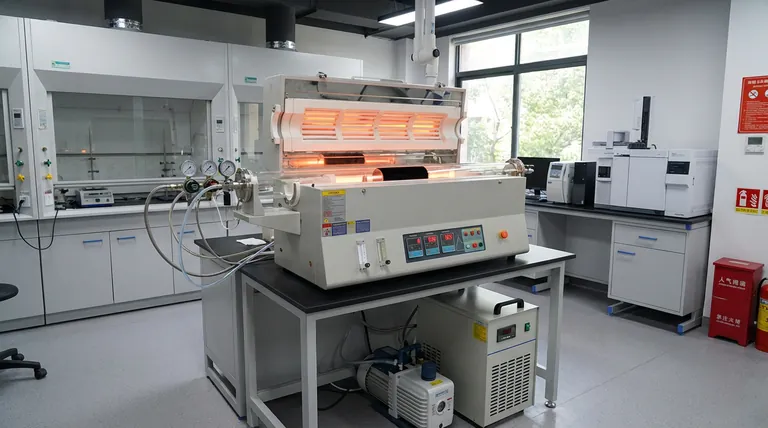
The horizontal tubular furnace acts as the thermal and containment engine for the Chemical Vapor Deposition (CVD) process. It provides a sealed environment that heats the substrate to critical reaction temperatures, such as 700 °C, while managing the flow of essential gases like argon, hydrogen, and acetylene. By establishing a precise thermal field, the furnace drives the decomposition of gases and the nucleation of catalyst particles required for the vertical growth of carbon nanotubes (VACNTs).
The furnace provides the necessary thermal energy to break down hydrocarbon gases and activate catalyst particles. This controlled heat, combined with a contained gas flow, drives the chemical reactions required to grow carbon nanotubes vertically from a substrate.
Creating the Ideal Reaction Environment
The primary function of the horizontal tubular furnace is to transform a passive substrate into an active growth site. This requires precise manipulation of heat and chemistry.
Thermal Activation and Decomposition
The furnace creates a high-temperature zone, typically around 700 °C, which is critical for the process.
This thermal energy is not merely for heating the substrate; it is the catalyst for chemical change. It forces the decomposition of the carbon source gas (acetylene) into the carbon atoms needed to build the nanotubes.
Catalyst Particle Nucleation
Inside the furnace, the thermal field plays a vital role in preparing the substrate.
The heat promotes the nucleation of catalyst particles on the substrate surface. These particles serve as the "seeds" from which the carbon nanotubes will eventually sprout and grow.
Managing Chemical Components
Beyond heat, the furnace serves as a flow reactor that manages the complex interplay of gases.
Controlled Gas Introduction
The tubular design allows for the streamlined introduction of specific process gases.
Argon is often used as an inert carrier gas to create a clean environment. Hydrogen acts as a reducing agent to prevent catalyst poisoning, while Acetylene (C2H2) serves as the carbon precursor.
Facilitating Vertical Growth
The combination of gas flow and thermal energy results in a specific growth mode.
As the precursor gases decompose over the nucleated catalyst particles, the carbon precipitates out. The crowded environment and directionality of the flow force the nanotubes to grow perpendicular to the substrate, resulting in Vertically Aligned Carbon Nanotubes (VACNTs).
Operational Considerations and Trade-offs
While the horizontal tubular furnace is effective, achieving high-quality VACNTs requires careful management of its limitations.
Uniformity of the Thermal Field
The "thermal field" mentioned in the reference must be consistent across the entire length of the substrate.
If the furnace has "cold spots," the catalyst nucleation will be uneven. This leads to patchy growth or variations in the height and density of the nanotube forest.
Gas Flow Dynamics
The introduction of gases must be balanced against the temperature profile.
If the flow rate of the precursor gas (acetylene) is too high relative to the temperature, it can lead to amorphous carbon buildup rather than structured nanotubes. Conversely, insufficient flow starves the reaction.
Making the Right Choice for Your Goal
To maximize the effectiveness of a horizontal tubular furnace for VACNT synthesis, align your operational parameters with your specific objectives.
- If your primary focus is structural uniformity: Prioritize the stability of the 700 °C thermal field to ensure consistent catalyst nucleation across the entire substrate.
- If your primary focus is growth efficiency: Optimize the introduction rates of acetylene relative to hydrogen and argon to balance carbon supply with catalyst activity.
Mastering the thermal and chemical environment within the furnace is the single most important factor in achieving high-quality vertically aligned carbon nanotubes.
Summary Table:
| Process Component | Role in VACNT Synthesis | Key Parameter |
|---|---|---|
| Thermal Field | Decomposes precursor gases and nucleates catalysts | Stable 700 °C Zone |
| Inert Gas (Argon) | Creates a clean, controlled reactor environment | Flow Rate Consistency |
| Reducing Agent (H2) | Prevents catalyst poisoning/oxidation | Gas Ratio Balance |
| Carbon Source (C2H2) | Provides raw carbon atoms for nanotube growth | Decomposition Efficiency |
Elevate Your Nanomaterial Research with KINTEK
Precision is the difference between a patchy forest and high-density Vertically Aligned Carbon Nanotubes (VACNTs). KINTEK provides industry-leading Tube, Vacuum, and CVD systems designed to maintain the rigorous thermal uniformity and gas flow dynamics required for advanced chemical vapor deposition.
Our expert-backed R&D team manufactures fully customizable lab high-temp furnaces—including Muffle, Rotary, and Horizontal Tube models—tailored to your unique material synthesis needs. Ensure peak catalyst activity and structural uniformity in every run.
Ready to optimize your CVD process? Contact KINTEK today to discuss your custom solution.
References
- Matías Picuntureo, Samuel A. Hevia. The Synthesis of Sponge-like V2O5/CNT Hybrid Nanostructures Using Vertically Aligned CNTs as Templates. DOI: 10.3390/nano14020211
This article is also based on technical information from Kintek Furnace Knowledge Base .
Related Products
- Custom Made Versatile CVD Tube Furnace Chemical Vapor Deposition CVD Equipment Machine
- Split Chamber CVD Tube Furnace with Vacuum Station CVD Machine
- Multi Heating Zones CVD Tube Furnace Machine for Chemical Vapor Deposition Equipment
- Slide PECVD Tube Furnace with Liquid Gasifier PECVD Machine
- Inclined Rotary Plasma Enhanced Chemical Deposition PECVD Tube Furnace Machine
People Also Ask
- Why are CVD tube furnace sintering systems indispensable for 2D material research and production? Unlock Atomic-Scale Precision
- What is a CVD tube furnace and what is its primary function? Discover Precision Thin-Film Deposition
- Which industries and research fields benefit from CVD tube furnace sintering systems for 2D materials? Unlock Next-Gen Tech Innovations
- How does CVD tube furnace sintering enhance graphene growth? Achieve Superior Crystallinity and High Electron Mobility
- What customization options are available for CVD tube furnaces? Tailor Your System for Superior Material Synthesis



















