
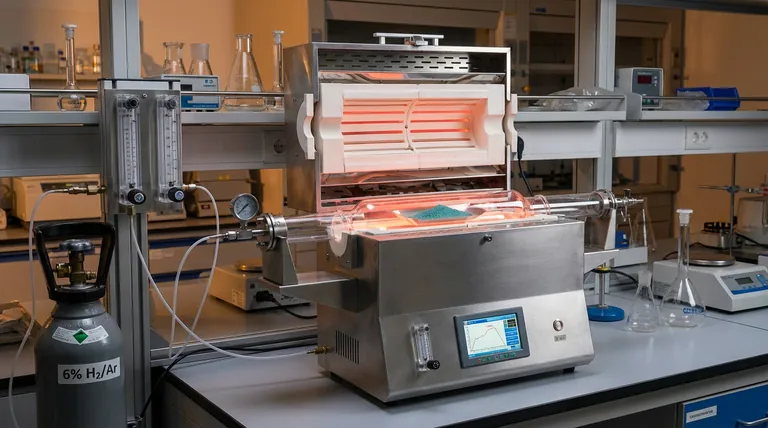
A high-precision tube furnace serves as the critical control vessel for the reduction of Cu/ZIF-8 catalysts, enabling the transformation of copper ions into metallic clusters without destroying the catalyst's support structure. It achieves this by maintaining a strictly controlled reducing atmosphere (specifically 6% H2/Ar) and a precise, programmed heating rate of approximately 10 K/min.
Core Insight: The primary function of the tube furnace in this application is protection through precision. It governs the reduction speed to ensure Cu2+ ions convert to metallic copper steady, preventing the thermal shock that leads to pore collapse or the clumping of particles (sintering) within the delicate ZIF-8 framework.
Precise Thermal Regulation
The most significant contribution of the tube furnace is its ability to execute a programmed temperature profile with high accuracy.
Controlled Heating Rates
For Cu/ZIF-8, the furnace is typically programmed to heat at a rate of approximately 10 K/min. This specific ramp rate is not arbitrary; it allows for a steady, controlled input of thermal energy.
Preventing Thermal Shock
By avoiding instantaneous high temperatures, the furnace prevents thermal shock to the material. This steady rise in temperature is essential for managing the kinetics of the reduction reaction.
Managing the Reaction Atmosphere
Beyond temperature, the tube furnace acts as a sealed environmental chamber that dictates the chemical interactions occurring at the catalyst surface.
Strict Atmosphere Control
The furnace maintains a specific reducing environment, such as a 6% H2/Ar mixture. The sealing precision of the furnace ensures that this ratio remains constant and that no external oxygen compromises the process.
Regulating Oxidation States
This controlled environment facilitates the steady reduction of Cu2+ species into tiny metallic Cu clusters. The furnace ensures the copper is reduced to the correct metallic state without over-reduction or re-oxidation.
Preserving Structural Integrity
The ultimate goal of using high-precision equipment is to maintain the architecture of the ZIF-8 support, which is known for its porosity but can be thermally fragile.
Preventing Pore Collapse
ZIF-8 frameworks are susceptible to degradation at high temperatures. The precision control of the furnace ensures the process stays within a thermal window that allows reduction to occur without causing the framework pores to collapse.
Avoiding Particle Sintering
If the temperature spikes or the reduction happens too violently, copper particles tend to migrate and clump together (sintering). The tube furnace's stability ensures the copper remains as highly dispersed, tiny clusters, which is vital for catalytic activity.
Understanding the Trade-offs
While high-precision tube furnaces offer superior control, it is important to understand the operational boundaries involved in this process.
Throughput vs. Precision
The requirement for a slow, controlled heating rate (e.g., 10 K/min) inherently limits the speed of production. This process cannot be rushed; attempting to accelerate the heating rate to increase throughput often results in the destruction of the ZIF-8 lattice.
Sensitivity to Gas Composition
The process relies heavily on the exact composition of the reducing gas (H2/Ar). Slight deviations in gas flow or a breach in the furnace seal can lead to incomplete reduction or the introduction of impurities, rendering the catalyst ineffective.
Making the Right Choice for Your Goal
To maximize the effectiveness of your Cu/ZIF-8 catalyst synthesis, align your furnace parameters with your specific performance objectives.
- If your primary focus is Maximizing Active Sites: Prioritize the accuracy of the heating ramp rate (10 K/min) to ensure the copper forms tiny, dispersed clusters rather than large particles.
- If your primary focus is Framework Stability: Focus on the upper temperature limit and gas flow consistency to prevent the structural collapse of the ZIF-8 pores during reduction.
Success in reducing Cu/ZIF-8 relies not just on reaching a high temperature, but on the disciplined, programmed journey to get there.
Summary Table:
| Parameter | Specification/Requirement | Impact on Cu/ZIF-8 Catalyst |
|---|---|---|
| Heating Rate | ~10 K/min | Prevents thermal shock and lattice destruction |
| Atmosphere | 6% H2/Ar mixture | Facilitates steady reduction and prevents oxidation |
| Temperature Control | High-precision programming | Avoids particle sintering and maintains dispersion |
| Structural Goal | Pore preservation | Ensures high porosity and catalytic active sites |
Elevate Your Catalyst Synthesis with KINTEK
Precise thermal processing is the difference between a high-performance catalyst and a collapsed framework. At KINTEK, we understand that success lies in the discipline of the thermal journey.
Backed by expert R&D and world-class manufacturing, KINTEK offers advanced Tube, Muffle, Rotary, Vacuum, and CVD systems—all fully customizable to meet your specific research or production needs. Whether you are reducing delicate metal-organic frameworks (MOFs) like ZIF-8 or developing next-generation materials, our high-precision furnaces provide the atmospheric integrity and ramp-rate accuracy your work demands.
Ready to optimize your reduction process? Contact our technical experts today to find the perfect high-temperature solution for your lab.
References
- Vijay K. Velisoju, Pedro Castaño. Copper nanoparticles encapsulated in zeolitic imidazolate framework-8 as a stable and selective CO2 hydrogenation catalyst. DOI: 10.1038/s41467-024-46388-4
This article is also based on technical information from Kintek Furnace Knowledge Base .
Related Products
- High Pressure Laboratory Vacuum Tube Furnace
- 1400℃ High Temperature Laboratory Tube Furnace with Alumina Tube
- 1700℃ High Temperature Laboratory Tube Furnace with Alumina Tube
- Vertical Laboratory Quartz Tube Furnace Tubular Furnace
- 1200℃ Split Tube Furnace Laboratory Quartz Tube Furnace with Quartz Tube
People Also Ask
- What role does a high vacuum tube furnace play in Co-Al sintering? Master High-Purity Porous Material Synthesis
- What are the different types of tube furnaces available? Find the Perfect Fit for Your Lab's Needs
- What is the role of a vacuum tube furnace during the final thermal treatment stage of Fe3O4@CSAC catalysts?
- What are the main advantages of vacuum tube furnaces in the market? Achieve Purity and Precision in Material Processing
- What conditions does a tube furnace provide for post-ion-implantation? Achieve Precise Microstructural Repair



















