
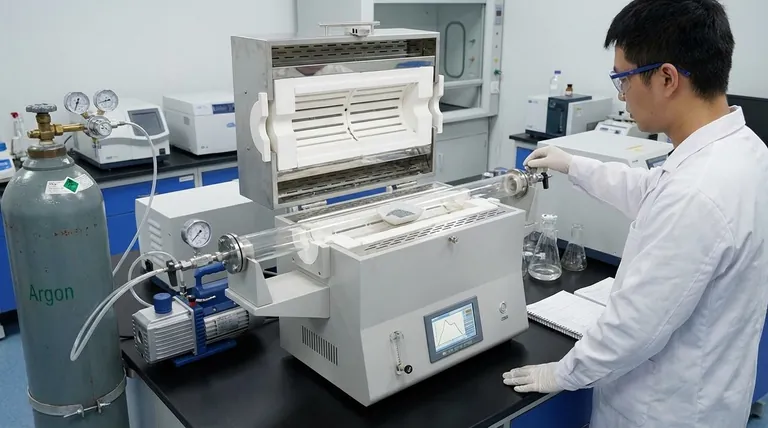
A horizontal tube furnace ensures safety and accuracy by isolating the highly reactive calcium aluminum hydride (Ca(AlH4)2) within a strictly controlled, hermetic environment. Through a precision gas path control system, the furnace enables segmented heating under a constant flow of dry argon or a vacuum, effectively preventing the material from contacting atmospheric oxygen or moisture.
Core Takeaway: The device's primary value lies in creating a sealed, programmable ecosystem that decouples thermal decomposition from environmental interference. This isolation is mandatory for obtaining pure data on phase compositions without the risk of sample oxidation or combustion.
Securing the Reaction Environment
Preventing Atmospheric Contact
Metal hydrides like Ca(AlH4)2 are extremely sensitive to the environment. Exposure to air can lead to rapid oxidation or hazardous reactions.
The horizontal tube furnace mitigates this by functioning as a physical barrier. It creates an enclosed heating environment that separates the sample from the laboratory atmosphere.
Utilizing Inert Atmospheres
To ensure safety, the system replaces the air inside the tube with a non-reactive medium.
This is achieved by maintaining a dry argon flow or establishing a vacuum. This neutralizes the environment, ensuring the only chemical changes occurring are those induced by heat, not by moisture or oxygen contamination.
Achieving Experimental Accuracy
Precision Gas Path Control
Accuracy in dehydrogenation experiments depends on stability. The furnace utilizes a precision gas path control system to regulate the internal atmosphere.
This system ensures that the flow of inert gas remains constant and predictable throughout the experiment, preventing pressure fluctuations that could skew data.
Segmented Heating and Phase Identification
Thermal decomposition often happens in stages. The furnace allows for segmented heating, enabling researchers to pause or slow temperature ramps at specific intervals.
This granular control allows for the accurate identification of phase compositions at various stages of dehydrogenation. Because the sample remains pure (unoxidized), the resulting data accurately reflects the material's intrinsic properties.
Critical Operational Protocols
Programming Thermal Curves
To ensure the heating process aligns with the experimental design, you must pre-program the temperature curve.
This involves setting specific heating and cooling rates before the experiment begins. Adhering to a programmed curve ensures that the thermal stress applied to the sample is reproducible.
Pre-Start Verification
Safety relies on rigorous pre-checks. Before applying heat, you must confirm that all valves are closed effectively and that the gas flow is normal.
Monitoring the temperature continuously after starting the program ensures the furnace adheres strictly to the set curve, preventing thermal runaway.
Understanding the Trade-offs
Sensitivity to System Integrity
While highly accurate, this method is unforgiving of mechanical failures. The reliability of the data is entirely dependent on the integrity of the seals.
Even a microscopic leak in the gas path can introduce enough oxygen to ruin the sample and invalidate the phase composition data.
Complexity of Operation
This is not a "set and forget" instrument. It requires active monitoring of gas flows and temperature curves.
The precision required to manage the gas path control system adds a layer of operational complexity compared to standard muffle furnaces.
Making the Right Choice for Your Goal
To maximize the effectiveness of a horizontal tube furnace for hydride dehydrogenation, align your approach with your specific experimental needs:
- If your primary focus is Safety: Prioritize the pre-start check of all valves and confirm the stability of the dry argon flow to prevent any risk of combustion.
- If your primary focus is Data Accuracy: Focus on programming precise segmented heating curves to isolate and identify specific phase changes without thermal overshoot.
By strictly controlling the atmosphere and thermal profile, you convert a volatile chemical reaction into a precise, measurable scientific standard.
Summary Table:
| Feature | Function in Ca(AlH4)2 Dehydrogenation | Benefit |
|---|---|---|
| Hermetic Sealing | Isolates reactive hydrides from O2 and moisture | Prevents oxidation and combustion risk |
| Inert Gas Flow | Maintains dry argon environment or vacuum | Ensures chemical purity of the sample |
| Segmented Heating | Controls temperature ramps in precise stages | Allows accurate phase composition identification |
| Gas Path Control | Regulates internal atmospheric pressure | Eliminates data skewing from fluctuations |
Elevate Your Lab’s Precision with KINTEK
Handling volatile materials like calcium aluminum hydride requires equipment that never compromises on safety or accuracy. KINTEK provides state-of-the-art horizontal tube furnaces designed for the most demanding research environments.
Why partner with KINTEK?
- Expert R&D & Manufacturing: Our systems are built for high-performance thermal processing.
- Versatile Solutions: From Tube and Rotary to Vacuum and CVD systems, we offer a full range of high-temp lab furnaces.
- Fully Customizable: We tailor our systems to meet your unique experimental protocols and safety requirements.
Ensure your next breakthrough is backed by reliable technology. Contact KINTEK today to discuss your custom furnace needs!
Visual Guide

References
- Franziska Habermann, Florian Mertens. Thermodynamic and kinetic study of the effect of LiCl and NaCl on the thermal dehydrogenation of Ca(AlH<sub>4</sub>)<sub>2</sub>. DOI: 10.1039/d4mr00140k
This article is also based on technical information from Kintek Furnace Knowledge Base .
Related Products
- Vertical Laboratory Quartz Tube Furnace Tubular Furnace
- Vacuum Sealed Continuous Working Rotary Tube Furnace Rotating Tube Furnace
- Split Multi Heating Zone Rotary Tube Furnace Rotating Tube Furnace
- High Pressure Laboratory Vacuum Tube Furnace
- Multi Zone Laboratory Quartz Tube Furnace Tubular Furnace
People Also Ask
- What are the key differences between single-zone and multi-zone vertical tube furnaces? Choose the Right Furnace for Your Lab
- How does a vertical tube furnace achieve precise temperature control? Unlock Superior Thermal Stability for Your Lab
- How does a vertical single-temperature zone tube furnace facilitate the growth of high-quality PdSe2 single crystals?
- How are wafers loaded and unloaded in a vertical tube furnace? Achieve Precision and Purity in Wafer Processing
- How do heat treatment processes influence the configuration of a vertical tube furnace? Optimize for Quenching, Annealing, and More



















