
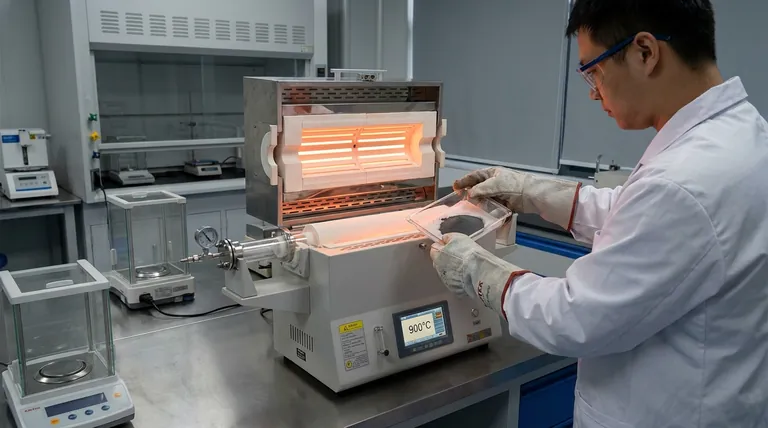
An industrial tube furnace functions as a controlled oxidation chamber to rigorously test the durability of modified diamond powders. By subjecting both raw and coated diamond samples to a precise temperature of 900°C in an atmospheric environment for exactly one hour, the equipment forces an accelerated oxidation reaction to occur.
The tube furnace provides the stable thermal environment necessary to quantify protection. By measuring mass loss after heat treatment, engineers calculate a thermal resistance coefficient ($K_{ts}$), effectively scoring how well a coating prevents the diamond from burning away.
The Mechanics of the Thermal Stability Test
Precise Thermal Stress at 900°C
The core function of the tube furnace in this application is to maintain a targeted temperature of 900°C.
At this specific thermal threshold, diamond is highly susceptible to oxidation. The furnace ensures the sample is exposed to this uniform heat, eliminating cold spots that could skew the data.
The Atmospheric Environment
Unlike processes that require a vacuum to prevent reaction, this evaluation intentionally utilizes an atmospheric environment.
The presence of air provides the oxygen necessary to attack the carbon structure of the diamond. This simulates harsh operating conditions where the diamond might degrade.
Controlled Duration
The standard test protocol requires a duration of one hour.
The tube furnace automates this "soak time," ensuring that every batch of diamond powder is exposed to the oxidizing environment for the exact same amount of time. This consistency is vital for comparative analysis between different coating batches.
Quantifying Protection: The Calculation
Measuring Mass Loss
The physical evaluation relies on measuring the mass loss of the samples.
When diamond oxidizes, the carbon converts to gas (primarily Carbon Dioxide), causing the solid material to lose weight. The tube furnace facilitates this by burning away any unprotected diamond material.
The Thermal Resistance Coefficient ($K_{ts}$)
The raw data is converted into a metric known as the thermal resistance coefficient ($K_{ts}$).
By comparing the mass before and after the 900°C heat treatment, this coefficient provides a numerical value for stability. A higher coefficient indicates that the modified coating successfully acted as a barrier, preventing oxygen from reaching and degrading the diamond core.
Understanding the Trade-offs
Sensitivity to Process Variables
While the tube furnace is precise, the accuracy of the $K_{ts}$ value is heavily dependent on strict temperature stability.
Even minor fluctuations below 900°C can significantly reduce the rate of oxidation, potentially producing a "false positive" result where the coating appears more effective than it actually is.
Destructive Testing
It is important to note that this is a destructive test.
The portion of the sample used for the evaluation undergoes permanent chemical change and mass reduction. Therefore, the results are representative of the batch but the specific sample tested cannot be reused for abrasive applications.
Making the Right Choice for Your Goal
If your primary focus is Quality Assurance: Prioritize the consistency of the $K_{ts}$ value across multiple batches to ensure your coating process is stable.
If your primary focus is R&D for New Coatings: Compare the mass loss of your new prototype directly against the baseline data of raw diamond to determine the net gain in thermal stability.
The industrial tube furnace transforms abstract concepts of "durability" into concrete, actionable data regarding the lifespan of diamond abrasives.
Summary Table:
| Parameter | Specification | Purpose in Testing |
|---|---|---|
| Test Temperature | 900°C | Triggers accelerated oxidation of carbon structure |
| Environment | Atmospheric | Provides oxygen to simulate harsh operating conditions |
| Duration | 1 Hour | Ensures consistent soak time for comparative analysis |
| Key Metric | $K_{ts}$ | Quantifies coating effectiveness via mass loss ratio |
| Sample Type | Modified/Raw Diamond | Evaluates protective barrier performance |
Maximize Material Performance with KINTEK Precision
Achieving accurate thermal resistance data requires absolute temperature uniformity. KINTEK provides industry-leading Tube, Muffle, and Vacuum systems designed to meet the rigorous demands of material science R&D. Our high-temperature furnaces are fully customizable, ensuring your modified diamond powders and advanced ceramics are tested under the most stable conditions possible.
Benefit from our expert R&D and manufacturing excellence—Contact KINTEK today to find the perfect thermal solution for your lab!
Visual Guide

References
- V. I. Lavrinenko, Volodymyr Solod. ПОЛІПШЕННЯ ЕКСПЛУАТАЦІЙНИХ ХАРАКТЕРИСТИК АЛМАЗНОГО ШЛІФУВАЛЬНОГО ІНСТРУМЕНТУ МОДИФІКАЦІЄЮ ПОВЕРХНІ ЗЕРЕН СИНТЕТИЧНИХ АЛМАЗІВ. DOI: 10.15407/scine20.01.003
This article is also based on technical information from Kintek Furnace Knowledge Base .
Related Products
- Vacuum Sealed Continuous Working Rotary Tube Furnace Rotating Tube Furnace
- 1400℃ High Temperature Laboratory Tube Furnace with Alumina Tube
- 1700℃ High Temperature Laboratory Tube Furnace with Alumina Tube
- 1200℃ Split Tube Furnace Laboratory Quartz Tube Furnace with Quartz Tube
- Vertical Laboratory Quartz Tube Furnace Tubular Furnace
People Also Ask
- What is the purpose of rotary tube furnaces? Achieve Uniform Heat Treatment for Powders and Granules
- What are the key advantages of using a rotary tube furnace? Achieve Dynamic, Uniform Heating for Powders
- What are the advantages of rotary tube furnaces in fuel compatibility? Boost Efficiency and Cut Costs
- How does the amount of material processed vary between batch and continuous rotary tube furnaces? Scale Your Production Efficiently
- What is the temperature range of some rotary tube furnaces? Achieve Uniform Heating Up to 1200°C



















