
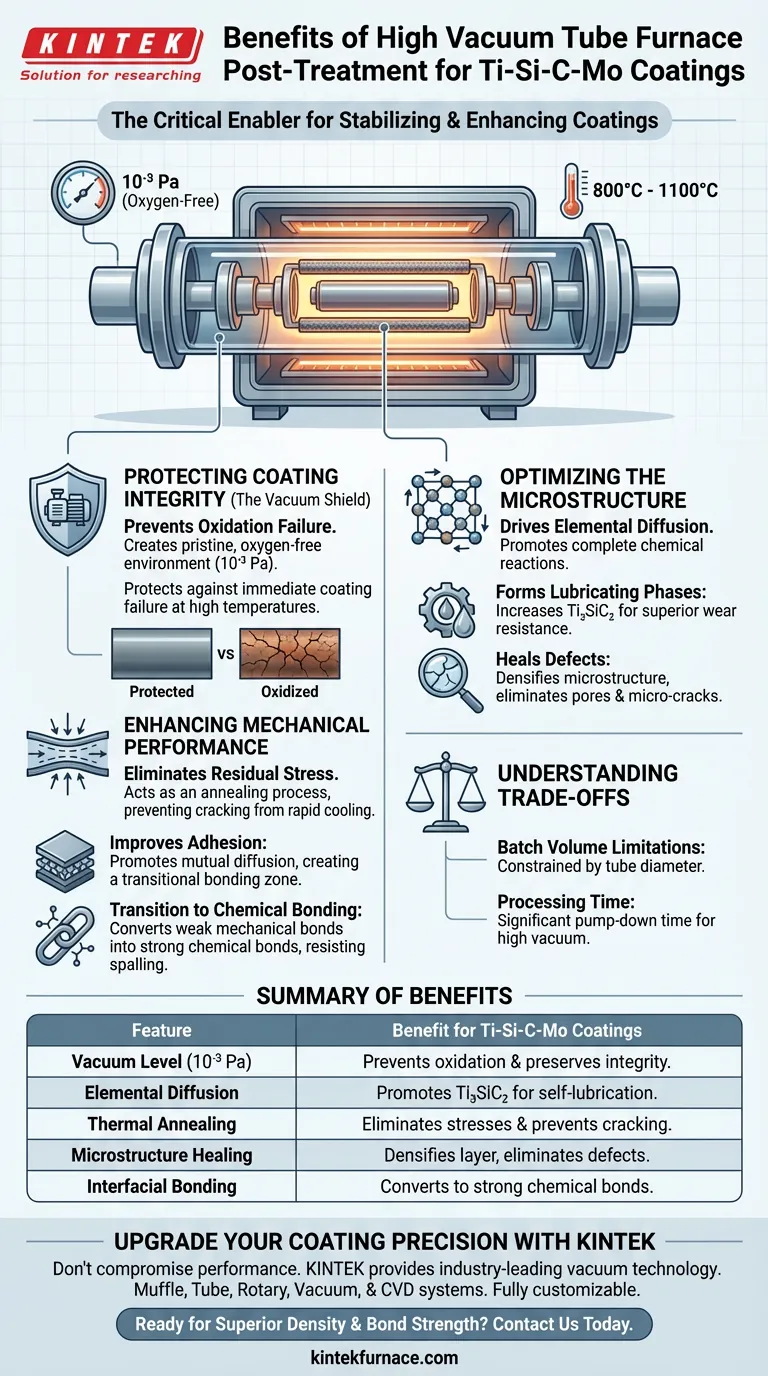
A high vacuum tube furnace is the critical enabler for stabilizing and enhancing Ti-Si-C-Mo coatings. It creates an oxygen-free environment with a vacuum level of approximately $10^{-3}$ Pa, allowing for processing between 800°C and 1100°C without the risk of oxidation failure. This equipment is essential for driving elemental diffusion, healing micro-defects, and synthesizing the specific lubricating phases required for high-performance applications.
By combining precise thermal control with a deep vacuum, you transform a sprayed coating from a mechanically bonded, stressed layer into a dense, chemically bonded system with superior self-lubricating properties.

Protecting Coating Integrity
The Vacuum Shield
The primary benefit is the creation of a pristine, oxygen-free environment ($10^{-3}$ Pa). Ti-Si-C-Mo coatings are highly susceptible to oxidation at elevated temperatures.
Preventing Failure
Without this vacuum protection, the high temperatures required for treatment would cause the coating components to oxidize. This leads to immediate coating failure rather than enhancement.
Optimizing the Microstructure
Driving Elemental Diffusion
The furnace provides a constant temperature field that promotes the movement of atoms within the material. This allows components that did not fully react during the initial spraying process to complete their chemical reactions.
Formation of Lubricating Phases
This diffusion process is specifically tuned to increase the content of $Ti_3SiC_2$. This phase is critical because it acts as a solid lubricant, significantly improving the wear properties of the final coating.
Healing Defects
The high-temperature dwell time allows the microstructure to densify. This process actively heals micro-cracks and eliminates pores, resulting in a more solid and continuous barrier.
Enhancing Mechanical Performance
Eliminating Residual Stress
Sprayed coatings often harbor significant internal tension due to rapid cooling during application. The vacuum heat treatment acts as an annealing process, effectively eliminating residual stresses that could otherwise lead to cracking.
Improving Adhesion
Beyond the coating itself, the treatment affects the interface between the coating and the substrate. The heat promotes mutual diffusion, creating a transitional bonding zone.
Transition to Chemical Bonding
This diffusion converts the connection from a weak mechanical bond into a strong chemical bond. This significantly increases the coating's resistance to spalling (flaking off) under operational stress.
Understanding the Trade-offs
Batch Volume Limitations
Tube furnaces are generally constrained by the diameter of the tube. This limits the size and quantity of components you can treat simultaneously compared to larger box furnaces.
Processing Time
Achieving a high vacuum of $10^{-3}$ Pa requires significant pump-down time before heating can begin. This adds to the overall cycle time compared to atmospheric or inert gas processes.
Making the Right Choice for Your Goal
- If your primary focus is Wear Resistance: Ensure your cycle time is sufficient to maximize the formation of the $Ti_3SiC_2$ lubricating phase.
- If your primary focus is Durability/Adhesion: Prioritize temperatures that favor deep elemental diffusion to convert mechanical bonds into chemical bonds.
The high vacuum tube furnace is not just a heater; it is a reactor that fundamentally alters the chemistry and physics of your coating to ensure longevity.
Summary Table:
| Feature | Benefit for Ti-Si-C-Mo Coatings |
|---|---|
| Vacuum Level ($10^{-3}$ Pa) | Prevents oxidation failure and preserves material integrity. |
| Elemental Diffusion | Promotes $Ti_3SiC_2$ formation for superior self-lubrication. |
| Thermal Annealing | Eliminates residual stresses and prevents cracking. |
| Microstructure Healing | Densifies the layer by eliminating pores and micro-defects. |
| Interfacial Bonding | Converts mechanical bonds into strong chemical bonds. |
Upgrade Your Coating Precision with KINTEK
Don't let oxidation or residual stress compromise your material performance. KINTEK provides industry-leading vacuum technology designed to transform sprayed layers into high-performance systems. Backed by expert R&D and manufacturing, we offer Muffle, Tube, Rotary, Vacuum, and CVD systems, all fully customizable for your unique lab requirements.
Ready to achieve superior coating density and bond strength? Contact us today to discuss how our high-temperature furnace solutions can solve your specific engineering challenges.
Visual Guide
References
- Jining He, Jiawei Fan. High-Temperature Heat Treatment of Plasma Sprayed Ti–Si–C–Mo Coatings. DOI: 10.3390/coatings14010109
This article is also based on technical information from Kintek Furnace Knowledge Base .
Related Products
- Molybdenum Vacuum Heat Treat Furnace
- Vacuum Heat Treat Sintering Furnace Molybdenum Wire Vacuum Sintering Furnace
- 2200 ℃ Tungsten Vacuum Heat Treat and Sintering Furnace
- High Pressure Laboratory Vacuum Tube Furnace
- Magnesium Extraction and Purification Condensing Tube Furnace
People Also Ask
- How does vacuum heat treating work in terms of temperature and time control? Master Precise Material Transformations
- What is the primary application of vacuum heat treating furnaces in aerospace? Enhance Component Performance with Precision
- How does a vacuum heat treating furnace improve the condition of metal alloys? Achieve Superior Metal Performance
- What is the process of vacuum heat treating? Achieve Superior Metallurgical Properties
- Why are vacuum heat treating furnaces essential for aerospace? Ensure Superior Material Integrity for High-Stakes Applications



















