
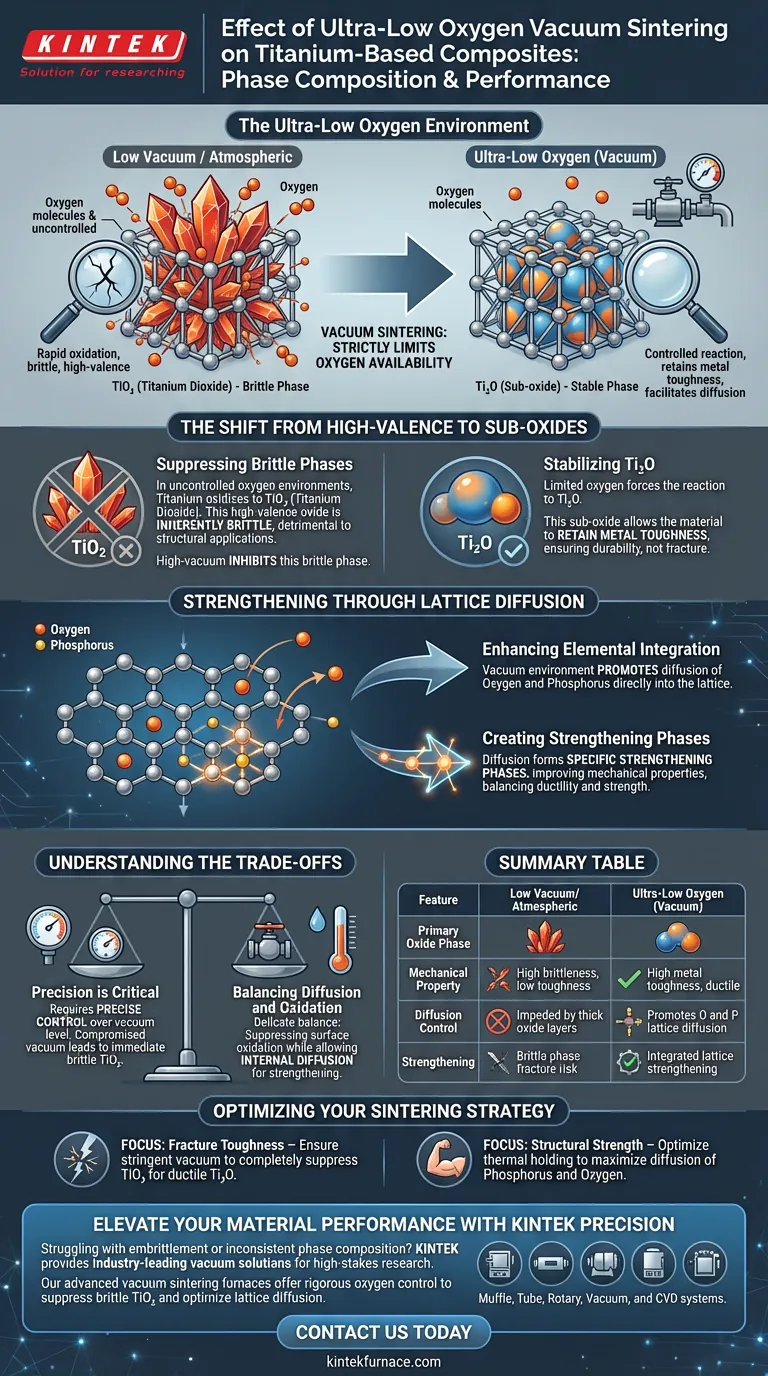
The ultra-low oxygen environment in a vacuum sintering furnace fundamentally alters the phase composition of titanium-based composites by strictly limiting the availability of oxygen. Instead of forming brittle, high-valence oxides like titanium dioxide (TiO2), the controlled vacuum forces the formation of stable sub-oxides, specifically Ti2O.
By regulating oxygen partial pressure, vacuum sintering prevents the embrittlement typical of standard oxidation. It preserves the metal’s intrinsic toughness while simultaneously facilitating the diffusion of strengthening elements into the titanium lattice.
The Shift from High-Valence to Sub-Oxides
Suppressing Brittle Phases
In environments with uncontrolled oxygen, titanium rapidly oxidizes to form TiO2 (titanium dioxide).
This high-valence oxide phase is detrimental to structural applications because it is inherently brittle.
The high-vacuum environment lowers the oxygen partial pressure enough to effectively inhibit the formation of this brittle phase.
Stabilizing Ti2O
With oxygen availability strictly limited, the chemical reaction is forced into a different pathway.
The titanium reacts to form Ti2O, a sub-oxide phase.
Unlike TiO2, Ti2O allows the material to retain its metal toughness, ensuring the composite remains durable rather than prone to fracture.
Strengthening Through Lattice Diffusion
Enhancing Elemental Integration
Beyond preventing bad oxides, the vacuum environment actively promotes beneficial internal changes.
It facilitates the diffusion of oxygen and phosphorus atoms directly into the titanium lattice.
Creating Strengthening Phases
This diffusion process is not merely a side effect; it is a strengthening mechanism.
As oxygen and phosphorus integrate into the lattice, they form specific strengthening phases within the material.
This results in a scaffold with improved overall mechanical properties, balancing ductility with increased strength.
Understanding the Trade-offs
Precision is Critical
While the formation of Ti2O is desirable, it requires precise control over the vacuum level.
If the vacuum is compromised or insufficient, the oxygen partial pressure will rise, leading to the immediate formation of brittle TiO2.
Balancing Diffusion and Oxidation
There is a delicate balance between removing oxygen to prevent TiO2 and allowing enough mobility for diffusion.
Process parameters must be tuned to ensure that while surface oxidation is suppressed, the internal diffusion of phosphorus and oxygen still occurs to provide the necessary strengthening.
Optimizing Your Sintering Strategy
To leverage these phase transformations effectively, you must align your furnace parameters with your specific mechanical goals.
- If your primary focus is Fracture Toughness: Ensure your vacuum levels are stringent enough to completely suppress TiO2 formation in favor of the ductile Ti2O phase.
- If your primary focus is Structural Strength: Optimize thermal holding times to maximize the diffusion of phosphorus and oxygen into the lattice for hardening.
Success relies on maintaining a vacuum environment that is rigorous enough to protect the metal, yet conducive to the internal chemistry that builds strength.
Summary Table:
| Feature | Low Vacuum/Atmospheric | Ultra-Low Oxygen (Vacuum) |
|---|---|---|
| Primary Oxide Phase | TiO2 (Titanium Dioxide) | Ti2O (Sub-oxide) |
| Mechanical Property | High brittleness, low toughness | High metal toughness, ductile |
| Diffusion Control | Impeded by thick oxide layers | Promotes O and P lattice diffusion |
| Strengthening | Brittle phase fracture risk | Integrated lattice strengthening |
Elevate Your Material Performance with KINTEK Precision
Are you struggling with material embrittlement or inconsistent phase composition in your titanium alloys? KINTEK provides industry-leading vacuum solutions tailored for high-stakes aerospace, medical, and industrial research. Backed by expert R&D and manufacturing, KINTEK offers Muffle, Tube, Rotary, Vacuum, and CVD systems, all customizable for your unique high-temperature processing needs.
Our advanced vacuum sintering furnaces provide the rigorous oxygen partial pressure control required to suppress brittle TiO2 and optimize lattice diffusion. Contact us today to consult with our technical specialists and discover how our high-performance lab equipment can transform your composite manufacturing.
Visual Guide
References
- Xingping Fan, Hao Zhang. Fabrication and Characterization of LaF3-Reinforced Porous HA/Ti Scaffolds. DOI: 10.3390/coatings14010111
This article is also based on technical information from Kintek Furnace Knowledge Base .
Related Products
- Vacuum Heat Treat Sintering Furnace Molybdenum Wire Vacuum Sintering Furnace
- Small Vacuum Heat Treat and Tungsten Wire Sintering Furnace
- 9MPa Air Pressure Vacuum Heat Treat and Sintering Furnace
- Vacuum Heat Treat Sintering Furnace with Pressure for Vacuum Sintering
- 2200 ℃ Tungsten Vacuum Heat Treat and Sintering Furnace
People Also Ask
- What are the main structural components of a vacuum sintering furnace? Unlock Precision in High-Temperature Processing
- What are the key components of a vacuum sintering furnace? Essential Parts for Precision Material Processing
- How does vacuum sintering improve dimensional tolerances? Achieve Uniform Shrinkage and Precision
- What is the purpose of setting a mid-temperature dwell stage? Eliminate Defects in Vacuum Sintering
- How does vacuum sintering contribute to cost reduction in material processing? Lower Expenses with Superior Parts



















