
At its core, a 70mm tube furnace is a high-precision instrument designed to create a thermally stable and atmospherically controlled environment within its cylindrical chamber. Its key features are high-temperature capability often exceeding 1200°C, exceptional temperature uniformity across a defined "hot zone," and the ability to manage the gas atmosphere from inert to vacuum conditions. The 70mm inner diameter specifically allows for processing larger samples or small batches.
A tube furnace should be understood not as a simple oven, but as a controlled reaction environment. Its true value lies in the precise and simultaneous management of temperature, heat distribution, and atmosphere, which enables repeatable and high-purity material processing.
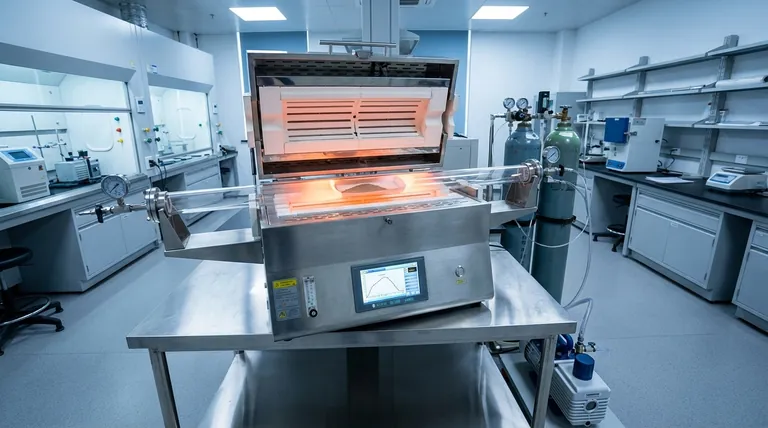
Core Capabilities: The Pillars of Performance
The primary function of a tube furnace is to provide a controlled environment for thermal processing. This is achieved through three fundamental capabilities that work in concert.
High-Temperature Operation
Most 70mm tube furnaces are capable of reaching sustained temperatures between 1200°C and 1600°C. This high-temperature range is essential for a wide variety of applications, including annealing, sintering, calcination, and crystal growth.
The specific maximum temperature is determined by the type of heating elements used, such as Kanthal (up to ~1200°C) or Molybdenum Disilicide (MoSi2) for higher temperatures.
Precise Temperature & Zone Uniformity
A critical feature is the creation of a uniform temperature zone within the center of the tube. While the furnace has a total heated length, the uniform zone is a specific region where the temperature variation is minimal, often within ±1°C to ±5°C.
This uniformity is paramount for ensuring that an entire sample is processed under identical thermal conditions, leading to consistent and reproducible results. The horizontal orientation common in these furnaces helps stabilize this uniform zone along the tube's length.
Controllable Atmosphere Environment
Unlike a standard oven, a tube furnace is designed to be sealed. Using specialized flanges, you can control the gaseous environment inside the processing tube.
This allows for operations under vacuum, an inert gas (like Argon or Nitrogen) to prevent oxidation, or even a reducing or oxidizing atmosphere to drive specific chemical reactions. This feature is indispensable for air-sensitive materials and high-purity synthesis.
Understanding the Physical Design
The physical construction of the furnace directly impacts its performance, capacity, and versatility.
The 70mm Tube: Your Reaction Chamber
The "70mm" designation refers to the inner diameter of the processing tube. This relatively large diameter provides a significant advantage for accommodating larger sample boats, processing small batches, or improving throughput compared to smaller furnaces.
The tube itself is a consumable component and is typically made from quartz (for use up to ~1100°C, offering good thermal shock resistance) or alumina (for higher temperatures up to 1700°C and greater chemical inertness).
Heating Elements and Insulation
The chamber is heated externally by high-performance resistive heating elements. These elements surround the process tube, ensuring efficient heat transfer.
This assembly is encased in multi-layered ceramic fiber insulation. This insulation minimizes heat loss, which improves energy efficiency and ensures the outer casing of the furnace remains cool and safe to the touch.
Compact and Horizontal Form Factor
Most lab-scale tube furnaces feature a compact, benchtop design to conserve valuable laboratory space. The horizontal orientation is standard as it simplifies the loading and unloading of samples using a push rod.
Critical Trade-offs and Considerations
To use a tube furnace effectively, you must understand its inherent limitations and the interplay between its components.
Tube Material vs. Maximum Temperature
A common mistake is assuming the furnace's maximum temperature can be used with any tube. The maximum operating temperature is always limited by the process tube material. Using a quartz tube in a furnace heated to 1400°C will cause it to soften and fail. Always match your tube material to your target temperature.
Uniform Zone vs. Total Heated Length
The specified uniform temperature zone is always shorter than the total heated length of the furnace. The ends of the tube will be cooler due to heat loss. For reliable results, you must ensure your sample is positioned entirely within the calibrated uniform zone.
Atmosphere Control Requires a System
The furnace provides the sealed chamber, but "gas control" requires an external system. This includes vacuum pumps, gas tanks, pressure regulators, mass flow controllers, and appropriate sealing flanges. These components are often sold separately and must be integrated to achieve a controlled atmosphere.
Making the Right Choice for Your Goal
The ideal furnace configuration depends entirely on your specific experimental or production needs.
- If your primary focus is high-purity synthesis: Prioritize a high-quality quartz or alumina tube and a robust vacuum and gas-purging system to eliminate contaminants.
- If your primary focus is batch heat treatment: The 70mm diameter's larger capacity and a model with a long, certified uniform hot zone are your most critical features.
- If your primary focus is rapid material screening: Look for models with advanced temperature programmers that allow for fast heating/cooling rates and complex thermal cycles.
Understanding these core features and trade-offs empowers you to use the 70mm tube furnace as the powerful and versatile tool it is.
Summary Table:
| Feature | Description |
|---|---|
| High-Temperature Operation | Sustained temperatures from 1200°C to 1600°C for annealing, sintering, etc. |
| Temperature Uniformity | Uniform hot zone with ±1°C to ±5°C variation for consistent results. |
| Atmosphere Control | Sealed design for vacuum, inert, or reactive gas environments. |
| 70mm Tube Diameter | Accommodates larger samples or small batches with quartz or alumina tubes. |
| Compact Horizontal Design | Benchtop form factor for easy sample loading and space efficiency. |
Ready to elevate your thermal processing? KINTEK specializes in advanced high-temperature furnace solutions, including Tube Furnaces, tailored for diverse laboratory needs. Leveraging exceptional R&D and in-house manufacturing, we offer deep customization to precisely meet your unique experimental requirements—whether for high-purity synthesis, batch heat treatment, or rapid material screening. Contact us today to discuss how our expertise can enhance your lab's performance and efficiency!
Visual Guide

Related Products
- Vertical Laboratory Quartz Tube Furnace Tubular Furnace
- Vacuum Sealed Continuous Working Rotary Tube Furnace Rotating Tube Furnace
- Magnesium Extraction and Purification Condensing Tube Furnace
- Split Multi Heating Zone Rotary Tube Furnace Rotating Tube Furnace
- High Pressure Laboratory Vacuum Tube Furnace
People Also Ask
- What are the key differences between single-zone and multi-zone vertical tube furnaces? Choose the Right Furnace for Your Lab
- What makes a vertical tube furnace easy to operate? Discover Intuitive Automation for Precision Heating
- How do heat treatment processes influence the configuration of a vertical tube furnace? Optimize for Quenching, Annealing, and More
- What is a vertical tube furnace and how does it function? Optimize Material Processing with Precision
- How does a vertical tube furnace achieve precise temperature control? Unlock Superior Thermal Stability for Your Lab



















