
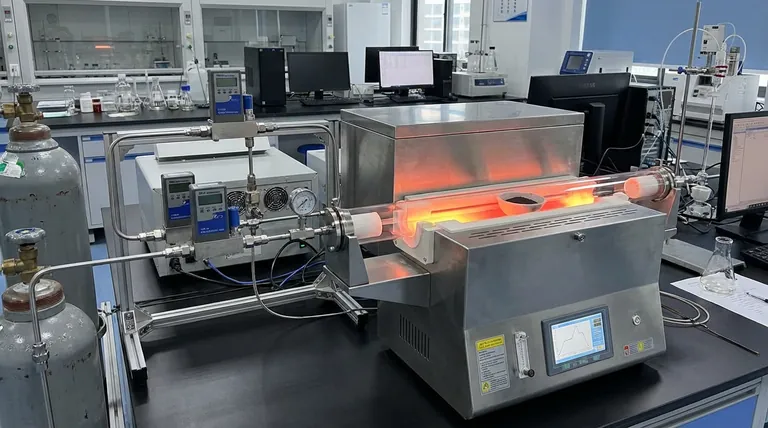
A laboratory high-temperature tube furnace serves as the primary vessel for orchestrating the precise thermal and atmospheric conditions required to synthesize Ni-rich oxide cathode materials. It enables the transformation of raw precursors into a stable crystalline structure by strictly controlling heating rates, maintaining a pure oxygen environment, and holding specific temperatures to drive phase formation.
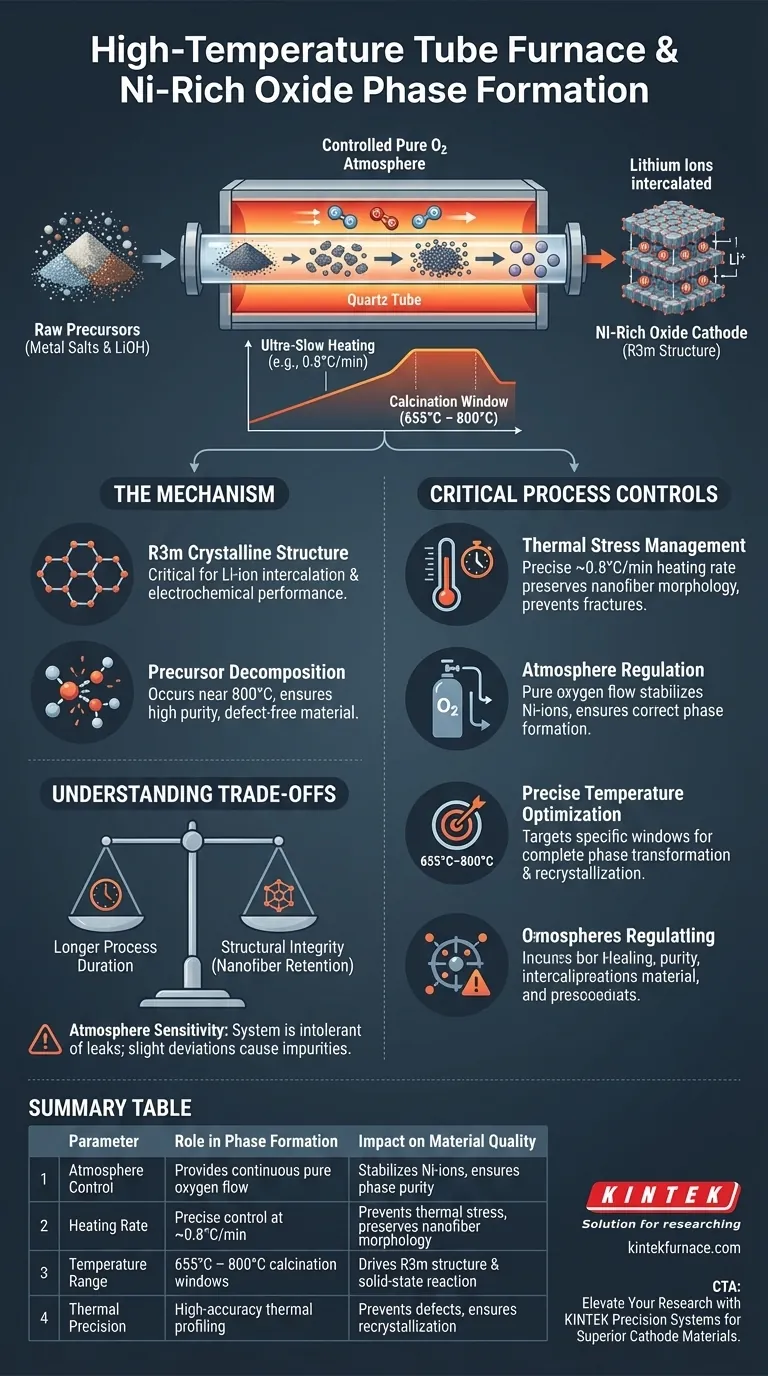
By maintaining a continuous pure oxygen flow and executing ultra-slow heating rates (such as 0.8°C/min), the furnace facilitates the decomposition of precursors into a hexagonal layered R3m structure. This controlled environment is essential for preserving nanofiber morphology and preventing fractures caused by thermal stress.
The Mechanism of Phase Formation
Achieving the R3m Crystalline Structure
The primary role of the furnace is to drive the transition of materials into the R3m space group hexagonal layered structure.
This specific crystal arrangement is critical for the electrochemical performance of the cathode. The furnace facilitates the solid-state reaction between metal salt precursors and lithium hydroxide, allowing lithium ions to intercalate correctly into the crystal lattice.
Decomposition of Precursors
Before the final structure forms, the starting materials must undergo chemical decomposition.
At temperatures approaching 800°C, the tube furnace ensures that metal salt precursors break down completely. This step is the foundation for creating high-purity, single-phase materials free from structural defects.
Critical Process Controls
Management of Thermal Stress
One of the most vital functions of the tube furnace is the regulation of heating rates to protect the material's physical shape.
Rapid heating can cause the unique nanofiber morphology of these materials to fracture. By utilizing a precise, slow heating rate of 0.8°C/min, the furnace mitigates thermal stress, ensuring the material retains its structural integrity throughout the calcination process.
Atmosphere Regulation
Ni-rich oxides are highly sensitive to their environment during synthesis.
The tube furnace provides a pure oxygen atmosphere (or continuous oxygen flow field) necessary for the reaction. This oxygen-rich environment is mandatory to stabilize the nickel ions and ensure the formation of the correct oxide phases.
Precise Temperature Optimization
The furnace enables the user to target specific thermal windows to optimize the material's properties.
While decomposition often occurs near 800°C, optimized calcination processes may range between 655°C and 710°C depending on the specific composition. The furnace’s ability to hold these temperatures precisely ensures complete phase transformation and recrystallization.
Understanding the Trade-offs
Process Duration vs. Structural Integrity
The requirement for ultra-slow heating rates (e.g., 0.8°C/min) creates a significant trade-off in processing time.
To prevent fracturing the nanofiber morphology, researchers must accept much longer cycle times compared to standard sintering processes. Rushing this step almost invariably leads to structural degradation.
Sensitivity to Atmosphere Fluctuations
The reliance on a pure oxygen atmosphere means the system is intolerant of leaks or impure gas sources.
Even minor deviations in the oxygen flow field within the tube can lead to incomplete phase transformation or the formation of impurities on the cathode surface, compromising electrochemical performance.
Making the Right Choice for Your Goal
When configuring your thermal processing parameters for Ni-rich oxides, prioritize your settings based on the material's critical needs:
- If your primary focus is Morphology Retention: strictly adhere to the slow heating rate (0.8°C/min) to prevent thermal stress fractures in nanofiber structures.
- If your primary focus is Phase Purity: ensure the furnace maintains a continuous, pure oxygen flow to drive the complete transition to the R3m space group.
- If your primary focus is Electrochemical Optimization: experiment within the calcination window (655°C–800°C) to find the balance between complete recrystallization and grain growth.
Precision in the thermal profile is the difference between a functional powder and a high-performance cathode.
Summary Table:
| Parameter | Role in Phase Formation | Impact on Material Quality |
|---|---|---|
| Atmosphere Control | Provides continuous pure oxygen flow | Stabilizes Ni-ions and ensures phase purity |
| Heating Rate | Precise control at ~0.8°C/min | Prevents thermal stress and preserves nanofiber morphology |
| Temperature Range | 655°C – 800°C calcination windows | Drives R3m crystalline structure and solid-state reaction |
| Thermal Precision | High-accuracy thermal profiling | Prevents structural defects and ensures recrystallization |
Elevate Your Material Research with KINTEK Precision
Unlock superior electrochemical performance for your Ni-rich cathode materials with KINTEK’s high-precision thermal solutions. Backed by expert R&D and world-class manufacturing, we provide high-temperature Tube, Muffle, Rotary, Vacuum, and CVD systems specifically designed to meet the rigorous demands of battery research.
Whether you require ultra-slow heating rates for nanofiber integrity or strict atmospheric control for phase purity, our systems are fully customizable to your unique research needs.
Ready to optimize your synthesis process? Contact us today to speak with a technical expert.
Visual Guide
References
- Soumyadip Mitra, C. Sudakar. High rate capability and cyclic stability of Ni‐rich layered oxide LiNi<sub>0.83</sub>Co<sub>0.12</sub>Mn<sub>0.05−<i>x</i></sub>Al<sub><i>x</i></sub>O<sub>2</sub> cathodes: Nanofiber versus nanoparticle morphology. DOI: 10.1002/bte2.20230066
This article is also based on technical information from Kintek Furnace Knowledge Base .
Related Products
- 1700℃ High Temperature Laboratory Tube Furnace with Alumina Tube
- 1400℃ High Temperature Laboratory Tube Furnace with Alumina Tube
- 1700℃ Controlled Inert Nitrogen Atmosphere Furnace
- 1200℃ Split Tube Furnace Laboratory Quartz Tube Furnace with Quartz Tube
- 1400℃ Controlled Inert Nitrogen Atmosphere Furnace
People Also Ask
- How does zone-melting in tube furnaces synthesize bismuth micro-wires? Master Single-Crystal Thermoelectric Growth
- How are high-temperature laboratory tube furnaces applied in long-term vacuum homogenization heat treatments for intermetallic samples?
- How do high-temperature laboratory tube furnaces ensure environmental stability? Precision Thermal Reduction Tips
- How are high-temp tube furnaces used to measure diffusion coefficients per Fick's law? Master Precision Annealing
- How are high-temperature tube furnaces applied in testing ceramic-supported alloy membranes? Insights



















