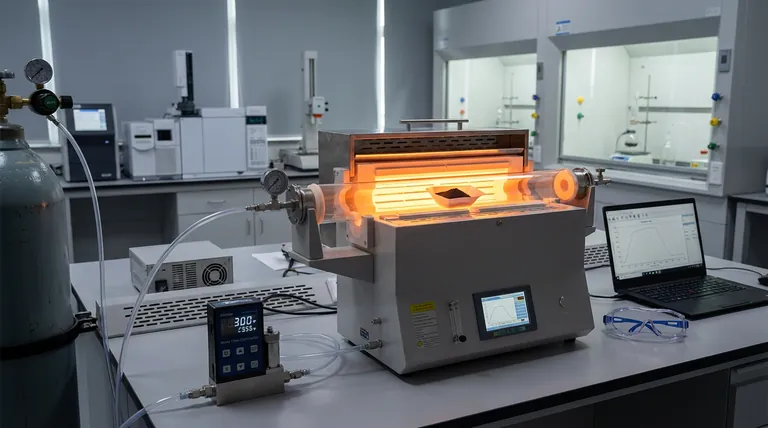
The primary function of Argon gas in this context is to establish and maintain an inert protective atmosphere within the tube furnace. By continuously flowing through the chamber, Argon effectively displaces oxygen and prevents the Molybdenum Disulfide ($MoS_2$) from reacting to form unwanted molybdenum oxides at high temperatures. This ensures that the thermal treatment focuses solely on generating specific structural defects without chemical contamination.
Argon acts as a chemical shield, enabling the precise creation of sulfur vacancies through thermal decomposition while blocking oxidative destruction. This controlled environment is essential for isolating the mechanism that induces room-temperature ferromagnetism in the material.
Creating a Controlled Reaction Environment
Displacing Reactive Oxygen
At the elevated temperatures required for annealing, Molybdenum Disulfide becomes highly reactive. If oxygen were present, it would bond with the molybdenum to form oxides.
The Argon flow physically purges air from the tube furnace. This displacement is critical to maintaining the chemical integrity of the sample during the heating process.
Facilitating Thermal Decomposition
The objective of this heat treatment is not to add new elements, but to selectively remove specific atoms.
The inert Argon atmosphere allows the material to undergo thermal decomposition. This environment ensures that when bonds break, the material changes structurally rather than chemically reacting with the atmosphere.
The Role of Defects in Magnetism
Generating Sulfur Vacancies
The tube furnace provides the precise thermal energy needed to break sulfur bonds within the $MoS_2$ lattice.
As the material is annealed in the Argon environment, sulfur atoms detach, leaving behind empty spaces known as sulfur vacancies.
Unpaired Electrons and Ferromagnetism
These vacancies are the functional goal of the experiment.
The loss of sulfur creates unpaired electrons within the material's structure. These unpaired electrons are the primary mechanism that excites room-temperature ferromagnetism in the compound.
Understanding the Trade-offs
The Risk of Oxidation
The success of this process hinges entirely on the purity of the atmosphere.
If the Argon flow is insufficient or interrupted, oxygen will re-enter the chamber. The resulting molybdenum oxide is chemically distinct from the vacancy-doped $MoS_2$ and will not exhibit the desired magnetic properties.
Balancing Heat and Stability
The process requires a delicate balance between stability and decomposition.
You must apply enough heat to induce sulfur loss (decomposition) to create vacancies. However, the Argon flow must remain constant to ensure this decomposition happens in isolation, preventing the unstable material from reacting with environmental contaminants.
Making the Right Choice for Your Goal
To achieve the desired magnetic properties in Molybdenum Disulfide, you must manage both temperature and atmosphere.
- If your primary focus is chemical purity: Ensure the Argon flow is established well before the heating cycle begins to fully displace all oxygen and prevent oxide formation.
- If your primary focus is magnetic intensity: Precisely control the annealing temperature within the inert atmosphere to maximize the density of sulfur vacancies, as these defects directly drive the ferromagnetic response.
By rigorously excluding oxygen, you transform the tube furnace from a simple heater into a precision tool for atomic-scale defect engineering.
Summary Table:
| Feature | Function in $MoS_2$ Heat Treatment |
|---|---|
| Atmosphere Type | Inert (Non-reactive) |
| Primary Role | Displaces oxygen to prevent molybdenum oxide formation |
| Mechanism | Facilitates thermal decomposition for sulfur vacancy creation |
| Scientific Goal | Enables room-temperature ferromagnetism via unpaired electrons |
| Process Risk | Oxidation occurs if Argon flow is interrupted |
Elevate Your Material Research with KINTEK Precision
Unlock the full potential of your 2D materials with KINTEK’s high-performance thermal solutions. Backed by expert R&D and manufacturing, KINTEK offers high-precision Muffle, Tube, Rotary, Vacuum, and CVD systems—all fully customizable to meet your specific research needs.
Whether you are engineering sulfur vacancies in $MoS_2$ or developing next-generation semiconductors, our furnaces provide the precise atmosphere control and temperature uniformity essential for success. Don't let oxidation compromise your results.
Ready to optimize your heat treatment process? Contact our technical experts today to find the perfect furnace for your laboratory.
References
- Chang-Soo Park, Deuk Young Kim. Strong Room-Temperature Ferromagnetism of MoS2 Compound Produced by Defect Generation. DOI: 10.3390/nano14040334
This article is also based on technical information from Kintek Furnace Knowledge Base .
Related Products
- Vacuum Heat Treat Sintering Furnace Molybdenum Wire Vacuum Sintering Furnace
- Molybdenum Vacuum Heat Treat Furnace
- Molybdenum Disilicide MoSi2 Thermal Heating Elements for Electric Furnace
- Custom Made Versatile CVD Tube Furnace Chemical Vapor Deposition CVD Equipment Machine
- Inclined Rotary Plasma Enhanced Chemical Deposition PECVD Tube Furnace Machine
People Also Ask
- What are the main structural components of a vacuum sintering furnace? Unlock Precision in High-Temperature Processing
- How does vacuum sintering improve dimensional tolerances? Achieve Uniform Shrinkage and Precision
- What is the purpose of setting a mid-temperature dwell stage? Eliminate Defects in Vacuum Sintering
- What are the key components of a vacuum sintering furnace? Essential Parts for Precision Material Processing
- How does vacuum sintering contribute to cost reduction in material processing? Lower Expenses with Superior Parts