
The primary utility of a high-temperature tube furnace is structural preservation: it is used to grow a uniform silicon dioxide passivation layer in situ directly on the internal walls of nanopores. Unlike standard deposition methods, this thermal oxidation process creates a robust oxide layer—often around 25 nanometers thick—that is chemically bonded to the silicon substrate. This layer serves as a critical defensive barrier, ensuring the single-crystal silicon membrane survives subsequent harsh processing steps without deformation.
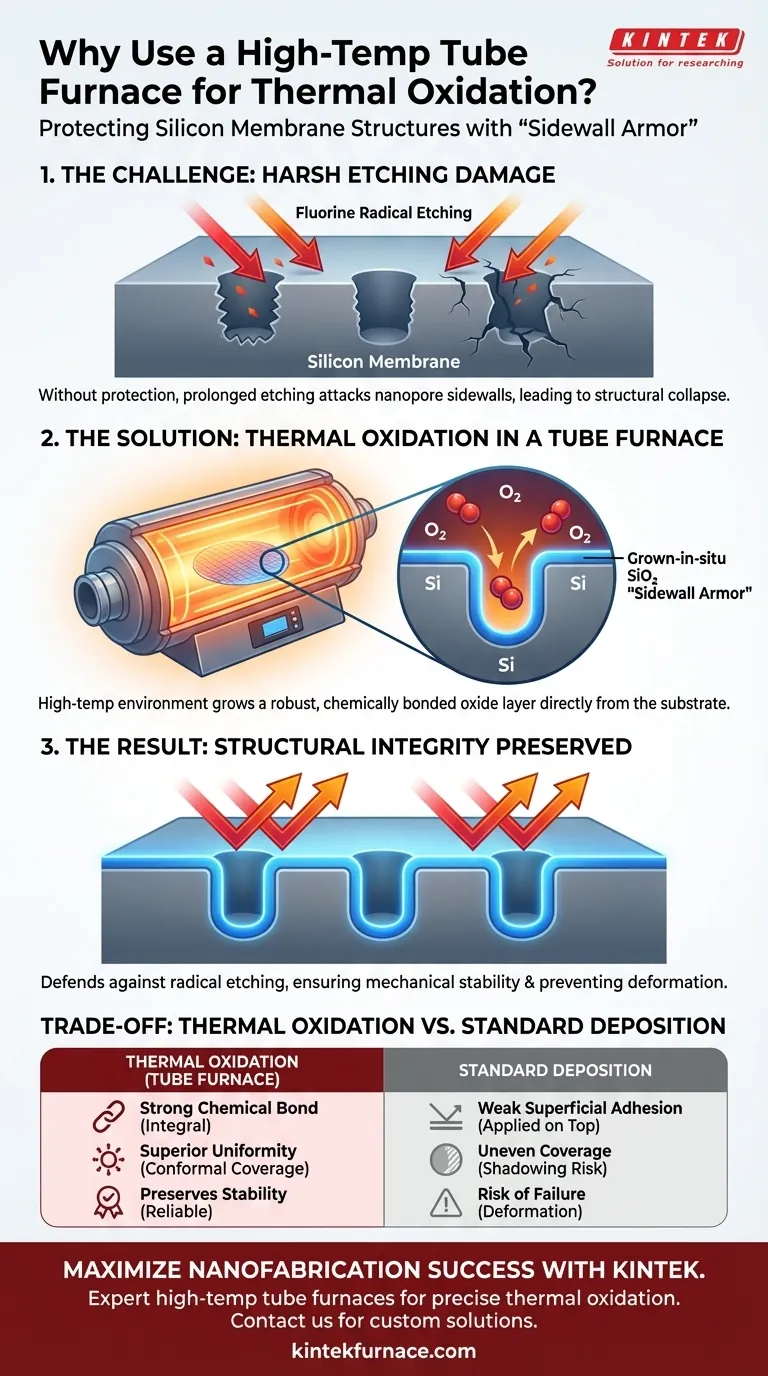
Core Takeaway: The tube furnace enables the creation of "sidewall armor"—a strongly bonded, highly uniform oxide layer—that protects delicate nanopore structures from damage during prolonged fluorine radical etching, thereby preserving the mechanical integrity of the silicon membrane.
Creating the Protective Barrier
Superior Bonding and Uniformity
The high-temperature environment of the tube furnace allows for thermal oxidation, a process distinct from simple coating methods.
During this process, oxygen reacts with the silicon substrate to grow a silicon dioxide layer in situ. This results in an oxide layer that possesses high thickness uniformity and is strongly bonded to the underlying silicon.
The "Sidewall Armor" Concept
The primary reference explicitly describes this oxide layer as "armor" for the nanopore sidewalls.
Because the oxidation occurs within the furnace, it effectively coats the internal geometry of the nanopores. This creates a continuous, protective shell that conforms perfectly to the complex structures of the membrane.
Ensuring Structural Integrity
Defending Against Radical Etching
The formation of buried cavities typically requires prolonged isotropic fluorine radical etching.
Without protection, this aggressive etchant would attack the sidewalls of the nanopores, altering their shape or destroying them entirely. The thermally grown oxide layer is resistant to this specific chemistry, effectively shielding the silicon sidewalls from the etchant.
Preventing Mechanical Failure
The ultimate goal of this treatment is to maintain the mechanical stability of the single-crystal silicon membrane.
If the sidewalls were exposed or weakly protected during cavity formation, the membrane could suffer from deformation or structural collapse. The tube furnace treatment ensures the membrane remains rigid and intact throughout the fabrication process.
Understanding the Process Trade-offs
Thermal Oxidation vs. Standard Deposition
The primary trade-off highlighted is the distinction between thermal oxidation and standard deposition processes.
Standard deposition often applies a material on top of a surface, which may suffer from poor adhesion or uneven coverage inside deep pores. In contrast, the tube furnace consumes a small amount of the silicon surface to grow the oxide, resulting in a bond that is integral to the material rather than superficial.
The Necessity of Precision
While standard deposition might be faster or operate at lower temperatures, it fails to provide the strong bonding required for this application.
For silicon membrane structures, the risk of sidewall deformation outweighs the convenience of standard deposition, making the high-temperature tube furnace the necessary choice for reliability.
Making the Right Choice for Your Goal
To ensure the success of your silicon membrane fabrication, consider the following regarding the oxidation step:
- If your primary focus is mechanical stability: Utilize the high-temperature tube furnace to grow an oxide layer that prevents deformation during aggressive etching cycles.
- If your primary focus is geometric precision: Rely on thermal oxidation to ensure high thickness uniformity inside the internal walls of the nanopores, rather than risking the uneven coverage of standard deposition.
The high-temperature tube furnace is not just a heating element; it is a precision tool for chemically engineering the durability of your device at the nanoscale.
Summary Table:
| Feature | Thermal Oxidation (Tube Furnace) | Standard Deposition Methods |
|---|---|---|
| Bonding Type | Chemical bond (grown in situ) | Superficial adhesion (applied on top) |
| Uniformity | Superior thickness uniformity in pores | Potential for uneven coverage/shadowing |
| Etch Resistance | High (acts as 'sidewall armor') | Variable (may delaminate) |
| Structural Impact | Preserves mechanical stability | Risk of deformation or collapse |
| Substrate Interaction | Consumes silicon surface to form oxide | Adds material to the surface |
Maximize Your Nanofabrication Success with KINTEK
Don't risk structural collapse in your delicate silicon membrane projects. KINTEK’s high-temperature tube furnaces provide the thermal precision and uniformity required for robust thermal oxidation, ensuring your nanopores are protected by superior 'sidewall armor.'
Backed by expert R&D and manufacturing, KINTEK offers customizable Tube, Muffle, Rotary, Vacuum, and CVD systems tailored for advanced lab high-temp needs.
Ready to enhance your lab's thermal processing? Contact KINTEK today for a custom furnace solution!
Visual Guide
References
- Sanjeev Vishal Kota, Henri Jansen. Nano-Perforated Silicon Membrane with Monolithically Integrated Buried Cavity. DOI: 10.3390/mi16010104
This article is also based on technical information from Kintek Furnace Knowledge Base .
Related Products
- 1400℃ High Temperature Laboratory Tube Furnace with Alumina Tube
- 1700℃ High Temperature Laboratory Tube Furnace with Alumina Tube
- 1200℃ Split Tube Furnace Laboratory Quartz Tube Furnace with Quartz Tube
- Vertical Laboratory Quartz Tube Furnace Tubular Furnace
- 1700℃ High Temperature Muffle Oven Furnace for Laboratory
People Also Ask
- How are high-temperature laboratory tube furnaces applied in long-term vacuum homogenization heat treatments for intermetallic samples?
- How are high-temp tube furnaces used to measure diffusion coefficients per Fick's law? Master Precision Annealing
- How do high-temperature laboratory tube furnaces ensure environmental stability? Precision Thermal Reduction Tips
- How are high-temperature tube furnaces applied in testing ceramic-supported alloy membranes? Insights
- What is the function of a furnace in CuAlMn alloy treatment? Achieve Perfect Microstructural Homogenization



















