
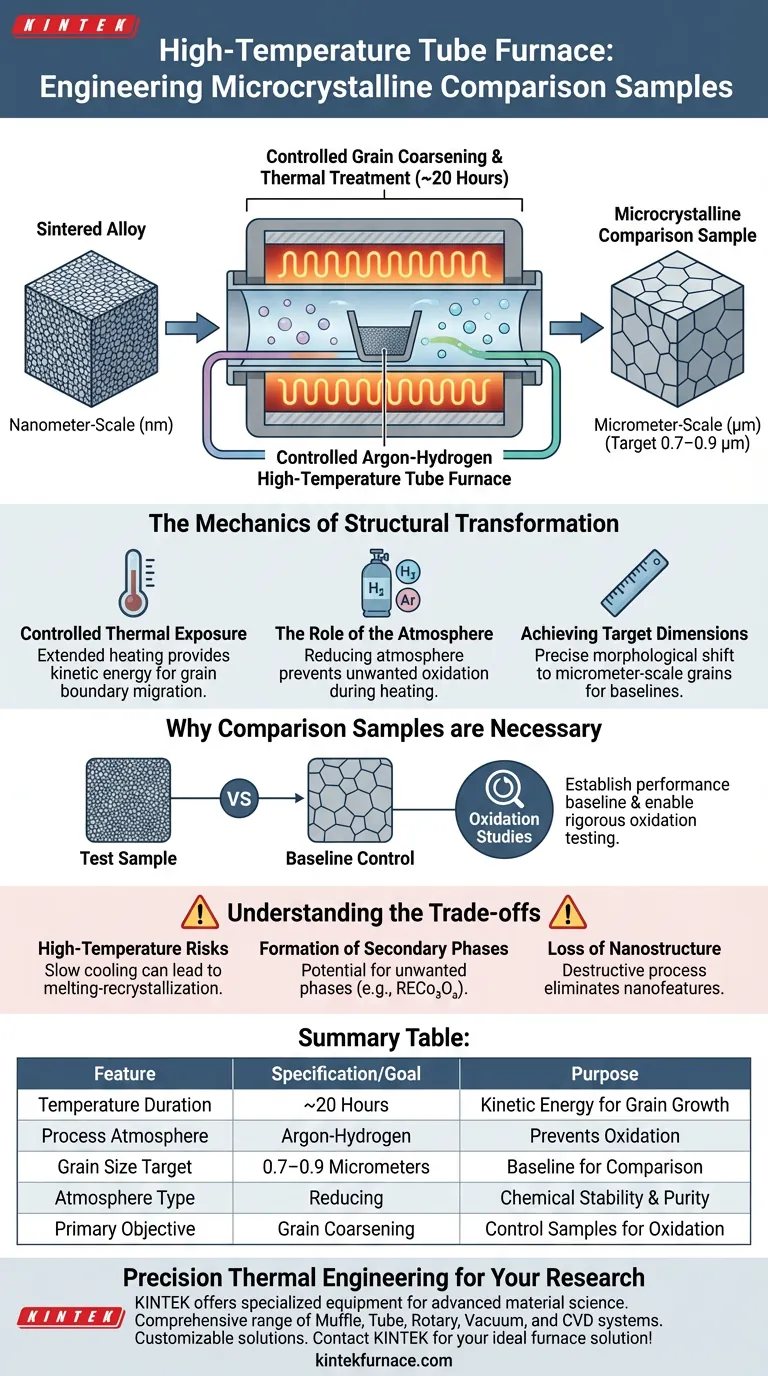
The high-temperature tube furnace functions as a specialized environment for controlled grain coarsening. It subjects sintered alloys to long-duration thermal treatments—typically lasting around 20 hours—within a stable, argon-hydrogen reducing atmosphere. This process intentionally drives the transformation of nanometer-scale grains into micrometer-scale structures to serve as baselines for comparative research.
The primary objective of this thermal treatment is to facilitate significant, controlled grain growth to a target size of approximately 0.7–0.9 micrometers. This creates the distinct microcrystalline structure necessary to benchmark oxidation performance against nanocrystalline alternatives.
The Mechanics of Structural Transformation
Controlled Thermal Exposure
The furnace provides a highly stable thermal environment essential for modifying the material's microstructure.
By maintaining high temperatures for extended periods (e.g., 20 hours), the equipment provides the kinetic energy required for grain boundaries to migrate and expand.
The Role of the Atmosphere
Crucially, this process occurs under a controlled argon-hydrogen reducing atmosphere.
This specific gas mixture prevents unwanted oxidation during the heating phase, ensuring that the grain growth is purely a result of thermal kinetics rather than chemical degradation.
Achieving Target Dimensions
The ultimate goal is a precise morphological shift.
The process converts original nanometer-scale grains into micrometer-scale grains, specifically targeting a size range of 0.7 to 0.9 micrometers.
Why Comparison Samples are Necessary
Establishing a Performance Baseline
To understand the benefits of advanced nanostructures, researchers must compare them against standard microstructures.
The tube furnace is the tool used to manufacture these "standard" microcrystalline samples.
Enabling Oxidation Studies
Once the grains have grown to the micrometer scale, the alloy acts as a control variable.
This allows scientists to rigorously test and compare oxidation performance, clearly differentiating the properties of the microcrystalline sample from those of nanocrystalline materials produced by other methods.
Understanding the Trade-offs
High-Temperature vs. Phase Purity
While high-temperature treatments are excellent for growing grains, they introduce risks regarding phase stability.
As noted in high-temperature contexts, slow cooling rates can lead to significant melting-recrystallization.
Formation of Secondary Phases
Without precise thermal control, the transition from high temperatures (e.g., 1200 °C) to room temperature can result in thermodynamically stable secondary phases.
For example, unwanted phases such as RECo₃Oₐ may form, potentially skewing composition data.
Loss of Nanostructure
It is critical to recognize that this tube furnace process is destructive to nanostructures.
Unlike low-temperature glycothermal methods which preserve phase purity and nanofeatures, the high-temperature tube furnace is specifically designed to eliminate them in favor of larger grains.
Making the Right Choice for Your Goal
To ensure your experimental design yields valid data, align your processing method with your structural requirements:
- If your primary focus is creating a baseline for comparison: Use the high-temperature tube furnace to deliberately grow grains to the 0.7–0.9 micrometer range.
- If your primary focus is preserving nanostructures: Avoid high-temperature treatments and utilize low-temperature methods (such as glycothermal processing) to maintain phase purity and grain size.
The tube furnace is not merely a heating device, but a precise instrument for engineering the specific grain architecture required for valid comparative analysis.
Summary Table:
| Feature | Specification/Goal | Purpose in Production |
|---|---|---|
| Temperature Duration | ~20 Hours | Provides kinetic energy for grain boundary migration |
| Process Atmosphere | Argon-Hydrogen (Reducing) | Prevents oxidation during long-term heating |
| Grain Size Target | 0.7–0.9 Micrometers | Converts nanostructures into micrometer baselines |
| Atmosphere Type | Reducing | Ensures chemical stability and phase purity |
| Primary Objective | Grain Coarsening | Creates control samples for oxidation studies |
Precision Thermal Engineering for Your Research
Are you looking to achieve precise grain architecture or preserve delicate nanostructures? KINTEK provides the specialized equipment needed for advanced material science. Backed by expert R&D and manufacturing, we offer a comprehensive range of Muffle, Tube, Rotary, Vacuum, and CVD systems.
Whether you need standard high-temperature processing or a fully customizable furnace tailored to your unique research needs, our team is ready to support your lab's success. Ensure the integrity of your alloy samples with industry-leading thermal stability and atmosphere control.
Contact KINTEK today to find your ideal furnace solution!
Visual Guide
References
- Rajiv Kumar, Smrutiranjan Parida. Exploring the Influence of Nanocrystalline Structure and Aluminum Content on High-Temperature Oxidation Behavior of Fe-Cr-Al Alloys. DOI: 10.3390/ma17071700
This article is also based on technical information from Kintek Furnace Knowledge Base .
Related Products
- 1400℃ High Temperature Laboratory Tube Furnace with Alumina Tube
- 1700℃ High Temperature Laboratory Tube Furnace with Alumina Tube
- 1200℃ Split Tube Furnace Laboratory Quartz Tube Furnace with Quartz Tube
- Vertical Laboratory Quartz Tube Furnace Tubular Furnace
- 1700℃ High Temperature Muffle Oven Furnace for Laboratory
People Also Ask
- How does zone-melting in tube furnaces synthesize bismuth micro-wires? Master Single-Crystal Thermoelectric Growth
- How do high-temperature laboratory tube furnaces ensure environmental stability? Precision Thermal Reduction Tips
- How are high-temp tube furnaces used to measure diffusion coefficients per Fick's law? Master Precision Annealing
- How are high-temperature laboratory tube furnaces applied in long-term vacuum homogenization heat treatments for intermetallic samples?
- How are high-temperature tube furnaces applied in testing ceramic-supported alloy membranes? Insights



















