
An alumina-lined vertical tube furnace secures experimental stability by combining high-grade chemical resistance with precise thermal regulation. The alumina lining serves as a critical protective shield against corrosive acidic gases, while the heating system maintains consistent temperatures for hundreds of hours, ensuring that delicate thermodynamic reactions proceed without interference from equipment degradation.
The core value of this setup lies in the alumina lining's ability to withstand aggressive byproducts like HCl and SO2, effectively decoupling the corrosive reaction environment from the furnace's structural body. This durability, paired with precision heating, allows for the long-duration testing necessary to observe the slow formation and transformation of metal chlorides.
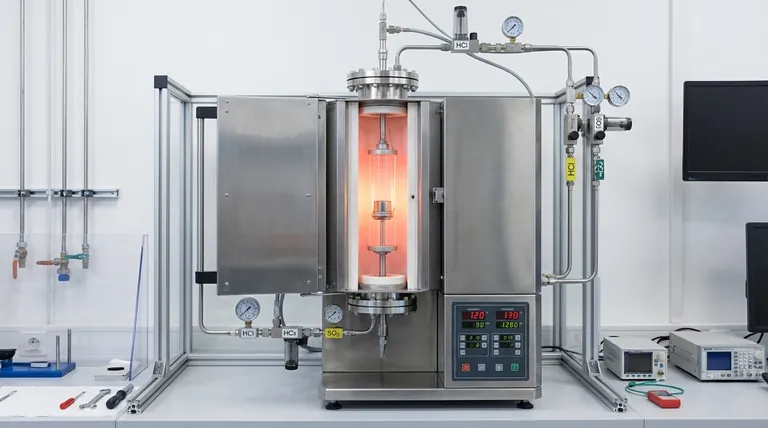
The Protective Function of the Alumina Lining
Chemical Inertness Against Acidic Gases
In high-temperature corrosion experiments, the stability of the equipment is as vital as the stability of the sample. Alumina (aluminum oxide) provides excellent chemical inertness.
This lining specifically protects the furnace body from acidic gases such as HCl and SO2, which are frequently generated or introduced during corrosion simulations. Without this protection, these gases would attack the heating elements and insulation, altering the thermal environment and potentially ruining the experiment.
Resistance to Thermal Shock
High-temperature experiments often involve rapid heating or cooling cycles. The alumina lining offers excellent thermal shock resistance.
This ensures that the physical structure of the furnace acts as a stable barrier even under fluctuating thermal loads. It prevents cracking or structural failure that could lead to heat leaks or the breach of the controlled atmosphere.
Maintaining Thermodynamic Conditions
Long-Duration Temperature Precision
Corrosion is rarely an instantaneous process; it requires time. The vertical tube furnace is designed to provide precision temperature control over extended durations.
For example, these systems can maintain stability for 500 hours at temperatures such as 550°C. This consistency is mandatory for studying slow-acting kinetic behaviors where temperature fluctuations would invalidate the data.
Enabling Equilibrium Reactions
The stability provided by the furnace ensures that thermodynamic equilibrium reactions can occur naturally.
Specific reactions, such as the formation and transformation of metal chlorides, require a strictly maintained temperature range. The vertical configuration and precise control allow the system to reach and hold the specific conditions required for these chemical phases to stabilize.
Understanding the Trade-offs
Lining Protection vs. Reaction Purity
While the alumina lining protects the furnace body, it is distinct from the reaction vessel itself. In many setups, a separate quartz reaction tube is inserted to hold the sample.
Researchers must distinguish between the stability of the furnace (ensured by the alumina lining) and the purity of the immediate reaction atmosphere. Relying solely on the lining without a proper inner reaction tube may still expose samples to contaminants from the furnace cavity if not sealed correctly.
Vertical vs. Horizontal Configuration
The vertical orientation is excellent for suspending samples to ensure uniform exposure to gases. However, it can present challenges compared to horizontal setups regarding gas flow dynamics.
In a vertical setup, buoyancy effects of hot gases can influence flow rates. While horizontal furnaces often allow for easier placement of gas-tight seals for atmosphere switching, vertical furnaces require careful management of gas inlets to ensure the corrosive agents (like CO or H2S) are distributed evenly across the specimen surface.
Making the Right Choice for Your Goal
To maximize the reliability of your corrosion data, align your equipment usage with your specific experimental needs:
- If your primary focus is Long-Term Durability Testing: Rely on the alumina lining's inertness to run extended exposures (500+ hours) involving acidic gases like HCl without risking damage to your heating elements.
- If your primary focus is Kinetic Modeling: Prioritize the precision temperature control system to maintain a deviation-free environment, ensuring that the formation of metal chlorides represents true thermodynamic equilibrium.
By leveraging the chemical resistance of the alumina lining and the thermal precision of the vertical design, you create a repeatable, contamination-free environment essential for high-fidelity corrosion research.
Summary Table:
| Feature | Benefit in Corrosion Testing |
|---|---|
| Alumina Lining | High chemical inertness against HCl, SO2, and aggressive acidic gases |
| Thermal Precision | Maintains stability for 500+ hours to observe slow kinetic transformations |
| Vertical Design | Ideal for suspending samples to ensure uniform gas exposure |
| Shock Resistance | Prevents structural cracking during rapid heating and cooling cycles |
Elevate Your Material Research with KINTEK
Precise corrosion data starts with a stable thermal environment. Backed by expert R&D and manufacturing, KINTEK offers high-performance Muffle, Tube, Rotary, Vacuum, and CVD systems, all fully customizable to meet your unique laboratory requirements. Whether you are conducting long-term durability testing or complex kinetic modeling, our furnaces provide the durability and temperature precision your research demands.
Ready to optimize your high-temperature experiments?
Visual Guide
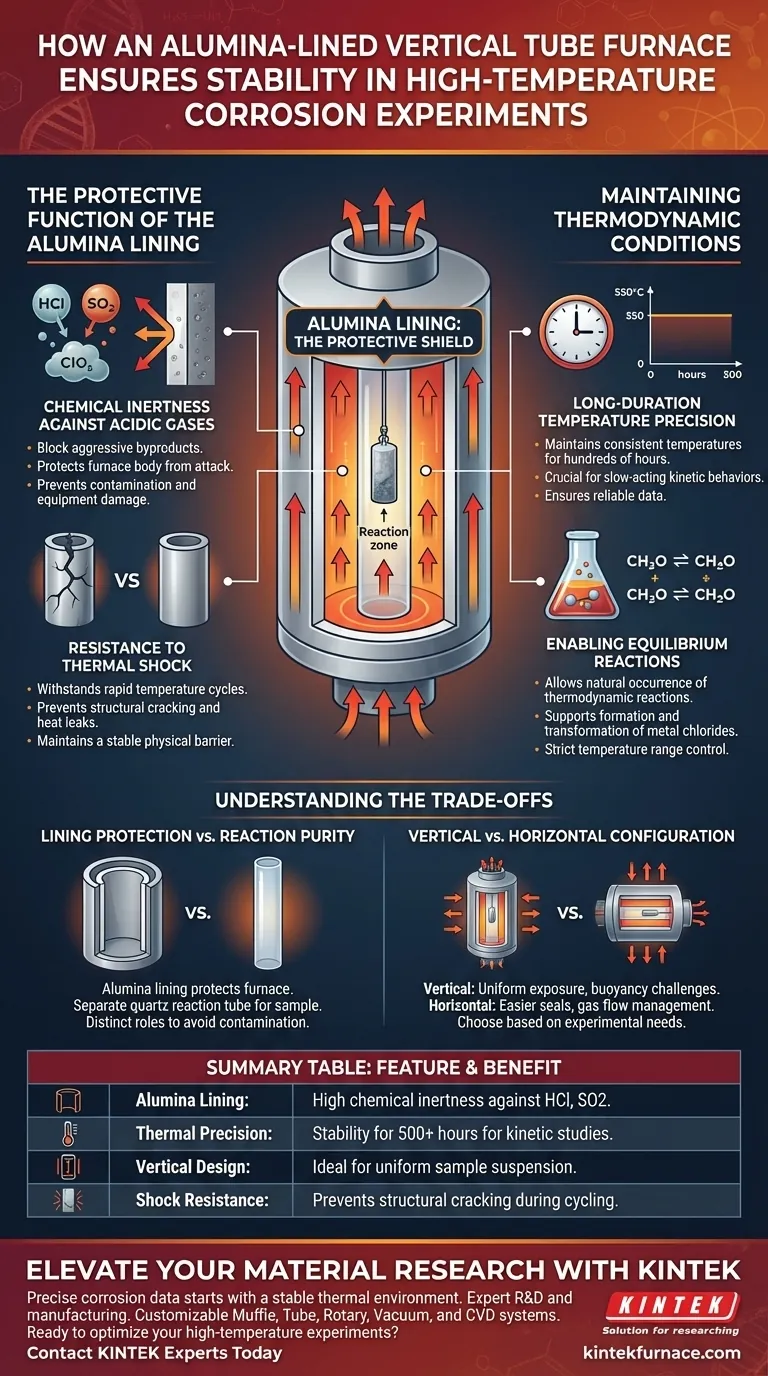
References
- Ahmad Usman, Adnan U. Syed. Fireside Corrosion Behavior of Thermally Sprayed Coatings for Waste-to-Energy Power Plant Applications. DOI: 10.1007/s11665-025-11630-7
This article is also based on technical information from Kintek Furnace Knowledge Base .
Related Products
- 1400℃ High Temperature Laboratory Tube Furnace with Alumina Tube
- 1700℃ High Temperature Laboratory Tube Furnace with Alumina Tube
- Vertical Laboratory Quartz Tube Furnace Tubular Furnace
- Magnesium Extraction and Purification Condensing Tube Furnace
- Custom Made Versatile CVD Tube Furnace Chemical Vapor Deposition CVD Equipment Machine
People Also Ask
- How does zone-melting in tube furnaces synthesize bismuth micro-wires? Master Single-Crystal Thermoelectric Growth
- How do high-temperature laboratory tube furnaces ensure environmental stability? Precision Thermal Reduction Tips
- How are high-temp tube furnaces used to measure diffusion coefficients per Fick's law? Master Precision Annealing
- How are high-temperature laboratory tube furnaces applied in long-term vacuum homogenization heat treatments for intermetallic samples?
- How are high-temperature tube furnaces applied in testing ceramic-supported alloy membranes? Insights



















