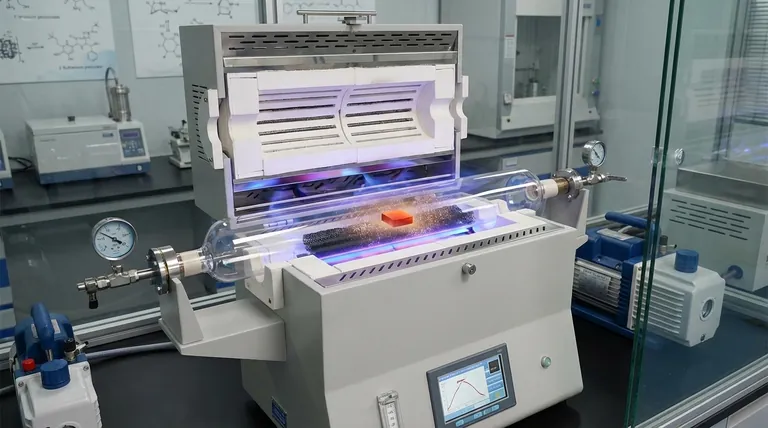
The primary function of vacuum-sealed tubes and controlled heating is to induce the sublimation of ruthenium precursors, converting them from a solid directly into a gas phase. This process, driven by the pressure gradient within the vacuum, forces the gaseous molecules to penetrate deeply into the carbon structure rather than simply coating the exterior.
Core Takeaway By combining thermal energy with a vacuum environment, you achieve a gas-phase transport mechanism that drives precursors into the hardest-to-reach areas of the substrate. This ensures ruthenium is uniformly distributed within internal cavities and step edges at the nanometer scale, rather than aggregating on the surface.
The Mechanics of Vapor-Phase Embedding
To achieve high-quality material dispersion, this process relies on two distinct physical mechanisms working in tandem: phase change and pressure-driven transport.
Sublimation via Controlled Heating
The application of controlled heating is designed to trigger sublimation. This specific thermal input converts the solid ruthenium precursor (specifically Ru3(CO)12) directly into a gas.
By bypassing the liquid phase, the precursor molecules become highly mobile. This mobility is essential for interacting with the complex geometry of the carbon nanofibers.
The Role of the Vacuum Environment
The vacuum-sealed tube is not merely for containment; it creates a critical pressure gradient.
This gradient acts as the driving force for the operation. It pulls the now-gaseous precursor molecules away from their source and directs them toward the carbon nanofibers.
Targeting Internal Geometries
The ultimate goal of this setup is to access the internal cavities and step edges of the nanofibers.
Without the vacuum-induced pressure drive, the precursor might settle on the outer shell. The vacuum ensures the gas penetrates deep into the fiber's architecture, resulting in a uniform distribution at the nanometer scale.
Critical Process Constraints
While effective, this method relies on the precise balance of environmental variables. Understanding the limitations is key to reproducibility.
Dependence on Vacuum Integrity
The efficacy of the embedding is entirely dependent on the pressure gradient.
If the vacuum seal is compromised, the driving force dissipates. This results in poor penetration and likely leads to surface aggregation rather than internal embedding.
Thermal Precision
The heating must be strictly controlled to match the sublimation point of the specific precursor (Ru3(CO)12).
Insufficient heat will fail to generate enough gas-phase molecules. Conversely, excessive or uneven heating could lead to precursor decomposition before it successfully embeds into the nanofiber lattice.
Optimizing Synthesis for Your Goals
When designing or evaluating this synthesis step, consider your specific structural requirements.
- If your primary focus is internal loading: Prioritize the integrity of the vacuum seal to maximize the pressure gradient, ensuring the gas is driven deep into the nanofiber cavities.
- If your primary focus is coating uniformity: Focus on the precision of the heating ramp to maintain a steady rate of sublimation, preventing "clumps" of precursor from forming.
Mastering the interaction between sublimation and pressure gradients is the defining factor in creating high-performance, nanometer-scale composites.
Summary Table:
| Process Component | Primary Mechanism | Strategic Function |
|---|---|---|
| Controlled Heating | Sublimation | Converts solid Ru3(CO)12 to gas without melting, increasing molecular mobility. |
| Vacuum-Sealed Tube | Pressure Gradient | Creates the driving force to pull gaseous precursors into deep internal geometries. |
| Phase Interaction | Gas-Phase Transport | Ensures uniform dispersion within cavities and step edges at the nanometer scale. |
Elevate Your Nanomaterial Synthesis with KINTEK
Precise thermal and vacuum control is the difference between surface aggregation and deep internal embedding. Backed by expert R&D and manufacturing, KINTEK offers high-performance Muffle, Tube, Rotary, Vacuum, and CVD systems—all customizable to meet your unique laboratory requirements. Whether you are perfecting ruthenium precursor sublimation or developing advanced carbon composites, our equipment ensures the thermal precision and vacuum integrity your research demands.
Ready to optimize your material dispersion? Contact us today to find your custom furnace solution.
Visual Guide

References
- Mehtap Aygün. RuTe2 Decorated Carbon Nanofiber Electrocatalyst Synthesized via a Sustainable Method for Electrochemical Hydrogen Evolution in Acidic and Alkaline Electrolytes. DOI: 10.21597/jist.1647816
This article is also based on technical information from Kintek Furnace Knowledge Base .
Related Products
- Vacuum Sealed Continuous Working Rotary Tube Furnace Rotating Tube Furnace
- Ultra-High Vacuum Flange Aviation Plug Glass Sintered Airtight Circular Connector for KF ISO CF
- Ultra Vacuum Electrode Feedthrough Connector Flange Power Lead for High Precision Applications
- CF KF Flange Vacuum Electrode Feedthrough Lead Sealing Assembly for Vacuum Systems
- Laboratory Vacuum Tilt Rotary Tube Furnace Rotating Tube Furnace
People Also Ask
- What is the purpose of rotary tube furnaces? Achieve Uniform Heat Treatment for Powders and Granules
- What are the key advantages of using a rotary tube furnace? Achieve Dynamic, Uniform Heating for Powders
- How does the amount of material processed vary between batch and continuous rotary tube furnaces? Scale Your Production Efficiently
- What are the advantages of rotary tube furnaces in fuel compatibility? Boost Efficiency and Cut Costs
- What is the temperature range of some rotary tube furnaces? Achieve Uniform Heating Up to 1200°C