
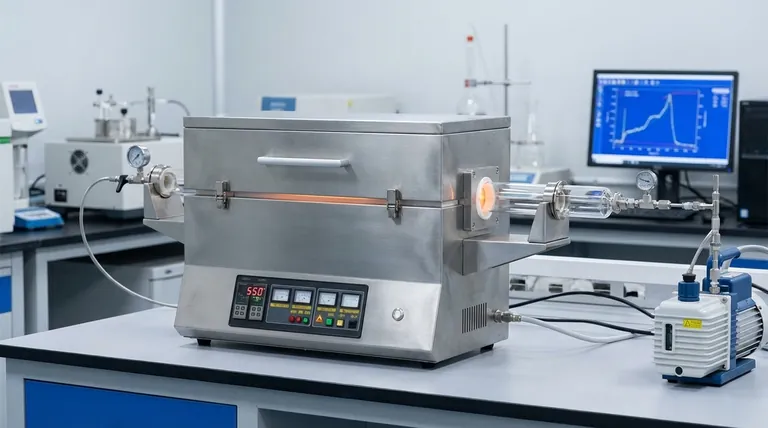
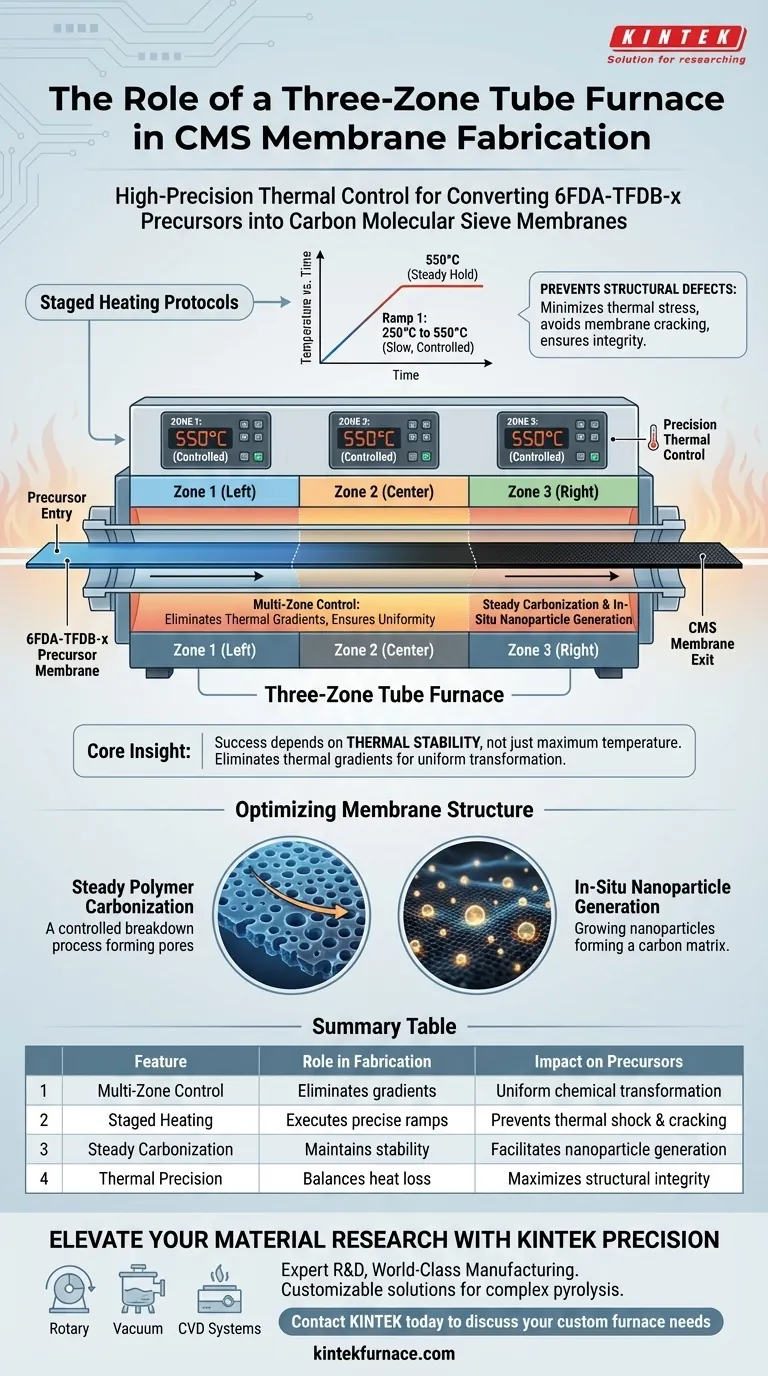
A three-zone tube furnace serves as a high-precision thermal control system essential for converting 6FDA-TFDB-x precursors into Carbon Molecular Sieve (CMS) membranes. By maintaining strict temperature uniformity and executing complex staged heating protocols, this equipment facilitates steady carbonization and in-situ nanoparticle generation while preventing structural failures like cracking.
Core Insight: The success of CMS membrane fabrication depends less on maximum temperature and more on thermal stability. The three-zone furnace is critical because it eliminates thermal gradients that cause stress, ensuring the delicate polymer structure survives the transition to carbon.
Ensuring Thermal Field Uniformity
The Mechanism of Multi-Zone Control
The defining characteristic of a three-zone furnace is its ability to divide the heating chamber into three individually controlled segments. Unlike single-zone furnaces, which may suffer from temperature drop-offs near the ends, this configuration actively balances heat input across the entire tube length.
Consistency for Pyrolysis
For 6FDA-TFDB-x precursors, the pyrolysis environment must be identical across the entire membrane surface. The multi-zone system creates a high-uniformity temperature field, ensuring that every part of the precursor undergoes the same chemical transformation at temperatures of 550°C or higher.
Managing Pyrolysis Dynamics
Precise Staged Heating
Converting polymer precursors is a delicate process requiring specific ramp rates. The furnace enables precise, staged heating controls, particularly in the critical window between 250°C and 550°C. This allows the material to evolve chemically without undergoing thermal shock.
Preventing Structural Defects
Membrane cracking is a common failure mode caused by thermal stress during rapid or uneven heating. By strictly controlling the heating rate and maintaining uniformity, the furnace minimizes these stresses. This protection allows the membrane to remain intact during the significant volume changes associated with carbonization.
Optimizing Membrane Structure
Steady Polymer Carbonization
The stability provided by the furnace ensures that carbonization proceeds at a steady, predictable pace. This controlled breakdown is necessary to form the specific pore structures required for effective molecular sieving.
In-Situ Nanoparticle Generation
Beyond preventing defects, the thermal environment plays an active role in material synthesis. The precise thermal treatment facilitates the in-situ generation of nanoparticles within the matrix, a key factor in the performance of the final CMS membrane.
Understanding the Trade-offs
Calibration Complexity
While a three-zone furnace offers superior control, it introduces operational complexity. To achieve a perfectly flat temperature profile, the three zones must be carefully calibrated to compensate for heat loss at the tube ends.
Throughput vs. Precision
The rigorous staged heating protocols required for 6FDA-TFDB-x precursors often necessitate longer processing times compared to rapid thermal treatments. This is a necessary trade-off: speed is sacrificed to ensure the structural integrity and chemical uniformity of the final membrane.
Making the Right Choice for Your Goal
When configuring your thermal treatment process for CMS membranes, consider the following priorities:
- If your primary focus is preventing membrane cracking: Prioritize the staged heating control capabilities of the furnace to ensure a slow, steady ramp from 250°C to 550°C.
- If your primary focus is consistent pore structure: Rely on the multi-zone temperature control to eliminate gradients and ensure every millimeter of the sample experiences the exact same thermal history.
Mastering the thermal profile of the three-zone furnace is the decisive factor in producing defect-free, high-performance carbon molecular sieve membranes.
Summary Table:
| Feature | Role in CMS Membrane Fabrication | Impact on 6FDA-TFDB-x Precursors |
|---|---|---|
| Multi-Zone Control | Eliminates thermal gradients across the tube | Ensures uniform chemical transformation and pore structure |
| Staged Heating | Executes precise ramp rates (250°C to 550°C) | Prevents thermal shock and membrane cracking |
| Steady Carbonization | Maintains consistent thermal field stability | Facilitates in-situ nanoparticle generation |
| Thermal Precision | Balances heat loss at tube ends | Maximizes structural integrity of the delicate polymer matrix |
Elevate Your Material Research with KINTEK Precision
Achieving the perfect pore structure in CMS membranes requires more than just heat—it requires absolute thermal control. KINTEK provides industry-leading Three-Zone Tube Furnaces, alongside our specialized Rotary, Vacuum, and CVD systems, specifically engineered for complex pyrolysis and carbonization workflows.
Backed by expert R&D and world-class manufacturing, our systems are fully customizable to meet the rigorous staged heating demands of 6FDA-TFDB-x precursors and other advanced polymers. Ensure defect-free results and superior molecular sieving performance—Contact KINTEK today to discuss your custom furnace needs.
Visual Guide
References
- Xiuling Chen, Nanwen Li. Atomically distributed Al-F3 nanoparticles towards precisely modulating pore size of carbon membranes for gas separation. DOI: 10.1038/s41467-024-54275-1
This article is also based on technical information from Kintek Furnace Knowledge Base .
Related Products
- Split Multi Heating Zone Rotary Tube Furnace Rotating Tube Furnace
- Multi Zone Laboratory Quartz Tube Furnace Tubular Furnace
- Multi Heating Zones CVD Tube Furnace Machine for Chemical Vapor Deposition Equipment
- Magnesium Extraction and Purification Condensing Tube Furnace
- Vertical Laboratory Quartz Tube Furnace Tubular Furnace
People Also Ask
- What are the main applications of multi zone tube furnaces in university laboratories? Unlock Precision in Material Science and Energy Research
- How are multi zone tube furnaces used in ceramics, metallurgy and glass research? Unlock Precise Thermal Control for Advanced Materials
- What environmental protection applications utilize multi zone tube furnaces? Unlock Precision in Waste Treatment and Green Tech
- What role do multi zone tube furnaces play in new energy research? Unlock Precise Thermal Control for Innovation
- Why are multi zone tube furnaces particularly useful for nanomaterial research? Unlock Precise Thermal Control for Advanced Synthesis



















